Terrell rotation is confusing!

  • Context: Undergrad 
  • Thread starter Thread starter Physicsperson123
  • Start date Start date
  • Tags Tags
    Astronomy Relativity
Click For Summary
SUMMARY

The discussion centers on Terrell rotation, a relativistic effect observed when an object moves at relativistic speeds. Participants clarify that light from point B on a rotating sphere can reach an observer due to the combination of Lorentz contraction and light travel time, which allows the sphere to clear the light path faster than the light itself. The concept of aberration of light is also emphasized, explaining how the apparent angle of light affects visibility without altering the straight-line path of light. Understanding these principles is crucial for grasping the nuances of Terrell rotation.

PREREQUISITES
  • Relativity concepts, specifically Lorentz contraction
  • Understanding of light propagation and aberration of light
  • Basic knowledge of the geometry of motion in physics
  • Familiarity with the principles of inertial frames
NEXT STEPS
  • Study the mathematical derivation of Lorentz transformations
  • Explore the implications of relativistic aberration in different inertial frames
  • Investigate the visual effects of relativistic speeds on objects
  • Learn about the relationship between light travel time and observer perception in relativity
USEFUL FOR

Physics students, educators, and anyone interested in advanced concepts of relativity and visual perception of moving objects.

Physicsperson123
Messages
5
Reaction score
0
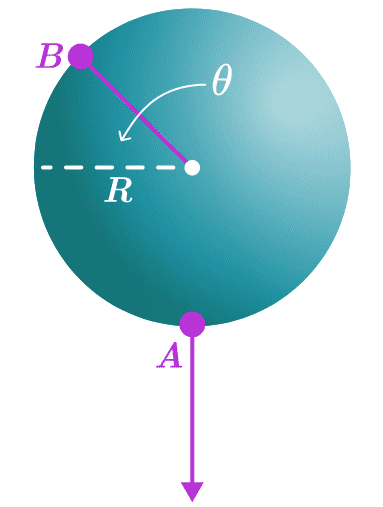
Imagine in the distance you see a glowing spherical object hovering in the air.
Suppose light from point B on the surface of the sphere facing away from you can arrive at the camera simultaneously with light from A:
Screenshot 2023-11-09 164646.png

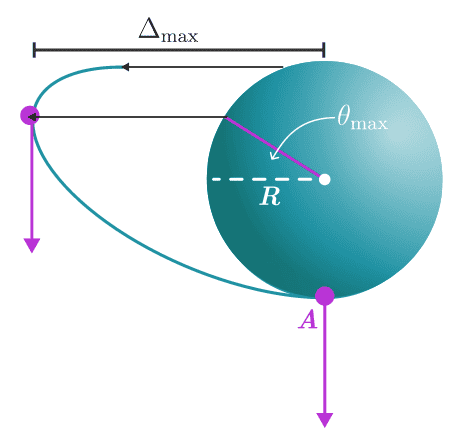
Since the object is moving at relativistic speeds, by the time light begins to propagate from A to reach your camera simultaneously with light from B, the object has already moved a certain distance.
Screenshot 2023-11-09 164718.png

In this way one can see a rotation of the sphere by Θmax.
What I don't understand about Terrell rotation is how light from point B would ever be able to reach an observer looking front on, because any straight path from point B would be blocked by the sphere.
I suspect that the light doesn't follow a straight path, and maybe this is where aberration of light comes in?
Any explanation would be greatly appreciated!
 
Physics news on Phys.org
The path of the light only needs to be unblocked when the light arrives there.
 
  • Like
Likes   Reactions: FactChecker
Physicsperson123 said:
how light from point B would ever be able to reach an observer looking front on, because any straight path from point B would be blocked by the sphere.
Take point B to right at the edge of the visible disk so it is just barely not blocked and it will make more sense.
I suspect that the light doesn't follow a straight path, and maybe this is where aberration of light comes in?
Light always travels in a straight line (gravitational effects introduce some subtleties in the definition "straight" but none of that is involved in this problem). Aberration affects the apparent angle at which the light reaches you but not the straight-line path between emission event and reception event.
 
Orodruin said:
The path of the light only needs to be unblocked when the light arrives there.
Sorry, I'm struggling to understand what you mean by "unblocked"
 
Physicsperson123 said:
What I don't understand about Terrell rotation is how light from point B would ever be able to reach an observer looking front on, because any straight path from point B would be blocked by the sphere.
The object moves slower than light, but it clears the light path faster than the light, because the intersection between the light path and the object moves faster than light. It's simpler to understand with a box:

bi20_3.jpg

From: https://www.spacetimetravel.org/bewegung/5
 
  • Like
Likes   Reactions: Physicsperson123
Physicsperson123 said:
What I don't understand about Terrell rotation is how light from point B would ever be able to reach an observer looking front on, because any straight path from point B would be blocked by the sphere.
One way to look at it is to think about light hypothetically emitted straight down from point B. In a small time ##\delta t## it would move down the page ##c\delta t##. But in that same time the sphere has moved a small distance ##v\delta t## to the right. If you specify the latitude of B, you could work out how fast the sphere would have to be going so that it had moved far enough to be out of the way, in terms of ##\delta t## and ##\theta##. Then you could take the limit as ##\delta t\rightarrow 0##. Does the necessary speed converge to anything?

Another approach is just to derive relativistic aberration. In the rest frame of the sphere, write down the ##x(t)## and ##y(t)## positions of a pulse of light emitted by B, tangent to the surface of the sphere at B. This clearly does not intersect the surface of the sphere, right? Then use the Lorentz transforms to write down the ##x'(t')## and ##y'(t')## positions of the pulse of light. Clearly this cannot intersect the sphere because the light can't intersect the sphere in one frame but not another. Can you get ##y'## to be independent of ##t'##? If so, it's travelling vertically without intersecting tge sphere.
 
  • Like
Likes   Reactions: Physicsperson123
First, do not use spheres.
Let me say that again. Do not use spheres.

Using something symmetric under rotation to understand rotations is a bad idea. Do not use spheres.

There are two effects. The object shrinks because of Lorentz contraction, and the object appears to stretch because of light travel time. To first order, these cancel. The residual 2nd order effect is the Terrell Rotation.
 
  • Like
Likes   Reactions: FactChecker and PeterDonis
A.T. said:
The object moves slower than light, but it clears the light path faster than the light, because the intersection between the light path and the object moves faster than light. It's simpler to understand with a box:

bi20_3-jpg.jpg


From: https://www.spacetimetravel.org/bewegung/5
A consequence of this, is that while an omnidirectional light pulse propagates spherically in all inertial frames, the fraction of that sphere blocked by obstacles is frame dependent.

In the above example, the wavefront in the rest frame of the box is initially half of a sphere, while in the frame where the box moves, it is more than half of a sphere.
 
A.T. said:
A consequence of this, is that while an omnidirectional light pulse propagates spherically in all inertial frames, the fraction of that sphere blocked by obstacles is frame dependent.

In the above example, the wavefront in the rest frame of the box is initially half of a sphere, while in the frame where the box moves, it is more than half of a sphere.
It should be noted that this is a direct consequence of the aberration of light.
 

Similar threads

  • · Replies 14 ·
Replies
14
Views
2K
  • · Replies 34 ·
2
Replies
34
Views
3K
  • · Replies 11 ·
Replies
11
Views
705
  • · Replies 11 ·
Replies
11
Views
2K
  • · Replies 17 ·
Replies
17
Views
1K
  • · Replies 3 ·
Replies
3
Views
1K
Replies
82
Views
5K
  • · Replies 20 ·
Replies
20
Views
2K
  • · Replies 25 ·
Replies
25
Views
2K
  • · Replies 22 ·
Replies
22
Views
2K