What Causes Inverted Voltage Peaks in a Rogowski Coil?

  • Thread starter Thread starter F.ono
  • Start date Start date
  • Tags Tags
    Coil
Click For Summary

Discussion Overview

The discussion revolves around the behavior of a Rogowski coil, particularly focusing on the causes of inverted voltage peaks observed when measuring high-frequency pulses. Participants explore the theoretical and practical aspects of the coil's operation, including its self-integration characteristics and the implications of circuit elements like resistance and inductance.

Discussion Character

  • Exploratory
  • Technical explanation
  • Debate/contested
  • Mathematical reasoning

Main Points Raised

  • One participant describes their experimental setup using a Rogowski coil and questions the cause of inverted voltage peaks observed in their measurements.
  • Another participant explains that the output of the Rogowski coil is positive when the rate of change of current (di/dt) is increasing and negative when it is decreasing, noting that the average voltage should be zero after the pulse.
  • A different participant emphasizes that the coil's output is related to the rate of change of the primary current, leading to high voltage outputs during rapid changes and zero output when the current is steady.
  • One participant mentions the self-integration characteristic of the Rogowski coil and raises concerns about its failure to behave as expected at high frequencies, linking this to the relationship between inductance and impedance.
  • Another participant seeks clarification on an equation related to the coil's behavior, questioning the absence of certain elements in the author's analysis.
  • Several participants inquire about the fundamental frequency of the pulse, with one suggesting that it may relate to repetitive waveforms.
  • A participant discusses the conditions under which the Rogowski coil operates as a self-integrating device, highlighting the importance of reactance exceeding resistance in the circuit.
  • Another participant proposes methods to extend the coil's operational range to lower frequencies, including reducing load resistance and using a magnetic core.

Areas of Agreement / Disagreement

Participants express varying interpretations of the Rogowski coil's behavior, particularly regarding its self-integration and the effects of circuit elements. There is no consensus on the exact causes of the observed voltage peaks or the implications of the equations discussed.

Contextual Notes

Participants note limitations in understanding certain equations and the dependence on circuit configurations, including the roles of resistance and inductance. Some discussions involve assumptions about the behavior of the coil that may not be universally accepted.
F.ono
Messages
16
Reaction score
0
I've been doing some test on a rogowski coil that I built. It is like an air-cored current transformer.

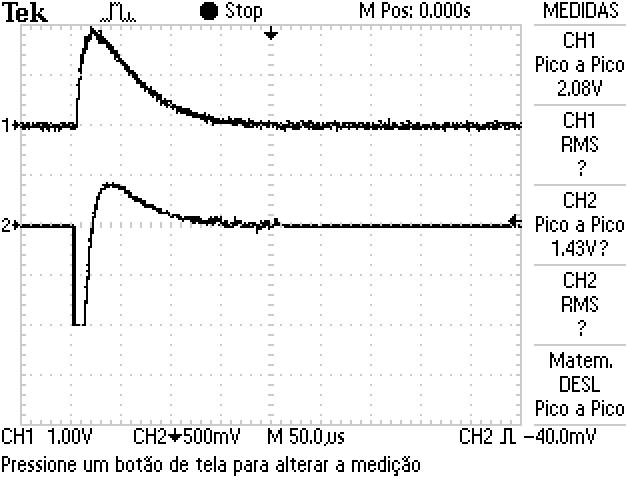
I am using it to measure high frequency pulses. The picture shows a discharging capacitor being captured by a current probe (above) and by the rogowski coil (below).
I don't know what is causing the inverted voltage peak. Would someone be able to explain this?
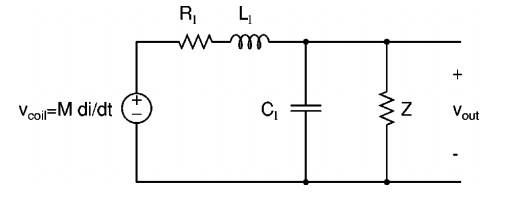
The picture below is the equivalent circuit of the rogowski coil. Vcoil is the voltage induced in the secondary winding and Vout is the actual voltage measured in its terminals.

10mpk06.jpg


1zce4ae.jpg
 
Engineering news on Phys.org
I would prefer for TEK #2 to be shown with the + and - reversed. (Upside down)

When di/dt is increasing, output is positive.

When di/dt is decreasing, output is negative.

The average voltage detected in the rogowski coil has to be zero, since the magnetic flux starts at zero and returns to zero after the pulse is over.
 
F.ono said:
I've been doing some test on a rogowski coil that I built. It is like an air-cored current transformer.

I am using it to measure high frequency pulses.
You'll find my answer very similar to that of Carl Pugh. You'd like the coil to act as a current sensor, but transformers don't work on current, their secondary voltage is determined by the primary current's rate of change. So when the current is at first rapidly changing, your coil probe returns a high voltage. When the capacitor current is momentarily steady at its peak value, di/dt = 0 and you can see the sensor's voltage passes through zero at that moment.
 
Thank you for your answers! It really helped me understanding what is going on.
For high frequencies, the rogowski coil is supposed to be self-integrating, that is why I didn't even think that what I was getting was the di/dt wave. But this self-integration characteristic depends on the 2pifL and Z relationship, which in this case does not occur.
 
In order to understand why the rogowski coil is not working as a self-integrating coil (as it is supposed to in high frequencies), I found the article attached.
Section D in that article explains the self-integrating behavior. But it is necessary to understand Equation (1), which I am not really getting.
The author says that he is not considering the capacitance. Okay, then according to the coil model, we have an equivalent impedance in series with a inductor. Shouldn't the equation be simply

(1/R)*(dphi/dt) = Ic

What is the (L/R)*(dIc/dt) in his equation?
 

Attachments

Another question: What is the fundamental frequency of the pulse? Do I just have to consider the total time that it took from start to end and calculate 1/T?
 
F.ono said:
Another question: What is the fundamental frequency of the pulse? Do I just have to consider the total time that it took from start to end and calculate 1/T?
Perhaps they are referring to the case of a repetitive waveform?
 
F.ono said:
The author says that he is not considering the capacitance. Okay, then according to the coil model, we have an equivalent impedance in series with a inductor. Shouldn't the equation be simply

(1/R)*(dphi/dt) = Ic
If an equivalent circuit involves R and L, you should expect that both R and L will appear in the analysis.
Something's seriously wrong if L goes missing, no reason given. ☹[/size][/color]

Draw a closed series circuit, just an L and an R. (In practice, I'd say R would include both the resistance of the coil plus that of your electronics input.) Across that 2 element circuit is applied the emf induced by the changing field, we usually know this voltage as N·dɸ/dt but this being the case of a single turn, here N=1.

Note: at the expense of a 600k download, I generally expect to find a document much more legible that what you've provided.
 
The Rogowski coil is self-integrating over a (high) frequency range where the self-inductance of the toroid winding creates a reactance that clearly exceeds the resistance of the circuit, which includes the winding's losses and the load resistance.

In this case, idealized, the induced current is created by a mutual inductance and limited by the self-inductance, which means that they're in phase and no differentiation (by the resistance) occurs. The load resistance creates a small maesurement voltage proportional to the current but doesn't significantly limit the current.

Second equivalent way to understand in: the measurement winding is nearly short-circuited, because the loop's resistance is clearly lower than the reactance (the imaginary part of the circuit's impedance). This (multiturn) loop in short circuit maintains a constant flux through itself, by circulating in itself a current that compensates the flux created there by the measured current. The induced current follows the measured current instantly and is a fraction of it, because the winding has several turns.

Note1: the "flux" for the self-inductance is greater than what flows through the toroid's section. It includes the flux that passes between the turns of the winding, what we would call a leakage inductance in a transformer. Hence the current ratio exceeds the number of turns.

Note2: the winding's losses are far greater than the DC resistance of the winding.

-----

Some ways to extend to lower frequencies this mode of operation:

- Reduce strongly the load resistance. Amplify if needed. But the following third option is better.

- Use a magnetic core. Nearly required at 50µs.

- Load the coil with a transimpedance amplifier, instead of a resistor followed by a voltage amplifier. The load resistance is then zero, and only the coil's own losses create a resistance. Extremely fast transimpedance amplifier exist commercially for photodiode receivers (>50Gb/s!), and at 50µs you can build yours easily.

- Have two windings at the coil: one that senses the flux, the other that zeroes it through an amplified feedback. This compensates fully the winding's losses. The current ratio nearly equals the number of compensating turns now. The magnetic core may not be required then. Mind the parasitic capacitance between the two windings; they can have different radius, and an electrostatic shield between them, slit so it doesn't short-circuit the flux.

Keep an eye at the DC behaviour of the circuit you design, and to its stability if using a feedback. This is now more a current transformer than a Rogowski coil, though they differ merely by the frequency range.

Ate logo!
 

Similar threads

Replies
4
Views
4K
  • · Replies 17 ·
Replies
17
Views
2K
  • · Replies 51 ·
2
Replies
51
Views
4K
  • · Replies 25 ·
Replies
25
Views
15K
Replies
64
Views
8K
  • · Replies 17 ·
Replies
17
Views
2K
Replies
12
Views
3K
  • · Replies 19 ·
Replies
19
Views
2K
  • · Replies 2 ·
Replies
2
Views
6K
  • · Replies 6 ·
Replies
6
Views
3K