The conservation of angular momentum

Click For Summary
SUMMARY

The discussion centers on the conservation of angular momentum, specifically how it relates to moment of inertia and angular acceleration. It is established that an object with a high moment of inertia experiences smaller angular acceleration compared to one with a low moment of inertia, as demonstrated by the example of a ballerina pulling her arms in to spin faster. The conversation also clarifies that angular momentum remains conserved in the absence of external torques, with examples such as ice skaters and hinged doors illustrating the principles of torque and angular motion. The key takeaway is that while angular momentum is conserved, kinetic energy can change due to internal work done on the system.

PREREQUISITES
  • Understanding of angular momentum and its conservation principles
  • Familiarity with moment of inertia and its impact on angular acceleration
  • Basic knowledge of torque and its role in rotational motion
  • Concept of kinetic energy in rotational systems
NEXT STEPS
  • Study the relationship between torque and angular acceleration using Newton's second law for rotation
  • Explore the mathematical derivation of conservation of angular momentum in closed systems
  • Investigate real-world applications of angular momentum conservation, such as in figure skating and gymnastics
  • Learn about the differences between rotational kinetic energy and linear kinetic energy
USEFUL FOR

Students of physics, educators teaching rotational dynamics, and anyone interested in the principles of angular momentum and its applications in real-world scenarios.

Josielle Abdilla
Messages
50
Reaction score
4
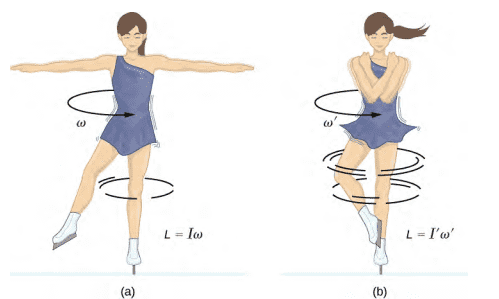
This question is about the conservation of angular momentum:
clipboard_e2763faf0369123cf747c1efd4f83b149.png

So far, I have understood the reason as to why an object with a high moment of inertia has a small angular acceleration whereas an object with a low moment of inertia has a larger angular acceleration. The reason for this is that if there are high values of r, the moment of inertia will be larger and hence a larger effort (to produce a larger torque) must be exerted. As a result, the angular acceleration of the object is small. This can be demonstrated in (a) where the change in omega/time is small
In example (b) shown above, the ballerina takes advantage of the moment of inertia by not stretching her hands out etc. and by doing so decreasing the moment of inertia and therefore a smaller torque is produced to rotate at a faster rate.
However, what I can't fathom out is; how is this related to the conservation of angular momentum which states that angular momentum is conserved unless there are external torques acting on the system.
I appreciate your comments about this and any other solutions as to why a ballerina rings in her arms and legs to spin. Thanks a lot!
 

Attachments

  • clipboard_e2763faf0369123cf747c1efd4f83b149.png
    clipboard_e2763faf0369123cf747c1efd4f83b149.png
    21.1 KB · Views: 4,236
Physics news on Phys.org
Josielle Abdilla said:
So far, I have understood the reason as to why an object with a high moment of inertia has a small angular acceleration whereas an object with a low moment of inertia has a larger angular acceleration.
For a given torque, an object with a smaller moment of inertia will have a greater angular acceleration. This is Newton's 2nd law applied to rotation.

Josielle Abdilla said:
However, what I can't fathom out is; how is this related to the conservation of angular momentum which states that angular momentum is conserved unless there are external torques acting on the system.
Here there's no external torque to worry about. Since there's no torque on the ballerina, her angular momentum is conserved. If she's able to decrease her moment of inertia -- by pulling her arms in as shown in (b) -- she will increase her angular speed. But her angular momentum cannot change.
 
Can you give me some examples when torque is involved? Is the electric driller an example or a merry-go round? Thanks a lot!
 
What textbook are you using? I suspect there are plenty of examples in the section on torque and rotational motion. Using the merry-go-round as an example: If you want to start it rotating (give it an angular acceleration) you'll need to apply a torque. The greater the torque, the greater the angular acceleration.
 
Thanks a lot I use the textbook called A-level physics (4th edition) by Roger Muncaster
 
To clarify this, the image is of an ice skater in a spin. Assuming no losses or transfer of momentum to the earth, angular momentum of the skater is always preserved, but as the skater pulls her arms inwards, internal potential energy is converted into mechanical angular kinetic energy, and an internal torque increases the rate of rotation, increasing the angular kinetic energy, but the angular momentum will remain constant.
 
An example that I always used in class was opening a hinged door.

If you push on the door near its outer edge (at the location of the doorknob or handle) with a certain amount of force, it gets some angular acceleration. If you push with the same amount of force on the middle of the door (closer to the hinges) it doesn't get as much angular acceleration because the torque is smaller.

If you push on the door at an angle, the torque also depends on the angle: maximum when you push perpendicular to the door, zero when you push directly toward the hinges.
 
Josielle Abdilla said:
This question is about the conservation of angular momentum:
View attachment 237056
So far, I have understood the reason as to why an object with a high moment of inertia has a small angular acceleration whereas an object with a low moment of inertia has a larger angular acceleration. The reason for this is that if there are high values of r, the moment of inertia will be larger and hence a larger effort (to produce a larger torque) must be exerted. As a result, the angular acceleration of the object is small. This can be demonstrated in (a) where the change in omega/time is small
In example (b) shown above, the ballerina takes advantage of the moment of inertia by not stretching her hands out etc. and by doing so decreasing the moment of inertia and therefore a smaller torque is produced to rotate at a faster rate.
However, what I can't fathom out is; how is this related to the conservation of angular momentum which states that angular momentum is conserved unless there are external torques acting on the system.
I appreciate your comments about this and any other solutions as to why a ballerina rings in her arms and legs to spin. Thanks a lot!
See the reply by rcgldr.

The drawing isn't intended to represent two different examples. The ice skater example is intended to illustrate how conservation of angular momentum works when transitioning between the two states.Edit: As rcgldr reminds me the following is wrong..

Instead of thinking about torque think about rotational kinetic energy. The KE of a rotating body is 0.5 * moment of inertia * angular velocity or KE=0.5Iw2.

In state a) the KE is 0.5Iaw2a.
In state b) the KE is 0.5Ibw2b.

If you apply conservation of energy these two should be equal so...

0.5Iaw2a = 0.5Ibw2b

That can be rearranged to give..

w2b = (Ia/Ib) * w2a

So the angular velocity in b depends on how the moment of inertia was changed from a to b.
 
Last edited:
CWatters said:
In state a) the KE is 0.5Iaw2a.
In state b) the KE is 0.5Ibw2b.

If you apply conservation of energy these two should be equal so...
The angular momentum is equal between the two states, but not the KE. Internal energy is used to increase the KE from state a to state b.
 
  • #10
rcgldr said:
The angular momentum is equal between the two states, but not the KE. Internal energy is used to increase the KE from state a to state b.
Thanks. Just realized my post above was wrong. It takes effort to pull the skaters arms in so they are doing work and KE isn't constant.

Sent from my Hudl 2 using Physics Forums mobile app
 

Similar threads

  • · Replies 13 ·
Replies
13
Views
2K
  • · Replies 10 ·
Replies
10
Views
688
  • · Replies 16 ·
Replies
16
Views
1K
  • · Replies 3 ·
Replies
3
Views
2K
  • · Replies 5 ·
Replies
5
Views
2K
  • · Replies 3 ·
Replies
3
Views
3K
  • · Replies 60 ·
3
Replies
60
Views
5K
Replies
2
Views
3K
  • · Replies 4 ·
Replies
4
Views
2K
  • · Replies 40 ·
2
Replies
40
Views
4K