The Dependence of Angular Acceleration on Moment of Inertia and Mass

  • Context: High School 
  • Thread starter Thread starter TheFallen018
  • Start date Start date
  • Tags Tags
    Measurements
Click For Summary

Discussion Overview

The discussion revolves around the relationship between angular acceleration, moment of inertia, and mass, particularly focusing on how these variables interact in the context of a physics problem involving a disk and a hanging mass. Participants explore the implications of the equation α=mgr/(I+mr²) and its dependence on various parameters, including the uncertainty in measurements and the conditions under which linear relationships might be observed.

Discussion Character

  • Exploratory
  • Technical explanation
  • Debate/contested
  • Mathematical reasoning

Main Points Raised

  • One participant expresses confusion over how to interpret the dependence of angular acceleration on mass and moment of inertia, questioning whether mass is independent and how linear dependence could be expected.
  • Another participant clarifies that the uncertainty of the mean is not solely based on the spread of data, suggesting that standard deviation is a more statistically useful measure.
  • Some participants discuss the conditions under which the relationship between angular acceleration and mass could appear linear, considering the roles of moment of inertia and radius.
  • There is a proposal that for a linear dependence of angular acceleration on mass, the equation could take the form α=mg/r, but this is contested by others who suggest that a constant factor must be maintained in the equation for it to appear linear.
  • Participants share differing interpretations of the original equation for angular acceleration and its implications for the problem at hand, with some asserting that the expression might be incorrect based on their understanding.
  • One participant requests clarification on how the equation for angular acceleration was derived, indicating a need for further explanation of the underlying principles.
  • There is a discussion about the conditions under which the term involving mass could become negligible, leading to a simplified relationship for angular acceleration.

Areas of Agreement / Disagreement

Participants generally agree that the relationship between angular acceleration and mass is complex and that multiple competing views exist regarding the interpretation of the equation and the conditions for linear dependence. The discussion remains unresolved, with participants exploring various hypotheses and interpretations without reaching a consensus.

Contextual Notes

Participants note several assumptions, including the neglect of the moment of inertia for the rotational sensor compared to the step pulley, the non-slipping nature of the string, and the absence of friction. There are also uncertainties regarding the radius of the step pulley and the masses involved in the problem.

TheFallen018
Messages
52
Reaction score
0
Hey guys,

Forgive my ignorance on some of these things. I'm having a bit of trouble understanding the meaning of this question.

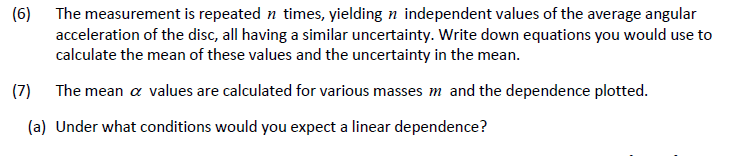
In a previous question, the angular acceleration was found to be given by α=mgr/(I+mr^2) where I is the moment of inertia for a disk.
WibpIcY.png


So, question 6, I figure that we would do that by first taking the mean of the set of measured values, and then getting the uncertainty in the mean by (x_max-x_min)/2

However, I'm unsure as to how the dependence would manifest here. I can't seem to find much clear cut info, and it's just leaving me more confused. Am I correct in thinking that the mass is independent, and the angular acceleration is the dependent variable?

If so, how could a linear dependence be expected? I've thought of a few things, such as changing r without changing the mass, but these things don't seem to make sense. I think I've just confused myself to the point that these efforts are futile without external input. Thanks
 

Attachments

  • WibpIcY.png
    WibpIcY.png
    8.2 KB · Views: 774
Physics news on Phys.org
Regarding the uncertainty of the mean, it is not just the spread of the data. The spread of the data indicates how much error there was in each measurement. The mean of all those measurements is much more precise than the spread of the data. For example, if you made n measurements AGAIN you would get a similar spread in the data, and you wouldn’t expect the new mean to ever be at the extremes of the data distribution. See if your textbook mentions “deviation of the mean”.

Also, (max - min)/2 is a simplistic way to understand the uncertainty, but it isn’t the usual way for lots of good reasons. A more statistically useful definition is the standard deviation. A choice of definition of uncertainty isn’t needed for this problem, so I won’t belabor the point. However, since you mentioned it, I thought I’d let you know.

As for question 7, I don’t think we can help until we understand the previous problem better. In short we have no idea what m is. The result you state looks like maybe there is a mass m hanging under gravity from a wire that is routed over a pulley and goes to the edge of the disk applying a torque. However you also seem to have some other mass (also m?) sitting on the edge of the disk and spinning with it?
 
  • Like
Likes   Reactions: TheFallen018
TheFallen018 said:
Am I correct in thinking that the mass is independent, and the angular acceleration is the dependent variable?
Yes. That's right.

Start by thinking what the equation for a linear dependence of ##\alpha## on ##m## would look like. How does α=mgr/(I+mr^2) differ from that equation? What part of that equation would have be to constant to make it look linear? Since you are trying to set up a linear dependence of ##\alpha## on ##m##, you can't hold ##m## constant, but you can play with ##I## and ##r##. What conditions on ##I## and ##r## would make the relationship look almost linear? (I say "almost" here, because it can't be exactly linear.)
 
  • Like
Likes   Reactions: TheFallen018
Cutter Ketch said:
Regarding the uncertainty of the mean, it is not just the spread of the data. The spread of the data indicates how much error there was in each measurement. The mean of all those measurements is much more precise than the spread of the data. For example, if you made n measurements AGAIN you would get a similar spread in the data, and you wouldn’t expect the new mean to ever be at the extremes of the data distribution. See if your textbook mentions “deviation of the mean”.

Also, (max - min)/2 is a simplistic way to understand the uncertainty, but it isn’t the usual way for lots of good reasons. A more statistically useful definition is the standard deviation. A choice of definition of uncertainty isn’t needed for this problem, so I won’t belabor the point. However, since you mentioned it, I thought I’d let you know.

As for question 7, I don’t think we can help until we understand the previous problem better. In short we have no idea what m is. The result you state looks like maybe there is a mass m hanging under gravity from a wire that is routed over a pulley and goes to the edge of the disk applying a torque. However you also seem to have some other mass (also m?) sitting on the edge of the disk and spinning with it?

Wow, you're sharp. What you described almost exactly describes the problem presented. I'm glad you mentioned using the standard deviation, as that's what I wanted to use, but it seemed obvious, so I was second guessing myself.

Here is what the problem looks like, for more info.
oJdSgZ9.png


The things that are assumed here is that the moment of inertia for the rotational sensor is negligible compared to the step pulley, the string doesn't slip or stretch, and at this point we are also assuming no friction. What we don't know is the radius of the step pulley, the mass or the step pulley, or the hanging mass.

tnich said:
Yes. That's right.

Start by thinking what the equation for a linear dependence of ##\alpha## on ##m## would look like. How does α=mgr/(I+mr^2) differ from that equation? What part of that equation would have be to constant to make it look linear? Since you are trying to set up a linear dependence of ##\alpha## on ##m##, you can't hold ##m## constant, but you can play with ##I## and ##r##. What conditions on ##I## and ##r## would make the relationship look almost linear? (I say "almost" here, because it can't be exactly linear.)

Am I right in thinking that an equation for linear dependence of ##\alpha## on ##m## would look like ##\alpha=a/r##? In this case, a linear dependence should occur when ##m>>I##. This would result in the equation breaking down to ##\alpha=g/r## if we cancel out ##I##, due to it being negligible. Does that seem right? Thanks
 

Attachments

  • oJdSgZ9.png
    oJdSgZ9.png
    4 KB · Views: 470
TheFallen018 said:
Am I right in thinking that an equation for linear dependence of ##\alpha## on ##m## would look like ##\alpha=mg/r##? In this case, a linear dependence should occur when ##m>>I##. Does that seem right? Thanks
No. I was thinking of something like this ##\alpha = Cm##. That would be a line with slope ##C##. So for your original equation for ##\alpha## to look like that ##\frac {gr} {I+mr^2}## would have to be a constant (or approximately constant).
 
  • Like
Likes   Reactions: TheFallen018
TheFallen018 said:
Here is what the problem looks like, for more info.
ojdsgz9-png.png
So based on this picture I think your expression for angular acceleration must be wrong. It will be hard to reason question 7 starting with an incorrect expression.
 

Attachments

  • ojdsgz9-png.png
    ojdsgz9-png.png
    4 KB · Views: 447
  • Like
Likes   Reactions: TheFallen018 and tnich
Cutter Ketch said:
So based on this picture I think your expression for angular acceleration must be wrong. It will be hard to reason question 7 starting with an incorrect expression.
I get exactly the same equation OP does for ##\alpha##.

TheFallen018 said:
In a previous question, the angular acceleration was found to be given by α=mgr/(I+mr^2) where I is the moment of inertia for a disk.
Could you show us how you arrived at this equation, please?
 
  • Like
Likes   Reactions: TheFallen018
Here, let me link in the whole two pages. It might fill in the gaps.

https://imgur.com/a/B4KI8KM

The equation for angular acceleration is given in that file. I still tried to work it out on paper. Here's what I got.

https://imgur.com/a/aRcxV1C

tnich said:
No. I was thinking of something like this ##\alpha = Cm##. That would be a line with slope ##C##. So for your original equation for ##\alpha## to look like that ##\frac {gr} {I+mr^2}## would have to be a constant (or approximately constant).

Hmm, it seems that the only way that it would be constant is as it approaches 1. If m is an independent variable, how would this be constant?
 
tnich said:
I get exactly the same equation OP does for αα\alpha.

Oops. My bad. Didn’t think about it hard enough. Yes, it’s correct. Please disregard.
 
  • Like
Likes   Reactions: TheFallen018
  • #10
TheFallen018 said:
Hmm, it seems that the only way that it would be constant is as it approaches 1. If m is an independent variable, how would this be constant?

No, not 1. The m just has to be irrelevant. (In the thing tnich identified as C, not in the whole thing, obviously). Looking at C what would have to be true for C to not change much when you change m?
 
  • Like
Likes   Reactions: TheFallen018
  • #11
Cutter Ketch said:
No, not 1. The m just has to be irrelevant. (In the thing tnich identified as C, not in the whole thing, obviously). Looking at C what would have to be true for C to not change much when you change m?

So, C should be independent of m? I'm not sure how the m could become irrelevant though, unless there is a large disparity between I and m? I apologise that I'm missing the obvious here
 
  • #12
TheFallen018 said:
So, C should be independent of m? I'm not sure how the m could become irrelevant though, unless there is a large disparity between I and m? I apologise that I'm missing the obvious here
You aren’t missing anything. That’s the answer. Only, not just “disparity”, direction matters. Which has to be bigger? And not just m. The whole term in the denominator.
 
  • Like
Likes   Reactions: TheFallen018

Similar threads

  • · Replies 30 ·
2
Replies
30
Views
4K
  • · Replies 13 ·
Replies
13
Views
2K
  • · Replies 2 ·
Replies
2
Views
1K
  • · Replies 3 ·
Replies
3
Views
2K
  • · Replies 69 ·
3
Replies
69
Views
6K
  • · Replies 10 ·
Replies
10
Views
1K
  • · Replies 2 ·
Replies
2
Views
3K
  • · Replies 6 ·
Replies
6
Views
3K
  • · Replies 60 ·
3
Replies
60
Views
6K
  • · Replies 3 ·
Replies
3
Views
3K