The difference between Ampere's law & Biot-Savart Law

Click For Summary
SUMMARY

The discussion clarifies the differences between Ampere's Law and Biot-Savart Law in calculating magnetic fields generated by infinite and finite wires. An infinite wire produces a stronger magnetic field at a given point (##P##) compared to a finite wire with the same current (##I##) and dimensions due to the contributions of all current elements along its length. The Biot-Savart Law is essential for understanding how magnetic fields are generated in three dimensions, emphasizing that the strongest field is orthogonal to the wire. The discussion highlights the importance of visualizing the full magnetic field rather than just the contributions from individual current elements.

PREREQUISITES
  • Understanding of Ampere's Law and Biot-Savart Law
  • Familiarity with magnetic field concepts and vector calculus
  • Knowledge of current flow in conductors
  • Basic principles of electromagnetism
NEXT STEPS
  • Study the derivation and applications of Ampere's Law
  • Learn how to apply the Biot-Savart Law to various geometries
  • Explore magnetic field visualization techniques using software tools
  • Investigate the implications of magnetic field strength in practical applications
USEFUL FOR

Students of physics, electrical engineers, and anyone interested in electromagnetism and magnetic field analysis will benefit from this discussion.

PhiowPhi
Messages
203
Reaction score
8
When considering the magnitude of the magnetic field at a certain point (##P##) away from an infinite/finite wire, I can't understand how an infinite wire would generate a stronger magnetic field (##B##) in contrast to a finite wire that has the same dimensions and current applied, at the same point (##P##). I understand how to use the equations, yet I can't fully understand the concept.

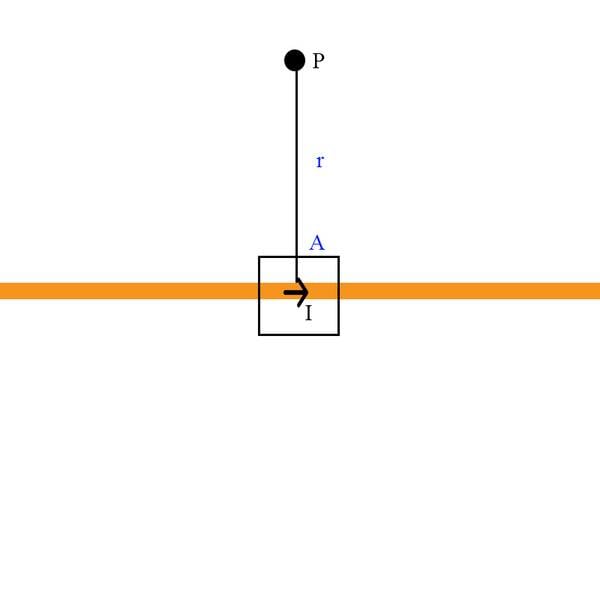
Considering the case of an infinite wire:
Case1.jpg

At the point the magnetic field is point out of the page.
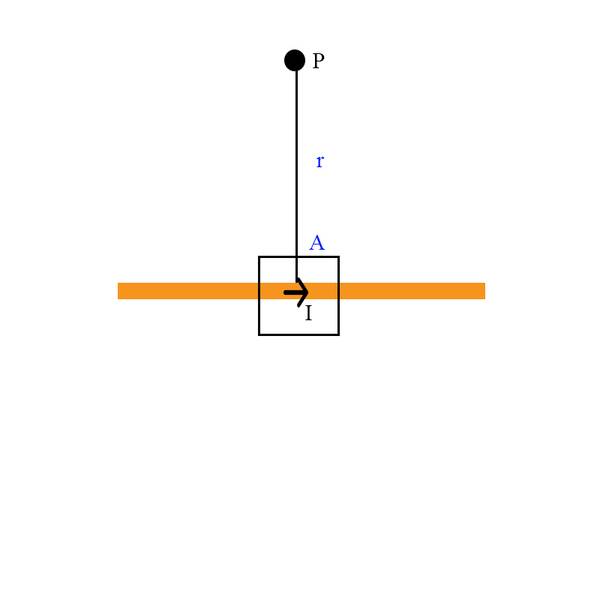
Case of the finite wire:
Case2ab.jpg


Where (A) is the current element region of focus.
Why are the different considering the same ##I## and dimensions for the two?
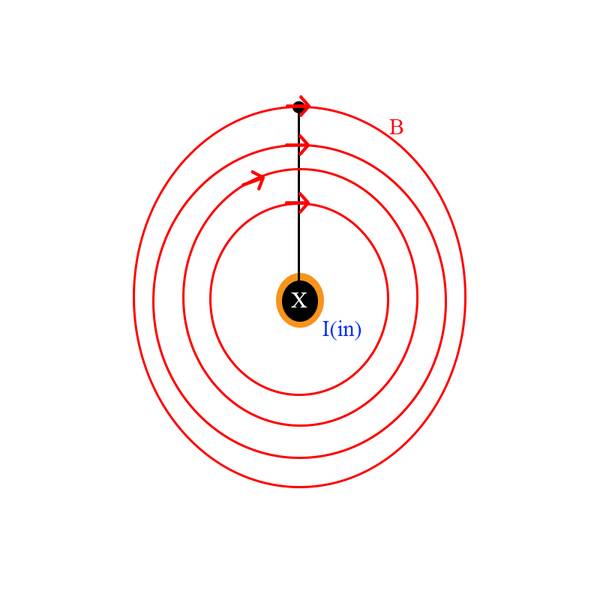
I found from other sources that all the current elements in the wire would contribute to the magnitude at point(##P##) but how is that so? If the magnetic field created by the current element loops around it:
Side_View.jpg

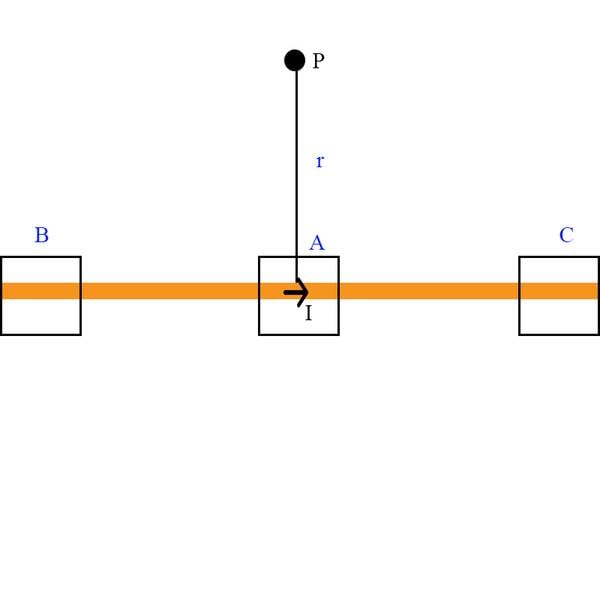
If so, how can regions B,C contribute to point(##P##) for the two wires?
Case2.jpg

For the finite wire:

Case2b.jpg
 
Physics news on Phys.org
PhiowPhi said:
If the magnetic field created by the current element loops around it:
That is not the full magnetic field induced by the wire element. The full magnetic field is 3-dimensional, it just has its strongest region orthogonal to the wire.

You can use Biot-Savart to calculate that.
 
mfb said:
The full magnetic field is 3-dimensional, it just has its strongest region orthogonal to the wire.

For some reason I can't imagine that...
 

Similar threads

Replies
8
Views
1K
  • · Replies 13 ·
Replies
13
Views
2K
  • · Replies 5 ·
Replies
5
Views
1K
  • · Replies 1 ·
Replies
1
Views
2K
  • · Replies 3 ·
Replies
3
Views
3K
  • · Replies 1 ·
Replies
1
Views
4K
  • · Replies 27 ·
Replies
27
Views
3K
  • · Replies 0 ·
Replies
0
Views
2K
  • · Replies 7 ·
Replies
7
Views
2K
  • · Replies 4 ·
Replies
4
Views
3K