brotherbobby
- 809
- 178
- TL;DR
- Taking a oscillating electric field ##E=E_0\sin\omega t##, we use kinematics to find the position of an electron under its influence : ##x(t) = \dfrac{a_0}{\omega}t-\dfrac{a_0}{\omega^2}\sin\omega t##. The second term is obvious - the electron oscillates too. But how do we explain the first term, which shows that the electron also "drifts" with uniform velocity along the same direction as that of the electric field. ##\text{How to understand this drift?}##
Statement of the problem : The problem is a solved example in Kleppner and Kollenkow's book, p. 21. The example is titled : "The Effect of a Radio Wave on an Ionospheric Electron". I copy and paste the example below and underline the last bit in red, which is my area of doubt. I hope the text is readable.
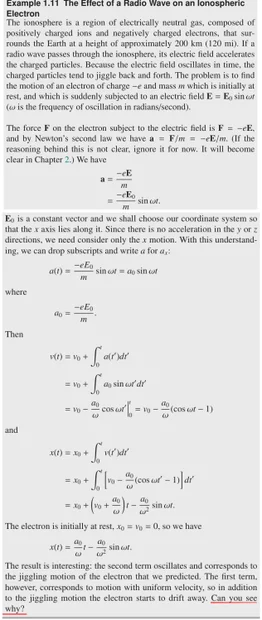
Question : The authors use the an oscillating field in one direction ##E=E_0\sin\omega t## to derive the position of the electron which is located at the origin at rest when time starts. The position of the elextron as a function of time turns out to be : ##x(t) = \underline{\dfrac{a_0}{\omega}t}-\dfrac{a_0}{\omega^2}\sin\omega t##.
The underlined term in the equation is the puzzle, which the authors refer to towards the end. They say that it "corresponds to motion with uniform velocity, so in addition to the jiggling motion the electron starts to drift away. Can you see why?" (my emphasis)
I am afraid I don't see why. Far as I can tell, the electron should oscillate back and forth about the origin ##x=0##.
Guess : (and of course I could be wrong), is that this is connected to the time-dependence of the electric field. As the electron oscillates, the field changes during that time. This keeps changing the mean position of oscillation for the electron, further ahead with time. But why is such a drift unform, even assuming I am correct? No clue as of yet.
Many thanks.
Question : The authors use the an oscillating field in one direction ##E=E_0\sin\omega t## to derive the position of the electron which is located at the origin at rest when time starts. The position of the elextron as a function of time turns out to be : ##x(t) = \underline{\dfrac{a_0}{\omega}t}-\dfrac{a_0}{\omega^2}\sin\omega t##.
The underlined term in the equation is the puzzle, which the authors refer to towards the end. They say that it "corresponds to motion with uniform velocity, so in addition to the jiggling motion the electron starts to drift away. Can you see why?" (my emphasis)
I am afraid I don't see why. Far as I can tell, the electron should oscillate back and forth about the origin ##x=0##.
Guess : (and of course I could be wrong), is that this is connected to the time-dependence of the electric field. As the electron oscillates, the field changes during that time. This keeps changing the mean position of oscillation for the electron, further ahead with time. But why is such a drift unform, even assuming I am correct? No clue as of yet.
Many thanks.
Attachments