The effect of a radio wave on an electron

  • Context: Undergrad 
  • Thread starter Thread starter brotherbobby
  • Start date Start date
brotherbobby
Messages
786
Reaction score
173
TL;DR
Taking a oscillating electric field ##E=E_0\sin\omega t##, we use kinematics to find the position of an electron under its influence : ##x(t) = \dfrac{a_0}{\omega}t-\dfrac{a_0}{\omega^2}\sin\omega t##. The second term is obvious - the electron oscillates too. But how do we explain the first term, which shows that the electron also "drifts" with uniform velocity along the same direction as that of the electric field. ##\text{How to understand this drift?}##
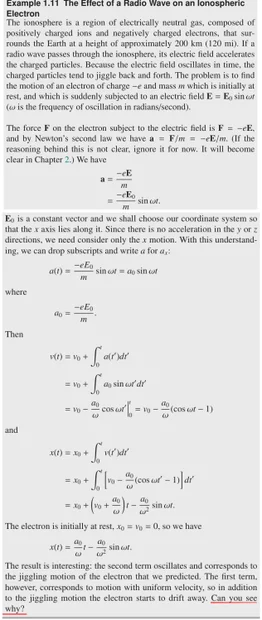
Statement of the problem : The problem is a solved example in Kleppner and Kollenkow's book, p. 21. The example is titled : "The Effect of a Radio Wave on an Ionospheric Electron". I copy and paste the example below and underline the last bit in red, which is my area of doubt. I hope the text is readable.
1779349629549.webp


Question : The authors use the an oscillating field in one direction ##E=E_0\sin\omega t## to derive the position of the electron which is located at the origin at rest when time starts. The position of the elextron as a function of time turns out to be : ##x(t) = \underline{\dfrac{a_0}{\omega}t}-\dfrac{a_0}{\omega^2}\sin\omega t##.

The underlined term in the equation is the puzzle, which the authors refer to towards the end. They say that it "corresponds to motion with uniform velocity, so in addition to the jiggling motion the electron starts to drift away. Can you see why?" (my emphasis)

I am afraid I don't see why. Far as I can tell, the electron should oscillate back and forth about the origin ##x=0##.

Guess : (and of course I could be wrong), is that this is connected to the time-dependence of the electric field. As the electron oscillates, the field changes during that time. This keeps changing the mean position of oscillation for the electron, further ahead with time. But why is such a drift unform, even assuming I am correct? No clue as of yet.

Many thanks.
 

Attachments
  • 1779349462068.webp
    1779349462068.webp
    27.7 KB · Views: 1
Physics news on Phys.org
Look at ##\dot x## instead of ##x##. What is the range of ##\dot x##?
 
brotherbobby said:
I am afraid I don't see why. Far as I can tell, the electron should oscillate back and forth about the origin ##x=0##.
This seems similar to this question you had recently:
brotherbobby said:
Doesn't the deflection due to the coriolis force while going up cancel the defection due to the force while going down? If it does, wouldn't the body drop at the same point?
Consider for simplicity what happens to a body initially at rest that experiences acceleration ##a## for 1s, and then ##-a## for 1s. Does it end up in the same place it started?
 
  • Like
Likes   Reactions: Lord Jestocost and Dale
brotherbobby said:
##x(t) = \dfrac{a_0}{\omega}t-\dfrac{a_0}{\omega^2}\sin\omega t##
##v(t) = \dfrac{a_0}{\omega} (1 -\cos\omega t)##

brotherbobby said:
in addition to the jiggling motion the electron starts to drift away. Can you see why?"
Assume you repeat periodically:
accelerate your car from 0 mph to 65 mph, then press the brake pedal to decelerate from 65 mph to 0 mph.

Then your car drifts in average.
 
Last edited:
brotherbobby said:
Far as I can tell, the electron should oscillate back and forth about the origin ##x=0##.
That would be in average the case for electrons in a resistor, but in the OP screenshot, the electron is - according to the problem - in the ionosphere.

In the ionosphere, the acceleration of the electron is proportional to E(t).
In a resistor, the drift-velocity of the electrons is proportional to E(t).
 
Last edited:
  • Like
Likes   Reactions: Dale
Dale said:
Look at ##\dot x## instead of ##x##. What is the range of ##\dot x##?
Yes, let me calculate. We have the position of the electron relative to the origin O : ##x(t) = \dfrac{a_0}{\omega}t-\dfrac{a_0}{\omega^2}\sin\omega t##. Upon differentiating, ##\dot x(t) = \dfrac{a_0}{\omega} - \dfrac{a_0}{\omega}\cos\omega t##. To check, this matches the initial condition of "at rest initially" : ##\dot x(0)=\dfrac{a_0}{\omega}-\dfrac{a_0}{\omega}=0##.
1779430896686.webp
We find that the velocity of the electron ##v_x (=\dot x)## has a drift component, independent of time. It would be good to plot the velocity function with time. I have taken ##a_0=1\;,\;\omega = 2##. The cosine curve is pushed up by the amount ##a_0/\omega##.
At time ##t=2n\pi/\omega##, the cosine term vanishes but the first term remains : ##x(2n\pi/\omega)=\dfrac{a_0}{\omega}##.
Is this the term responsible for the drift speed of the electron?
 
  • Like
Likes   Reactions: Dale
A.T. said:
Consider for simplicity what happens to a body initially at rest that experiences acceleration ##a## for 1s, and then ##-a## for 1s. Does it end up in the same place it started?

Imagine the body to start from the origin. After 1 s, the body is at a position of ##x(1)=\dfrac{1}{2}a## with a velocity ##v(1) = a##. After another second of deceleration by the same amount, the position of the particle is ##x(2) = a-\dfrac{a}{2}= \dfrac{a}{2}##. As for i ts velocity : ##v(2) = a-a=0##.
We find that while the particle returns to rest, it is not at the position where it began, but "ahead" of it. Clearly, this is the result of the velocity given to the body during the initial acceleration.
 
brotherbobby said:
After another second of deceleration by the same amount, the position of the particle is ##x(2) = a-\dfrac{a}{2}= \dfrac{a}{2}##.
That's wrong. Besides the fact, that the physical units on the left and right side of the equation are different, ##x(2s)## cannot be equal to ##x(1s)##, because the body continues to move while the deceleration.
 
Sagittarius A-Star said:
That's wrong. Besides the fact, that the physical units on the left and right side of the equation are different, ##x(2s)## cannot be equal to ##x(1s)##, because the body continues to move while the deceleration.
Yes, forgive me, I realised my mistake just after you posted. I was thinking of editing my response.
Let me do it again.

The velocity of the electron after 2 s is fine, ##v(2) = 0##.
The position of the electron : ##\boxed{x(2)} = \dfrac{a}{2}+a-\dfrac{a}{2} = \boxed{a}##. The electron moves a distance ##a## ahead.

Please note the physical units are taken care of. They seem out of place because everywhere there is the time duration of ##t=1\,\text{s}##.
 
  • #10
brotherbobby said:
The electron moves a distance ##a## ahead.
That's almost correct. It moves a distance ##a (1 \text{s})^2## ahead.
brotherbobby said:
Please note the physical units are taken care of. They seem out of place because everywhere there is the time duration of ##t=1\,\text{s}##.
Please see above.
 
  • #11
brotherbobby said:
We find that while the particle returns to rest, it is not at the position where it began
Yes, exactly. Acceleration is the derivative of velocity, so with equal but opposite acceleration phases, only the velocity changes cancel, but not necessarily the position changes. This also applies to the Coriolis accelerations on the way up and down.
 
Last edited:
  • Like
Likes   Reactions: sophiecentaur
  • #12
brotherbobby said:
Is this the term responsible for the drift speed of the electron?
Yes.

Note that each cycle accelerates and then decelerates the electron. The acceleration portion accelerates from zero to some positive velocity. The deceleration portion is symmetric. So it decelerates from the positive velocity back to zero. So the velocity never becomes negative. Without the velocity becoming negative the particle cannot return to its original location.
 
  • Like
Likes   Reactions: sophiecentaur and brotherbobby
  • #13
A.T. said:
Yes, exactly. Acceleration is the derivative of velocity, so with equal but opposite acceleration phases, only the velocity changes cancel, but not necessarily the position changes.
Thank you. The point may be elementary but deep. Far as I know, books don't say these things. One has to "discover" them on one's own, or with help.
 
  • #14
brotherbobby said:
Far as I know, books don't say these things. One has to "discover" them on one's own, or with help.
Well, K&K’s book didn’t give you the answer, but they did prepare you with the skills that you needed to discover it, and they did point out that there was something interesting to discover there. So I wouldn’t exactly say that this is something that books don’t say. More like they chose to present it in a way to encourage a student’s active participation in learning.
 
  • #15
Dale said:
Yes.

Note that each cycle accelerates and then decelerates the electron. The acceleration portion accelerates from zero to some positive velocity. The deceleration portion is symmetric. So it decelerates from the positive velocity back to zero. So the velocity never becomes negative. Without the velocity becoming negative the particle cannot return to its original location.
I have a small problem / comment with this. If the phase of the first cycle of incoming wave is inverted then won't the electron move down instead of up? The resulting drift could vary along the path of the wave. Or what?:smile:
 
  • #16
sophiecentaur said:
If the phase of the first cycle of incoming wave is inverted then won't the electron move down instead of up?
Yes. The result depends strongly on the initial velocity of the particle and the initial phase of the wave. The discussion above is about the specific conditions of the problem and does not generalize.
 
  • #17
Dale said:
Yes. The result depends strongly on the initial velocity of the particle and the initial phase of the wave. The discussion above is about the specific conditions of the problem and does not generalize.
It implies that the momentum change of the electron will be in a direction appropriate to the E field of the wave. So the scattering of the wave would also be a direction appropriate to the E field. That's not a problem as I see it; it's just a fact that's good tp know but the difference in the actual amount of scattering might be very small. For a wave from an MF transmitting mast the 'sign' of the scattering would depend on the +sign on the transmitter and, from the shape of the radiation pattern, would be greater in the vertical direction.

The induced free electron motion is relevant in mf ionospheric propagation (mentioned previously) and is also affected by the Earth's magnetic field (producing rotation of polarisation). Maybe that's a bigger effect.
The displacement effect would also be finite for the positive ions up there too but many thousandths smaller, I think.
 
  • Like
Likes   Reactions: Dale

Similar threads

  • · Replies 11 ·
Replies
11
Views
3K
  • · Replies 8 ·
Replies
8
Views
3K
  • · Replies 1 ·
Replies
1
Views
2K
  • · Replies 2 ·
Replies
2
Views
2K
  • · Replies 8 ·
Replies
8
Views
2K
  • · Replies 39 ·
2
Replies
39
Views
4K
  • · Replies 0 ·
Replies
0
Views
3K
  • · Replies 16 ·
Replies
16
Views
3K
  • · Replies 3 ·
Replies
3
Views
2K
  • · Replies 0 ·
Replies
0
Views
541