The factors determining the induced EMF in a wire

Click For Summary
SUMMARY

The induced electromotive force (emf) in a straight wire is calculated using the equation emf = Blv sinθ, where θ represents the angle between the direction of motion and the magnetic field lines. In scenarios where the wire is not perpendicular to the magnetic field, the angle θ should be defined as the angle between the velocity vector and the magnetic field vector. The induced emf is directly related to the change in magnetic flux through the circuit, and the actual induced emf can be determined using the triple product of the magnetic field, the differential length vector, and the velocity vector.

PREREQUISITES
  • Understanding of the equation for induced emf: emf = Blv sinθ
  • Knowledge of magnetic flux and its relationship to induced emf
  • Familiarity with vector mathematics, specifically cross products
  • Concept of motion in magnetic fields
NEXT STEPS
  • Study the derivation of the induced emf equation in different configurations
  • Learn about the applications of Faraday's Law of electromagnetic induction
  • Explore the implications of the triple product in electromagnetic contexts
  • Investigate practical experiments demonstrating induced emf in various setups
USEFUL FOR

Physics students, electrical engineers, and anyone interested in understanding the principles of electromagnetic induction and its applications in technology.

Asmaa Mohammad
Messages
182
Reaction score
7
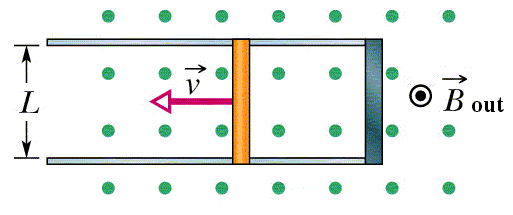
The induced emf in a straight wire is determined by the equation (emf=Blv sinθ) where θ is the angle between the direction of the motion and the lines of the magnetic field, and frequently, I see diagrams like these explaining the phenomenon:
Nc6gm.gif

vX8Hm.jpg

In those pictures the wire is perpendicular to the lines of the field, so it starts its motion of that state, and I was wondering what if the wire was like this:
3VfCi.jpg

In that diagram the angle between the wire and the field is not 90 it is θ1 and the angle between the direction of the motion and the magnetic field lines is θ2.
So, in the equation (emf=Blv sinθ) which angle will be involved here? θ1 or θ2? Or θ1=θ2? And then there will be no difference.
Note: in the last diagram the wire moves from position 1 to position 2.
 
Last edited:
Physics news on Phys.org
The basic tule id that the induced emf is dependent on the change of magnetic flux through the circuit. Then you may compute it and get some special case results in given setups.
 
Orodruin said:
The basic tule id that the induced emf is dependent on the change of magnetic flux through the circuit. Then you may compute it and get some special case results in given setups.
Actually I don't have given setups, this question came to my mind while studying the induced emf in a straight wire, and all the figures show that the wire starts its motion from the position where it is perpendicular to the field lines.
I wonder whether the equation still the same if the wire starts its motion from the position where there is an angle <90 between it and the magnetic field lines.
 
Asmaa Mohammad said:
Actually I don't have given setups, this question came to my mind while studying the induced emf in a straight wire, and all the figures show that the wire starts its motion from the position where it is perpendicular to the field lines.
I wonder whether the equation still the same if the wire starts its motion from the position where there is an angle <90 between it and the magnetic field lines.

But you do have closed circuits in your examples. Regardless, you can compute the emf in the wire by considering the magnetic flux through the area swept by the wire per time unit.
 
Asmaa Mohammad said:
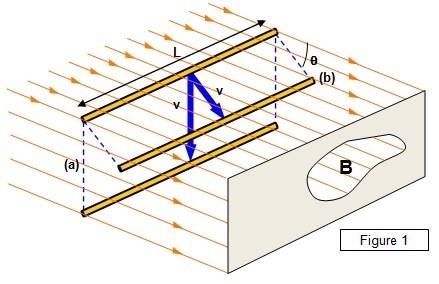
The induced emf in a straight wire is determined by the equation (emf=Blv sinθ) where θ is the angle between the direction of the motion and the lines of the magnetic field, and frequently, I see diagrams like these explaining the phenomenon:
Nc6gm.gif

vX8Hm.jpg

In those pictures the wire is perpendicular to the lines of the field, so it starts its motion of that state, and I was wondering what if the wire was like this:
3VfCi.jpg

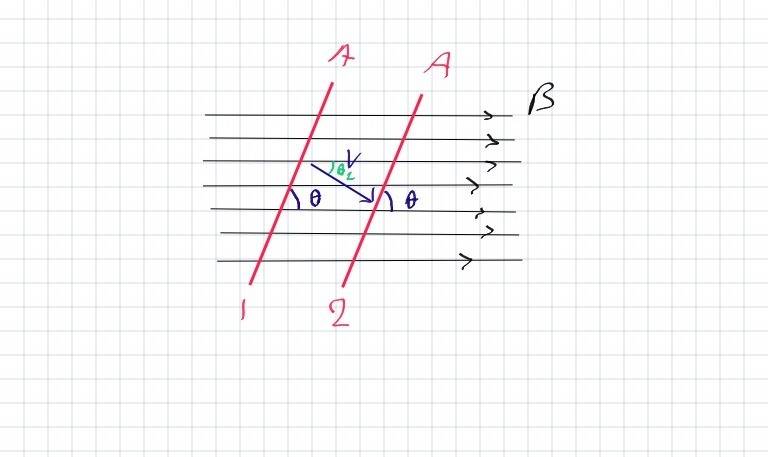
In that diagram the angle between the wire and the field is not 90 it is θ1 and the angle between the direction of the motion and the magnetic field lines is θ2.
So, in the equation (emf=Blv sinθ) which angle will be involved here? θ1 or θ2? Or θ1=θ2? And then there will be no difference.
Note: in the last diagram the wire moves from position 1 to position 2.
In motional emf equation, θ is the angle between the velocity vector and magnetic field vector.
 
cnh1995 said:
In motional emf equation, θ is the angle between the velocity vector and magnetic field vector.
So, we would ignore the angle between the wire and the magnetic field lines and only consider the angle between the direction of motion and the magnetic field lines?
 
cnh1995 said:
In motional emf equation, θ is the angle between the velocity vector and magnetic field vector.
This is not precisely true. It is true only when the wire is orthogonal to both velocity and field. The actual induced emf would be proportional to the triple product ##\vec B\cdot (d\vec \ell\times \vec v)##. The cross product would be the area element swept per unit time and taking its scalar product with ##\vec B## gives the flux.
 
  • Like
Likes   Reactions: vanhees71, Delta2 and Asmaa Mohammad

Similar threads

  • · Replies 3 ·
Replies
3
Views
1K
  • · Replies 9 ·
Replies
9
Views
2K
  • · Replies 3 ·
Replies
3
Views
17K
  • · Replies 2 ·
Replies
2
Views
1K
  • · Replies 42 ·
2
Replies
42
Views
3K
  • · Replies 9 ·
Replies
9
Views
2K
  • · Replies 4 ·
Replies
4
Views
3K
  • · Replies 11 ·
Replies
11
Views
6K
  • · Replies 7 ·
Replies
7
Views
2K
  • · Replies 39 ·
2
Replies
39
Views
4K