The formula for a tangent plane to a surface

Click For Summary
SUMMARY

The discussion focuses on deriving the formula for the tangent plane to a surface, specifically using the partial derivatives ∂f/dx, ∂f/dy, and ∂f/dz evaluated at a point (xo, yo, zo). The equation for the tangent plane is expressed as ∂f/dx|rox + ∂f/dy|ro y + ∂f/dz|roz = constant, where the constants represent the coefficients of the coordinates. The participants clarify that rearranging the equation does not change its validity, emphasizing the importance of understanding the role of these partial derivatives in defining the tangent plane.

PREREQUISITES
  • Understanding of partial derivatives in multivariable calculus
  • Familiarity with the concept of tangent planes
  • Knowledge of the notation for evaluating functions at specific points
  • Basic algebraic manipulation skills
NEXT STEPS
  • Study the derivation of the tangent plane formula in multivariable calculus
  • Learn about the geometric interpretation of tangent planes
  • Explore applications of tangent planes in optimization problems
  • Investigate the relationship between tangent planes and linear approximations
USEFUL FOR

Students and educators in mathematics, particularly those studying calculus and multivariable functions, as well as professionals applying these concepts in fields such as physics and engineering.

Mazzur
Messages
3
Reaction score
0
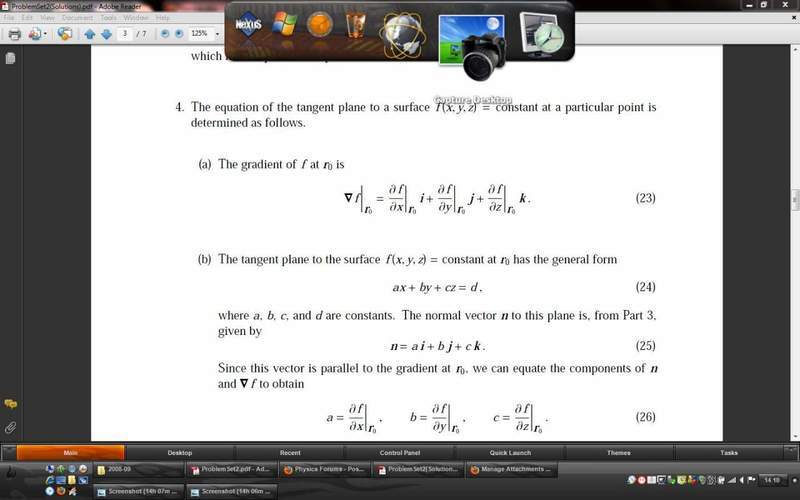
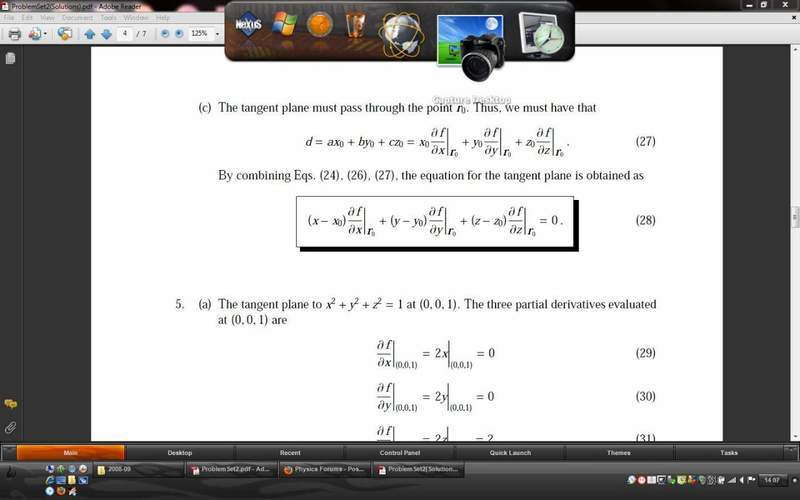
Hey I'm trying to understand how we arrive at the formula for the tangent plane to a surface. An image of what I'm talking about it shown below.

I think understand all the parts up to part c, but i don't see how we arrive at that final formula. The image of first part of the solution is shown just to provide context.
Screenshot (14h 10m 36s).jpg


Screenshot (14h 07m 23s).jpg
 
Physics news on Phys.org
Welcome to PF!

Mazzur said:
I think understand all the parts up to part c, but i don't see how we arrive at that final formula.

Hey Mazzur! Welcome to PF! :smile:

∂f/dx|ro ∂f/dy|ro and ∂f/dz|ro are all constants, and they are the constants that have to be the coefficients of x y and z …

that's the bit you understand, isn't it? :wink:

So the equation has to be
∂f/dx|rox + ∂f/dy|ro y + ∂f/dz|roz = constant,

and all they've done is to put that constant on the left of the = sign, and split it up between the three coordinates.

If you prefer, you can put it back on the right, like this …

∂f/dx|rox + ∂f/dy|ro y + ∂f/dz|roz = ∂f/dx|roxo + ∂f/dy|ro yo + ∂f/dz|rozo

either way, you can see that putting x = xo, y = yo, z = zo, makes the equation true. :smile:
 

Similar threads

  • · Replies 5 ·
Replies
5
Views
2K
  • · Replies 8 ·
Replies
8
Views
2K
Replies
7
Views
2K
  • · Replies 2 ·
Replies
2
Views
1K
Replies
4
Views
2K
  • · Replies 7 ·
Replies
7
Views
2K
  • · Replies 21 ·
Replies
21
Views
4K
  • · Replies 14 ·
Replies
14
Views
2K
  • · Replies 8 ·
Replies
8
Views
3K
  • · Replies 6 ·
Replies
6
Views
2K