Devin-M
- 1,078
- 771
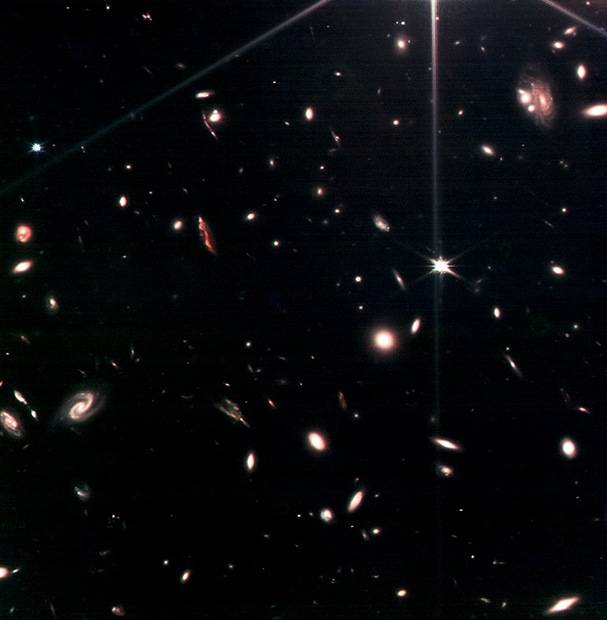
1 Sensor:
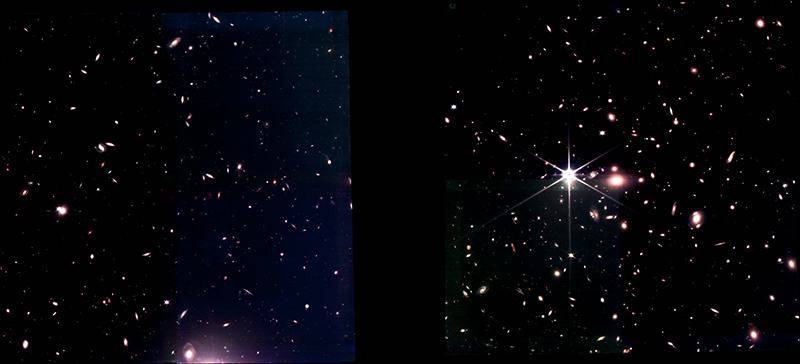
8 Sensor Mosaic:
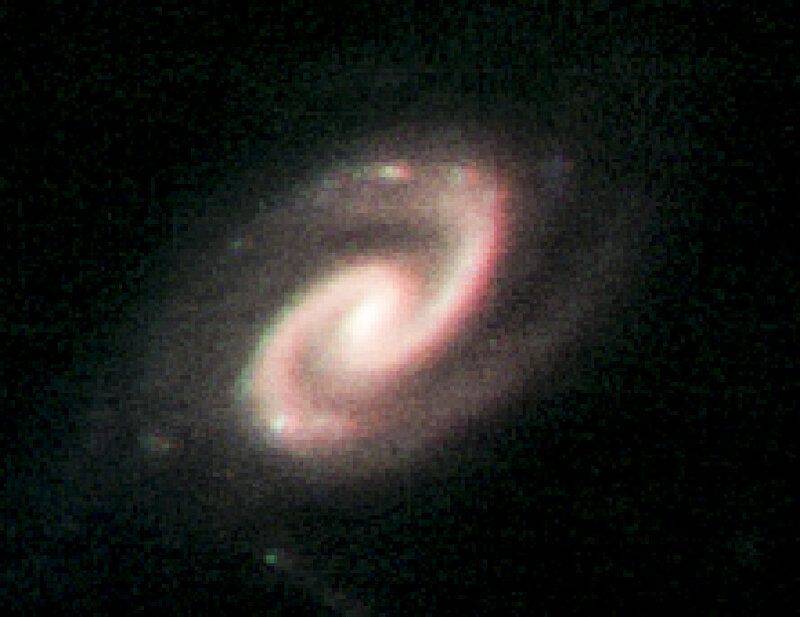
100% Crop:
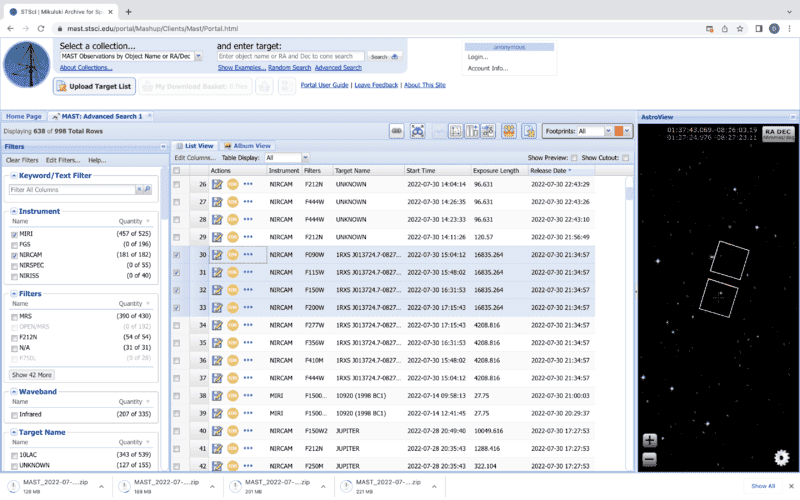
8 Sensor Mosaic:
100% Crop:
One picture is rotated in respect to the other.phinds said:I'm confused. If those are pics of the same area, how is it possible that the orientation / arrangement of the galaxies is so different?
AH HA! I was looking for 90-degree flips/mirrors/whatever. Not very bright this morning. Thanks.Motore said:One picture is rotated in respect to the other.
About 33degphinds said:AH HA! I was looking for 90-degree flips/mirrors/whatever. Not very bright this morning. Thanks.
I'm up way too early this morning (long story) and I was only able to think in 90 degree increments.pinball1970 said:About 33deg

That doesn't seem to make sense, but it's hard to judge without context. Maybe they just discuss how certain parameters are still not very well known, but that should be a symmetric uncertainty.pinball1970 said:The article I read/saw that I did not have time to post frustratingly, mentioned JWST ability to detect IR much better than any telescope before it. Therefore Galaxies "appear" to be further away than they actually are and the error could be as much as 20%.
It's only possible if you can find spectroscopic lines or use other spectroscopic features (like the Lyman break). Taken on its own a UV photon redshifted by a factor 15 to 3 micrometers and a visible light photon redshifted by a factor 5 to 3 micrometers are identical.pinball1970 said:Also, is it not possible to distinguish IR from a shorter wavelength that is red shifted to IR? What about Blue, red shifted to IR? UV?
Ok That makes sense thanks. I think I have come across that beforemfb said:That doesn't seem to make sense, but it's hard to judge without context. Maybe they just discuss how certain parameters are still not very well known, but that should be a symmetric uncertainty.It's only possible if you can find spectroscopic lines or use other spectroscopic features (like the Lyman break). Taken on its own a UV photon redshifted by a factor 15 to 3 micrometers and a visible light photon redshifted by a factor 5 to 3 micrometers are identical.
I have a subscription and the article contains the following relevant sentence:pinball1970 said:Ok That makes sense thanks. I think I have come across that before
If I find that article I will post it and get your/pf view.
This suggests that the problem affected calculations that compared the relative brightness at different wavelengths.NIRCam (one of the main cameras on the telescope) was overperforming in its reddest wavelengths.
The shift only tells you the recession speed and, although the shift of the (faint) spectral lines can only be measured to a certain accuracy, the distance that's calculated from that red shift depends on the Hubble constant being a constant. Another quantity that can be measured is the brightness of the observed objects and that can be affected by (unknown) quantities of dust etc. Will they actually know the sort of spectral tilt out towards the IR? I imagine that could affect their distance estimation. But someone will sort it out, I'm sure, with the appropriate frigg factor.pinball1970 said:Therefore Galaxies "appear" to be further away than they actually are and the error could be as much as 20%.
Would fit to the Lyman break, which is a drop in intensity at a specific wavelength. A miscalibration of the relative brightness shifts the fitted wavelength.Jonathan Scott said:This suggests that the problem affected calculations that compared the relative brightness at different wavelengths.
I am now observing P330E using NIRCam Engineering Imaging for 4 hours and 20 minutes. Keywords: G dwarfs. Proposal: https://stsci.edu/jwst/phase2-public/1538.pdf 55:1
That statement seems to show some careless publicity of their results. How ever could they be sure about the red shift if they haven't actually measured it? A bit egg on face iyam.pinball1970 said:When we get spectroscopy, I have little doubt that some of these galaxies we thought were very high redshifts will turn out not to be,”
For the first time, astronomers have used NASA’s James Webb Space Telescope to take a direct image of a planet outside our solar system. The exoplanet is a gas giant, meaning it has no rocky surface and could not be habitable.
I think you mean 400 light years.mfb said:100 AU away from its star at a distance of 400 AU.
You may be right but if the effect is being introduced locally (to the telescope) then what could be special about the light from the star? It doesn't occur for other stars.pinball1970 said:just an optical effect from the telescope like diffraction spikes?
Possibly but no apparent colour fringes and the star is not monochromatic.Borg said:Maybe dust from the main star being imaged? The other stars may be in front of the dust.