The James Webb Space Telescope

Join the discussion
Ask a follow-up here, or get your own question answered by working scientists, mathematicians and engineers — people, not an autocomplete.
Real named experts · corrections over time · the nuance an AI answer skips
545 replies · 65K views
Side side with Hubble on the left from 2014
I turned on all the lights off in the office so I could see this in all its glory.
Wow.
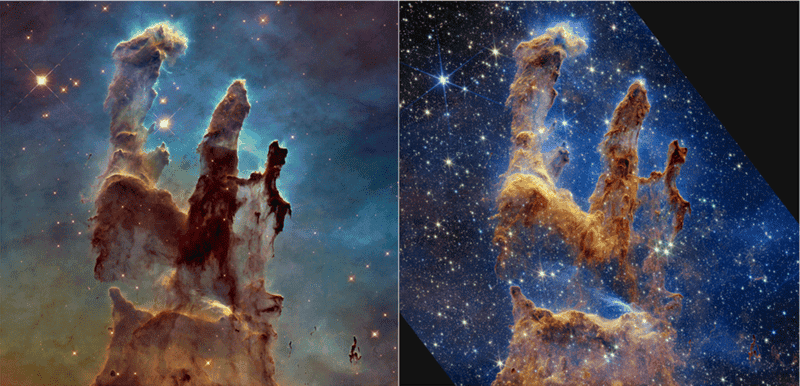
1666268948780.png
 
Reply
  • Like
Likes   Reactions: KurtLudwig, DennisN, Grinkle and 1 other person
Astronomy news on Phys.org
sophiecentaur said:
Weird.
Perhaps I am reading tea leaves. The hexagonal pattern is obviously from the optics (likely the mirror shape) but to my eye the green shape is rotated 30o relatve to the red one. I having trouble figuring a plausability argument for that, either diffraction or refraction. One also should be cognizant that these are false colors.
 
sophiecentaur said:
But why aren’t all (bright) star images like it?
My best guess (I just thought of it) is that it looks like the internal "camera" reflection from either the bright object in field or perhaps one just out of field off axis. I don't know enough about Webb optics to be any more definitive
 
hutchphd said:
My best guess (I just thought of it) is that it looks like the internal "camera" reflection from either the bright object in field or perhaps one just out of field off axis. I don't know enough about Webb optics to be any more definitive
I tried blowing up some of the other objects but they all were too blurred.
 
pinball1970 said:
I tried blowing up some of the other objects
Did you borrow Peter's blaster again? I thought we already had "the talk" about that... :wink:

1666288436083.png

https://www.deviantart.com/nocturnbros/art/Marvin-the-Martian-invades-DEATH-BATTLE-683673659
 
Reply
  • Haha
  • Like
Likes   Reactions: Imager, sophiecentaur, phinds and 1 other person
anorlunda said:
Is there a NASA source to get such images with full resolution?
The image is from the NASA site. I have been looking at other images and cannot see anything like this.
Dust has been mentioned, if it is fairly evenly distributed then could the rings which look almost concentric cause that effect via some sort diffraction?
 
Reply
  • Like
Likes   Reactions: anorlunda
pinball1970 said:
some sort diffraction?
But there are no coloured edges and you don't get diffraction effects from massive objects (i.e. out in space). Diffraction would have to be taking place the telescope optics and would apply to many images of the appropriate brightness.

The explanation that it's due to ripples in dust, caused by regular pulses of light certainly gets my vote. 1. Regular pattern. 2. No colour effects. 3. The fact that it's a rare effect indicates some very high energy involved.
 
Reply
  • Like
Likes   Reactions: BillTre and pinball1970
https://arxiv.org/abs/2210.10074
with a nice write-up by John Timmer at
https://arstechnica.com/science/202...ed-from-galaxies-11-billion-light-years-away/

New Webb images illuminate the formation of a galaxy cluster​

A team of researchers is publishing a paper based on new images taken by the Webb Space Telescope. The images reveal a dense concentration of matter in the early Universe, potentially indicating early stages in the formation of a galaxy cluster. And thanks to the spectrograph present, Webb was able to confirm that several galaxies previously imaged by Hubble were also part of the cluster. It even tracked the flow of gas ejected by the largest galaxy present.
image-11-800x924.png
 
Reply
  • Like
  • Informative
Likes   Reactions: DennisN and pinball1970
Thread is closed temporarily for Moderation (and possible thread split to break off the side-discussion about diffraction effects in telescopes)...
 
Reply
  • Like
Likes   Reactions: pinball1970 and sophiecentaur
https://esawebb.org/news/weic2219/?lang :
The NASA/ESA/CSA James Webb Space Telescope has revealed the once-hidden features of the protostar within the dark cloud L1527 with its Near Infrared Camera (NIRCam), providing insight into the formation of a new star. These blazing clouds within the Taurus star-forming region are only visible in infrared light, making it an ideal target for Webb.
weic2219a.jpg
 
Reply
  • Like
  • Love
Likes   Reactions: berkeman, Maarten Havinga, Borg and 1 other person
They have fixed the issue with MIRI apparently. Nothing on the NASA site though.
 
Last edited:
Analysis of micrometeorite impacts shows that the May event was likely really bad luck and should stay an outlier instead of a regular occurrence.

 
Reply
  • Like
  • Informative
Likes   Reactions: collinsmark, andrew s 1905, vanhees71 and 1 other person
Last edited:
Reply
  • Like
Likes   Reactions: sophiecentaur
Vanadium 50 said:
"Better"? It's in different wavelengths. Is green better than red? Or blue?
Resolution, detail.
 
Reply
  • Like
Likes   Reactions: vanhees71
Vanadium 50 said:
Uranus is pretty featureless. The rings seem to come out better, but that doesn;t surprise me
…please let me resist temptation for bad joke …
 
Reply
  • Haha
  • Like
Likes   Reactions: vanhees71, phinds and Borg
Vanadium 50 said:
I don't understand why they felt compelled to make a video of a still image/
Standard way of getting good planetary images. They aren't short of light with a big scope (or even a home one) so a large set of sequential images allows software to reject bad ones, re-position the selected images and then stack them. It's better than plain stacking of a few long exposures. Also, the contrast range will be a lot les for a planet than for galaxies and nebulae so it's a very different job altogether. "It's a very different job.":kiss:!!
There are pros and cons about flyby images vs Hubble images. Hubble can spot changes where a brilliant flyby image just shows things as they are - once in decades.
 
Reply
  • Like
  • Informative
Likes   Reactions: Imager, vanhees71, BvU and 1 other person
Vanadium 50 said:
No, what I don'y understand is why they took a picture and then put the picture on Youtube,. Why not just post the picture, a la APOD. Or is that so 20th century?
Oh, right. That sort of presentation is reckoned to be more sexy, I think. Screen saver stuff. But the image is not very special in the first place.
 
Reply
  • Like
Likes   Reactions: vanhees71