The James Webb Space Telescope

Join the discussion
Ask a follow-up here, or get your own question answered by working scientists, mathematicians and engineers — people, not an autocomplete.
Real named experts · corrections over time · the nuance an AI answer skips
545 replies · 65K views
Vanadium 50 said:
Uranus is pretty featureless. The rings seem to come out better, but that doesn;t surprise me in the IR.
Well I have never seen Uranus looking like that, the rings give it a different personality.
Set to music in a video I agree was probably not the best way to illustrate it.
 
Reply
  • Like
Likes   Reactions: Cyosis
Astronomy news on Phys.org
A recent clip on CBS 60 Minutes about the new images from JWST:

NASA's James Webb Space Telescope: Stunning new images captured of the universe | 60 Minutes
(April 10, 2023)

"As NASA’s Webb telescope scours the universe to find light from the first stars and galaxies, it is also capturing the universe like never before. Scott Pelley got an inside look at Webb’s new discoveries."

 
Reply
  • Like
  • Love
  • Informative
Likes   Reactions: Filip Larsen, BvU, pinball1970 and 1 other person
At 2:30, he states that the galaxy they are looking at is more than 33 billion ly away??? Am I missing something? Last I remember, the universe is only 13 billion years old.
 
Borg said:
Last I remember, the universe is only 13 billion years old.
Yes, but the observable universe has about a 45bn light years radius at present. The growth rate is not limited by ##c##.
 
Reply
  • Like
Likes   Reactions: pinball1970 and Borg
Image from Webb of a galaxy merger. All the galaxies in the back ground too

https://www.nasa.gov/feature/goddard/2023/webb-captures-the-spectacular-galactic-merger-arp-220

1682063262265.png
 
Reply
  • Like
  • Wow
Likes   Reactions: BvU, collinsmark, DennisN and 1 other person
pinball1970 said:
The six spike diffraction thing? @Andy Resnick @collinsmark with Webb?
Isn't that spike diffraction the standard thing with Webb, i.e. the same type of spikes that appear in photos of bright stars by Webb?

I don't know exactly why they appear (I guess it's either some "thingy" in front of the detector or maybe something due to the hexagonal mirrors, perhaps? (just a guess)). I remember seeing a video where they mentioned the spikes, but I don't think they specified in the video why the spikes appear.
 
Reply
  • Like
Likes   Reactions: pinball1970
DennisN said:
I don't know exactly why they appear (I guess it's either some "thingy" in front of the detector or maybe something due to the hexagonal mirrors, perhaps?
It's a diffraction effect from the mirror, with six-fold symmetry because of the hexagonal structure.
 
Reply
  • Like
Likes   Reactions: collinsmark, DennisN, pinball1970 and 2 others
If you look at (e.g.) this Astronomy Picture Of The Day from Hubble you can see cross shaped rays from the bright stars.
Arp273_HubblePohl_1824.jpg
Source

That's a diffraction effect from the + shaped "spider" that supports the secondary mirror. Webb's spikes are more impressive, I would guess because it's a hexagonal mirror rather than a basically round mirror with a relatively minor four-fold symmetric obstruction.
 
Reply
  • Like
  • Wow
Likes   Reactions: DennisN and pinball1970
Borg said:
At 2:30, he states that the galaxy they are looking at is more than 33 billion ly away??? Am I missing something? Last I remember, the universe is only 13 billion years old.
"Distance" in our expanding universe makes only sense if we mean distance at a fixed time, e.g. the distance between us and a galaxy far away at the time of emission or absorption of it's light.
 
Reply
  • Like
Likes   Reactions: pinball1970
Ibix said:
It's a diffraction effect from the mirror, with six-fold symmetry because of the hexagonal structure.
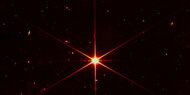
It's the first big one I have seen since that initial calibration image. The star image with all the galaxies in the background that got all the astronomy community very excited.
 
The six diffraction spikes are more caused by the three supports that support the secondary mirror. As said above, the Hubble has four secondary supports, so you get four diffraction spikes. The three Webb supports lead to six diffraction spikes, because you get one opposite to the support as well. I think the segmented mirrors also contribute to the diffraction spikes, but I think the secondary supports are the main cause.
 
Reply
  • Like
  • Informative
Likes   Reactions: russ_watters, timmdeeg, DennisN and 2 others
phyzguy said:
The six diffraction spikes are more caused by the three supports that support the secondary mirror. As said above, the Hubble has four secondary supports, so you get four diffraction spikes. The three Webb supports lead to six diffraction spikes, because you get one opposite to the support as well. I think the segmented mirrors also contribute to the diffraction spikes, but I think the secondary supports are the main cause.
Every detailed description I have seen says that the hexagonal mirrors are the larger contributor and if you just ballpark it there are more hexagon edges than support edges. Also there are not six spikes, it has eight. The fainter horizontal one is caused by the vertical support. The other two supports line up with the non horizontal hexagon edges.

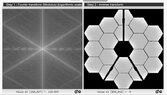
Fun fact if you run the FFT algorithm on the NIR selfie image you get the spike pattern as a result.

fft.jpgdownload.jpg
 
Reply
  • Like
  • Informative
Likes   Reactions: Motore, Tom.G, pinball1970 and 2 others
phyzguy said:
The six diffraction spikes are more caused by the three supports that support the secondary mirror. As said above, the Hubble has four secondary supports, so you get four diffraction spikes. The three Webb supports lead to six diffraction spikes, because you get one opposite to the support as well. I think the segmented mirrors also contribute to the diffraction spikes, but I think the secondary supports are the main cause.
That isn't quite right.

If a telescope's secondary mirror was attached with a single rod/pole holding there would still be two diffraction spikes; each spike being perpendicular to the direction of the pole/rod/support.

In other words, consider a vertical pole that extends from the bottom of view to the center, where it holds the secondary mirror, the result would be two horizontal diffraction spikes: one in each direction. Now you can add another support, going from top to the center, without increasing the number of diffraction spikes, since the diffraction spikes from the two supports simply overlap.

The bulk of the diffraction spikes on the James Webb Space Telescope (JWST) come from the hexagonal pattern of the mirrors. Each mirror has 6 sides, and each side produces two diffraction spikes, one in each perpendicular direction. So there are really 12 spikes, but due to the symmetry of a hexagon there's overlap, so the end result is 6 observed spikes caused by the hexagonal shape.

Now we consider the 3 rods from the spider vanes holding the secondary in place. Two of those rods are aligned with the sides of hexagonal shape of mirror, so no new diffraction spikes are created by these rods (since they overlap with other spikes). That leaves the third rod that is not in line with any of the sides of the hexagonal shape of the mirrors. This rod leaves a new set of diffraction spikes -- and those additional two spikes are perpendicular to the rod.

So in the end, there's 8 diffraction spikes on JWST's optics: 6 prominent ones and 2 minor ones in the diffraction pattern.
[Edit: Technically, of the 8 diffraction spikes, there's 4 really prominent ones caused by both the hexagonal mirrors plus two of the secondary support rods, 2 somewhat prominent ones caused by the hexagonal mirrors without any secondary mirror support diffraction, and finally 2 subtle spikes caused by one of the support rods.]

It's worthwhile to note that this this diffraction pattern (which is wavelength dependent; I haven't discussed that here) doesn't just affect the resultant appearances of bright stars, but also the dim stuff too. Every light ray, every pixel in the image is affected by the convolution of the diffraction pattern across the entire image. Sure, the pattern is only obvious to bright stars due their higher contrast, but the diffraction pattern actually affects everything.

Edit: Conceptually, this is like trying to paint a picture on a canvas with the limitation that your brush is the shape of the diffraction pattern. It's not possible to place a dot on the canvas smaller than the brush/diffraction pattern; it's all or nothing. You can change the brightness, but not the size (for a given color). Also different colors will have slightly different sized brushes, thus slightly different sized diffraction patterns.
 
Last edited:
Reply
  • Informative
Likes   Reactions: Tom.G, DennisN, Filip Larsen and 1 other person
collinsmark said:
That isn't quite right.

If a telescope's secondary mirror was attached with a single rod/pole holding there would still be two diffraction spikes; each spike being perpendicular to the direction of the pole/rod/support.

In other words, consider a vertical pole that extends from the bottom of view to the center, where it holds the secondary mirror, the result would be two horizontal diffraction spikes: one in each direction. Now you can add another support, going from top to the center, without increasing the number of diffraction spikes, since the diffraction spikes from the two supports simply overlap.

The bulk of the diffraction spikes on the James Webb Space Telescope (JWST) come from the hexagonal pattern of the mirrors. Each mirror has 6 sides, and each side produces two diffraction spikes, one in each perpendicular direction. So there are really 12 spikes, but due to the symmetry of a hexagon there's overlap, so the end result is 6 observed spikes caused by the hexagonal shape.

Now we consider the 3 rods from the spider vanes holding the secondary in place. Two of those rods are aligned with the sides of hexagonal shape of mirror, so no new diffraction spikes are created by these rods (since they overlap with other spikes). That leaves the third rod that is not in line with any of the sides of the hexagonal shape of the mirrors. This rod leaves a new set of diffraction spikes -- and those additional two spikes are perpendicular to the rod.

So in the end, there's 8 diffraction spikes on JWST's optics: 6 prominent ones and 2 minor ones in the diffraction pattern.
[Edit: Technically, of the 8 diffraction spikes, there's 4 really prominent ones caused by both the hexagonal mirrors plus two of the secondary support rods, 2 somewhat prominent ones caused by the hexagonal mirrors without any secondary mirror support diffraction, and finally 2 subtle spikes caused by one of the support rods.]

It's worthwhile to note that this this diffraction pattern (which is wavelength dependent; I haven't discussed that here) doesn't just affect the resultant appearances of bright stars, but also the dim stuff too. Every light ray, every pixel in the image is affected by the convolution of the diffraction pattern across the entire image. Sure, the pattern is only obvious to bright stars due their higher contrast, but the diffraction pattern actually affects everything.

Edit: Conceptually, this is like trying to paint a picture on a canvas with the limitation that your brush is the shape of the diffraction pattern. It's not possible to place a dot on the canvas smaller than the brush/diffraction pattern; it's all or nothing. You can change the brightness, but not the size (for a given color). Also different colors will have slightly different sized brushes, thus slightly different sized diffraction patterns.
This makes a lot of sense, and is much more correct than what I wrote. Thanks for the detailed explanation.
 
Reply
  • Like
Likes   Reactions: collinsmark
fft-jpg.jpg
https://www.physicsforums.com/attachments/fft-jpg.325333/
The vertical support causes the 2 horizontal spikes and the edges of each mirror segment and the other 2 supports cause the other 6 spikes, so there’s a actually 8 spikes but the 6 spikes from the mirror edges and slanted supports are more prominent.

If you look closely at the 2 horizontal spikes, wave interference effects are prominent (the dark areas within each horizontal spike.) Thats from the light taking 2 different length paths to the image sensor from diffraction on either side of the vertical support causing destructive wave interference at some locations.
 
Last edited:
Reply
  • Like
Likes   Reactions: pinball1970 and collinsmark
I was surprised to find out with such a big mirror the f ratio on the Webb is f/20.2. F ratio tells you how bright a point source will be on the sensor pixel at a given exposure time, with smaller numbers being brighter and generally “better” and more expensive, usually meaning a wider lens with more glass for the same field of view. A very nice camera lens is usually f/1.4 or f/2.8. Very expensive telescopes are usually f/4 to f/8 range. I have a sub $1000 (cheap) 2000mm focal length Maksutov Cassegrain reflector telescope and it’s roughly f/14.5… the James Webb is f/20.2! That means despite its huge mirror, a given point source will be much dimmer on a given pixel than an ordinary camera or telescope for the same exposure time. Interesting.
 
Borg said:
At 2:30, he states that the galaxy they are looking at is more than 33 billion ly away??? Am I missing something? Last I remember, the universe is only 13 billion years old.
To expand somewhat on what @timmdeeg said in post #432:

The universe IS only 13+billion years old, but it has been expanding all that time and the expansion is accelerating. SO ... something that we see, that released its light, say, 6 billion years ago is NOT 6 billion light years away. During the 6 billion years that it took for that light to reach us, the object that emitted it has moved MUCH father away.

The objects at the edge of the observable universe are receeding from us at about 3c and although we see their light as being 13 billion years old, the objects are now at something like 47 billion light years away from us.
 
Reply
  • Like
Likes   Reactions: pinball1970 and timmdeeg
Devin-M said:
I was surprised to find out with such a big mirror the f ratio on the Webb is f/20.2. F ratio tells you how bright a point source will be on the sensor pixel at a given exposure time, with smaller numbers being brighter and generally “better” and more expensive, usually meaning a wider lens with more glass for the same field of view. A very nice camera lens is usually f/1.4 or f/2.8. Very expensive telescopes are usually f/4 to f/8 range. I have a sub $1000 (cheap) 2000mm focal length Maksutov Cassegrain reflector telescope and it’s roughly f/14.5… the James Webb is f/20.2! That means despite its huge mirror, a given point source will be much dimmer on a given pixel than an ordinary camera or telescope for the same exposure time. Interesting.
To Illustrate:

50mm focal f/1.4:
C8277F6E-1493-433E-87AD-C4BF0B1ABEF9.jpeg


50mm focal f/16:
7B1239A0-D8F8-4861-BA6B-B25FFE00D56D.jpeg
 
Reply
  • Like
Likes   Reactions: DennisN
Devin-M said:
That means despite its huge mirror, a given point source will be much dimmer on a given pixel than an ordinary camera or telescope for the same exposure time. Interesting.
Large telescopes for digital imaging use often have very large focal length (and high focal ratios). They compensate by having very large imaging chips with large pixels. Focal ratio is not very useful for them and is seldom used, etendue is the performance metric of choice among the professionals.
 
Reply
  • Like
Likes   Reactions: pinball1970 and russ_watters
The Vera C Rubin Observatory will be f/1.2. Keck is f/1.75. Hubble f/24. Giant Magellan Telescope will be f/8.

115BC90F-8CA5-4B93-8264-C1AF3FD1A27E.png
 
Last edited:
Reply
  • Like
  • Informative
Likes   Reactions: Astronuc, DennisN, vanhees71 and 2 others
Devin-M said:
The Vera C Rubin Observatory will be f/1.2. Keck is f/1.75. Hubble f/24. Giant Magellan Telescope will be f/8.

View attachment 325423
Some of those things make Webb look small!
 
Reply
  • Haha
Likes   Reactions: DennisN
Webb Looks for Fomalhaut’s Asteroid Belt and Finds Much More (NASA, May 8, 2023)

NASA article: here
Nature paper: here
Science News article: here

stsci-01gwwhep4rves5p1vr29z2dbsz.png

"This image of the dusty debris disk surrounding the young star Fomalhaut is from Webb’s Mid-Infrared Instrument (MIRI). It reveals three nested belts extending out to 14 billion miles (23 billion kilometers) from the star. The inner belts – which had never been seen before – were revealed by Webb for the first time.

Credits: NASA, ESA, CSA, A. Gáspár (University of Arizona). Image processing: A. Pagan (STScI)"
 
Reply
  • Like
  • Informative
  • Love
Likes   Reactions: DAH, Filip Larsen, BillTre and 3 others
glappkaeft said:
Large telescopes for digital imaging use often have very large focal length (and high focal ratios). They compensate by having very large imaging chips with large pixels. Focal ratio is not very useful for them and is seldom used, etendue is the performance metric of choice among the professionals.
"etendue" That one I had to look up:

Short version:
https://en.wiktionary.org/wiki/etendue

Long version:
https://www.optica.org/en-us/events/webinar/2019/what_is_etendue_and_why_is_it_important/
 
DennisN said:
Webb Looks for Fomalhaut’s Asteroid Belt and Finds Much More (NASA, May 8, 2023)

NASA article: here
Nature paper: here
Science News article: here

DennisN looks at Fomalhaut's Center and Finds Much More (PF, May 12, 2023)

1 - Fomalhaut.png


2 - Fomalhaut.png


3 - Fomalhaut.png


4 - Fomalhaut.png


Sorry, I could not resist :smile:.
 

Attachments

  • 3 - Fomalhaut.png
    3 - Fomalhaut.png
    74.4 KB · Views: 165
Reply
  • Haha
Likes   Reactions: phinds, Astronuc, BillTre and 3 others