The James Webb Space Telescope

Join the discussion
Registration is free. Ask a follow-up in this thread, or start your own.
546 replies · 80K views · last reply
Black spots can represent an image where the detector is saturated at that point. It does not say in the link.

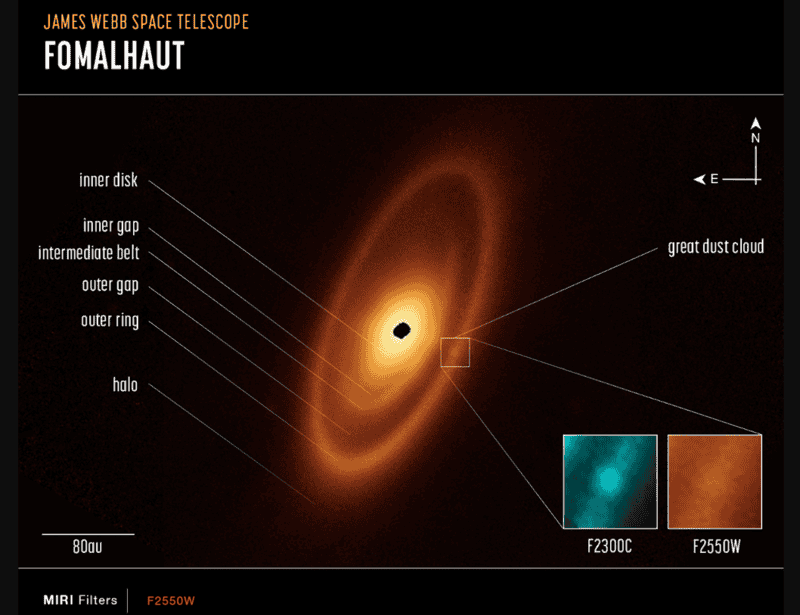
James Webb Space Telescope infographic of the Fomalhaut debris disk, a tilted orange ring with labelled inner disk, inner gap, intermediate belt, outer gap, outer ring and halo, plus a 80au scale bar and insets labelled F2300C and F2550W.
 
  • Like
  • Informative
Likes   Reactions: russ_watters, DennisN and berkeman
Astronomy news on Phys.org
This is a nice one Pandora's cluster. Bottom right quarter looks like lensing.

Deep-field astronomical image on black background with many small galaxies, several larger elliptical galaxies in clusters, and a bright star with diffraction spikes near the centre.
 
This yesterday. Barred spiral Galaxy.

Infrared image from the James Webb Space Telescope of gas tendrils and stars in the barred spiral galaxy NGC 5068, with a bright blue central region at upper left and dark dust lanes across the right side.
 
  • Like
  • Love
Likes   Reactions: Structure seeker, collinsmark, DennisN and 1 other person
pinball1970 said:
This was in universe today. Evidence of population 3 stars using data from JWST

https://arxiv.org/abs/2306.00953
Breaking news: Scientists find HeII in a galaxy at the edge of the universe!

Somebody hire me as a headline writer. I'll get you all the clicks.
 
  • Haha
  • Like
Likes   Reactions: Astranut and DennisN
Bandersnatch said:
Breaking news: Scientists find HeII in a galaxy at the edge of the universe!

Somebody hire me as a headline writer. I'll get you all the clicks.
" The very high EW(HeII) suggests that the putative PopIII
stars must have a top-heavy IMF reaching an upper mass
cutoff of at least 500 M⊙."

Anything over this presumably all hell would break loose?
 
  • Haha
  • Like
Likes   Reactions: Astranut, DennisN and BillTre
@Astranut drew my attention to this on X.
Infrared space telescope image of a star-forming region: bright red glowing jets and lobes of gas extend from a central young star against a blue nebula and a dense field of background stars.
 
Last edited by a moderator:
  • Like
  • Love
Likes   Reactions: DennisN, BillTre, collinsmark and 2 others
pinball1970 said:
https://webb.nasa.gov/content/webbL...31-23-STScI-01GZY2VJ33V4R0B7QKFEEQ72E1-1k.jpg

If you click on the link and get on image on the NASA site, you can zoom in closer (and closer and closer...)

Some descriptions what is going on with the lensing, dust, distances.


View attachment 330099
Here's a link to the NASA site with the expandable image:


[Edit: Actually, I see now it's not NASA's site directly, but is NASA's Flikr site. PF won't let me display the link text; it automatically embeds the media. Go ahead and click on it though to be taken to NASA's Flikr area.]
 
Last edited:
  • Like
Likes   Reactions: Astranut, pinball1970 and DennisN
mfb said:
There is a big question mark here. A galaxy-sized question mark, in fact, in the bottom center of the image.

View attachment 330193

Full picture at ESAWebb
Nice find! :biggrin:

I'm guessing it's some nebulosity within our own Milky Way Galaxy though. A new question mark shape, not to be confused with NGC 7822 (a different question mark).
 
  • Like
Likes   Reactions: pinball1970 and DennisN
https://www.nasa.gov/feature/goddard/2023/webb-reveals-new-structures-within-iconic-supernova

When I saw this image initially, I thought it looked blurred compared to the recent ring nebula images.

Infrared image of supernova remnant SN 1987A showing a bright glowing ring of material around a blue central core, surrounded by a faint reddish haze and scattered foreground stars.
However, with a quick check, the Ring Nebula is located a lot closer 2,567 ly and 1.3 ly across, whereas this supernova (SN 1987A) is 168,000 ly distant and 0.6 ly across.

Plus, there is a nice history with this image. https://en.wikipedia.org/wiki/SN_1987A

Neutrinos were observed on earth detectors few hours prior to the super nova according to the article.

Also within that link Hubble took images between 1994 and 2008 showing how it changed over time.

https://en.wikipedia.org/wiki/SN_19...7a_debris_evolution_animation_time_scaled.gif
 
Last edited:
  • Like
Likes   Reactions: Astranut, collinsmark, vanhees71 and 1 other person
A brand new video from the Royal Institution...
I haven't seen it myself yet, but I will.
I'm pretty sure it's good. 🙂

What has the James Webb Space Telescope discovered in its first year? – with Naomi Rowe-Gurney (14 September, 2023)


And there's also a Q&A here.
 
  • Like
  • Informative
Likes   Reactions: Astranut, pinball1970 and Tom.G
Webb with Chandra C.O. @Astranut (you can post these too fella!)
The detail is pretty stunning, an x-ray/IR combo.
UHZ1 Distant Galaxy and black hole.

Composite space image with purple X-ray glow over a field of galaxies; two inset panels labelled Chandra and JWST show a circled black hole and its host galaxy, with the label 'Chandra & JWST' in the corner.
 
Last edited:
  • Like
Likes   Reactions: DennisN, Astranut and berkeman
  • Like
Likes   Reactions: collinsmark, DennisN and Filip Larsen
This thread is two years old tomorrow!

Anyway, Cassiopeia A image by Webb.

Link with all the images here.

https://www.nasa.gov/missions/webb/nasas-webb-stuns-with-new-high-definition-look-at-exploded-star/

From the link.

“Embedded in this gas is a mixture of dust and molecules, which will eventually become components of new stars and planetary systems.
Some filaments of debris are too tiny to be resolved by even Webb, meaning they are comparable to or less than 10 billion miles across (around 100 astronomical units).
In comparison, the entirety of Cas A spans 10 light-years across, or 60 trillion miles.”

I had to read that twice to make sure I had not missed something, so if it is 10 billion miles across it is too small to be picked up by Webb. Given the exquisite detail it is easy to take for granted how enormous these structures are.

The article has a side by side with MIRI, below is a side by side with Hubble, see the difference in resolution/detail.

JWST 2023 HST 2016
Side-by-side comparison of the Cassiopeia A supernova remnant: left, a Webb image with dense gas and dust; right, a sharper view of pink filaments against a dark background with bright stars.
 
Last edited:
  • Like
  • Love
Likes   Reactions: collinsmark, BillTre, Astranut and 3 others
It is on the NASA front page image today.

Infrared image of Uranus showing its bright blue-white disk surrounded by a series of thin, faint concentric rings, with several small background stars against a dark sky.
 
  • Love
  • Like
Likes   Reactions: BillTre and DennisN