The k direction in a k.p model ?

Click For Summary
SUMMARY

The discussion centers on the k.p model of Gallium Nitride (GaN) as proposed by S. Chuang in "Phys. Rev. B, 54, 2491". The model utilizes an 8 by 8 Hamiltonian that incorporates the first order of k, specifically defined by the expressions for kx and ky. The user seeks clarification on how to express the direction of k along the path from the high symmetry point Γ to M in the context of the Hamiltonian. The response emphasizes the importance of understanding the little groups of the wavevector and ensuring the Hamiltonian's invariance under the corresponding transformations.

PREREQUISITES
  • Understanding of k.p models in solid-state physics
  • Familiarity with Hamiltonian mechanics in quantum mechanics
  • Knowledge of group theory as it applies to wavevectors
  • Basic concepts of reciprocal space and high symmetry points
NEXT STEPS
  • Research the little groups of the wavevector in the context of GaN
  • Study the implications of the 8 by 8 Kane model on electronic properties
  • Explore the derivation and application of the Hamiltonian in k.p models
  • Learn about the significance of high symmetry points in band structure calculations
USEFUL FOR

Physicists, materials scientists, and researchers working on semiconductor physics, particularly those focusing on the electronic properties of Gallium Nitride and related materials.

lichen1983312
Messages
85
Reaction score
2
I am trying to do some calculation based on a k.p model of GaN proposed by S. Chuang [Phys. Rev. B, 54, 2491]. It is a 8 by 8 Kane model with basis functions:
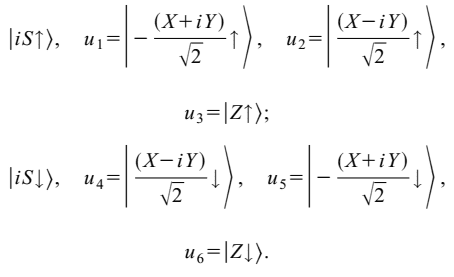
basis function.png

The 8 by 8 Hamiltonian contain first order of k is
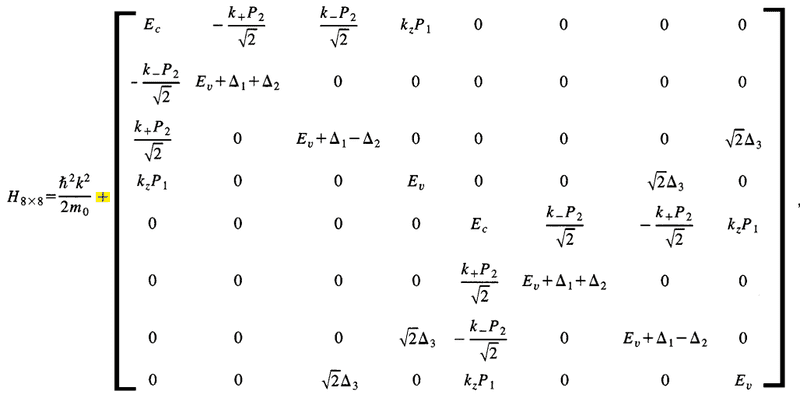
Hamiltonian 8by8.png

where ##{k_ \pm } = {k_x} \pm i{k_y}##

the reciprocal space and high symmetry points is pictures as [Phys. rev. B, 53, 10173]
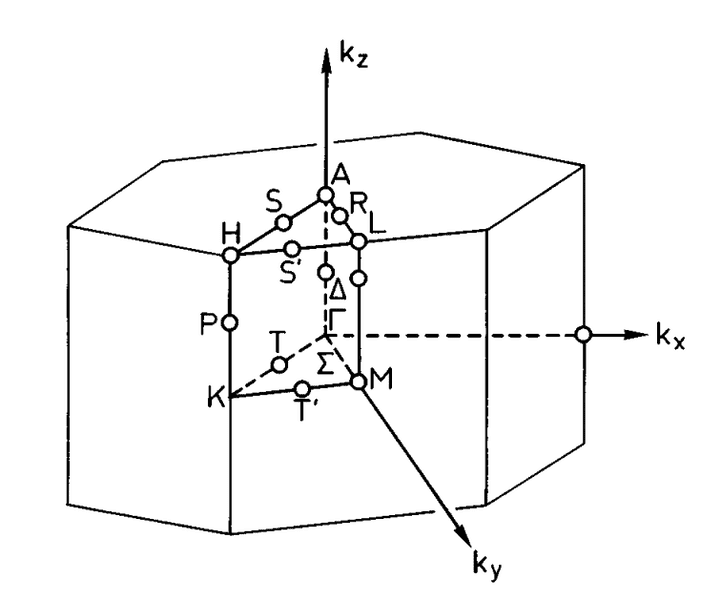
k-space.png


My question is: How is the direction of kx and ky defined in the 8 by 8 Hamiltonian?
Put is in another way. If I want to draw a E-k curve along ##\Gamma \to M##, how do I express this direction in terms of kx and ky ?
Thanks very much, please help.
 

Attachments

  • basis function.png
    basis function.png
    5.2 KB · Views: 1,101
  • k-space.png
    k-space.png
    14.1 KB · Views: 759
  • Hamiltonian 8by8.png
    Hamiltonian 8by8.png
    12.7 KB · Views: 1,206
Physics news on Phys.org
##k=(0,\lambda,0)^T## with ##\lambda=0## corresponding to ##\Gamma## and ##\lambda=k_\mathrm{M}## corresponding to M?
 
DrDu said:
##k=(0,\lambda,0)^T## with ##\lambda=0## corresponding to ##\Gamma## and ##\lambda=k_\mathrm{M}## corresponding to M?
Thanks
That is what is said in the graph, which is taken from a different article.

But if I only look at the Hamitonian and the basis functions, how can I tell?
 
##\Gamma##, M , ##\Sigma##, means that the hamiltonian is invariant under a specific group of rotations and reflections, respectively, which also leave k invariant. These groups are called the "little groups of the wavevector". This are sub groups of the point group under which ##\Gamma## is invariant. Look up which elements they contain in case of the Point Group of GaN and make sure that for the coice of k, your Hamiltonian is invariant under the corresponding transformations.
 
DrDu said:
##\Gamma##, M , ##\Sigma##, means that the hamiltonian is invariant under a specific group of rotations and reflections, respectively, which also leave k invariant. These groups are called the "little groups of the wavevector". This are sub groups of the point group under which ##\Gamma## is invariant. Look up which elements they contain in case of the Point Group of GaN and make sure that for the coice of k, your Hamiltonian is invariant under the corresponding transformations.
Thanks very much, I will look into it.
 

Similar threads

  • · Replies 2 ·
Replies
2
Views
3K
  • · Replies 1 ·
Replies
1
Views
4K
  • · Replies 1 ·
Replies
1
Views
5K
  • · Replies 6 ·
Replies
6
Views
21K
Replies
24
Views
8K
  • · Replies 19 ·
Replies
19
Views
18K