The Lagrangian for a piece of toast falling over the edge of a table

Click For Summary
SUMMARY

The discussion focuses on deriving the Lagrangian for a piece of toast falling off a table, modeled as a rectangle with homogeneous mass distribution. The kinetic energy is expressed as $$T = \frac{1}{2}m\dot s^2 + \frac{1}{24}ml^2\dot\theta^2 + s^2\dot\theta^2$$, while the potential energy is $$V = -mg s\cos(\theta)$$. The resulting Lagrangian is $$L = \frac{1}{2}m\dot s^2 + \frac{1}{24}ml^2\dot\theta^2 + ms^2\dot\theta^2 + mg s \cos(\theta)$$. The equations of motion derived from this Lagrangian are $$2s\dot\theta^2 + g \cos\theta = \ddot s$$ and $$l^2\ddot\theta + 48 s \dot s \dot\theta + 24s^2\ddot\theta + 12 gs\sin\theta = 0$$.

PREREQUISITES
  • Understanding of Lagrangian mechanics
  • Familiarity with kinetic and potential energy concepts
  • Knowledge of numerical methods for solving differential equations
  • Proficiency in using Mathematica for symbolic computation
NEXT STEPS
  • Explore the application of the parallel axis theorem in rotational dynamics
  • Learn about numerical integration techniques for solving ordinary differential equations
  • Investigate the stability of dynamic systems using Lagrangian mechanics
  • Study the implications of moment of inertia in complex systems
USEFUL FOR

Physicists, mechanical engineers, and students studying dynamics and Lagrangian mechanics, particularly those interested in modeling and simulating physical systems.

Markus Kahn
Messages
110
Reaction score
14
Homework Statement
The ultimate goal is to find the equations of motion for a piece of toast falling from a table.
Relevant Equations
Euler-Lagrange equations.
First of all, disclaimer: This isn't an official assignment or anything, so I'm not even sure if there is a resonably simple solution.

Consider the following sketch.
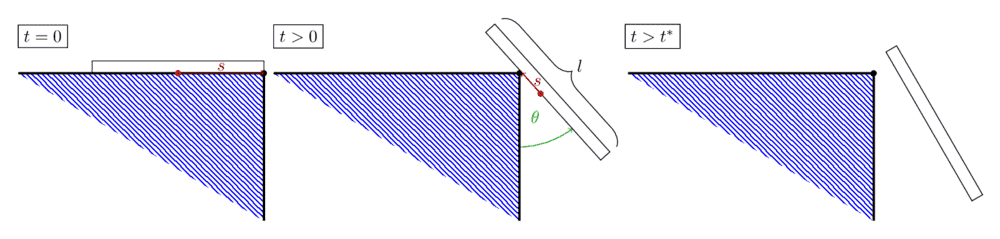
241363

(Forgive me if it isn't completely clear, I didn't want to fiddle around for too long with tikz...)

Let us assume that we can approximate a piece of toast as a rectangle with homogenous mass distribution ##m## and length ##l##. We further assume that for ##t=0## the toast has velocity in positive ##x## direction. We can describe the system over the two generalized coordinates ##s## and ##\theta##, where ##s## gives the distance from the center of mass to the coordinate frame center (let us for now assume that the toast is infinitely thin... Not sure if this is necessary though) and ##\theta## beeing the angle between the toast and the ##y## axis. We can then write for the center of mass
$$\vec{x}_p = s(t)\begin{pmatrix}\sin(\theta(t))\\-\cos(\theta(t))\end{pmatrix}.$$
We find therefore for the kinetic and potential energy
$$T=\frac{1}{2}m\dot{x}_p^2 = \frac{1}{2}m (\dot s ^2 + s^2\dot \theta^2)\quad\text{and}\quad V=-mg s\cos(\theta),$$
which therefore would result in the following Lagrange function
$$L = \frac{1}{2} m (2 g \cos(\theta(t)) s(t) + \dot s(t)^2 +
s(t)^2 \dot \theta (t)^2).$$
Is this correct up until here? Finding the eom's isn't really a problem if this is correct..

PS: the third picture should just indicate that one can find ##t^*## with the condition ##(\ddot{x_p})_x\overset{!}{=}0## for which the toast loose its contact to the table.
 
Last edited by a moderator:
Physics news on Phys.org
Your kinetic energy is not correct. You are missing the moment of inertia around the center of mass.
 
Thanks, completely forgot about that part... In that case we have
$$T= \frac{1}{2}m (\dot s ^2 + s^2\dot \theta^2)+ \frac{1}{2}I_{(0,0)} \dot\theta^2,$$
where ##I_{(0,0)}## is the moment of inertia in respect to the center of the coordinate frame. With the parallel axis theorem we have
$$I_{(0,0)} = \frac{1}{12}ml^2 + ms^2\Longrightarrow T = \frac{1}{2}m\dot s^2 + \frac{1}{24}ml^2\dot\theta^2 + s^2\dot\theta^2 .$$
 
I do not think that the solution to corresponding Lagrange equations is available in closed form
 
Me neither, so I just decieded to try it numerically but I'm already running into problems.. Mainly due to the fact that the condition I wanted to use to determine ##t^*## doesn't really lead to anything. If I calculate the second derivative of the ##x##-component of ##x_p## I get
$$(\ddot{x}_p)_x = \sin(\theta(t)) (\ddot s(t) - s(t) \dot\theta(t)^2) + \cos(\theta(t)) (2 \dot s(t) \dot\theta(t) + s(t)\ddot\theta(t))\overset{!}{=}0 $$
but Mathematica tells me that there are no zero values for this function (for the numerical solutions I obtained..)
 
Alright, I'm doing something wrong and I can't figure out what it is.. As established above the Lagrangian is given by
$$L = \frac{1}{2}m\dot s^2 + \frac{1}{24}ml^2\dot\theta^2 + ms^2\dot\theta^2 + mg s \cos(\theta) . $$
We therefore have
$$
\begin{align*}
\frac{\partial L}{\partial s} &= 2s\dot\theta ^2m + mg\cos\theta&\quad \frac{\partial L}{\partial\dot s} &= m\dot s & \quad \frac{\partial L}{\partial \theta} &= -mgs \sin\theta &\quad \frac{\partial L}{\partial\dot \theta} &= \frac{1}{12}ml^2\dot\theta + 2ms^2\dot\theta.
\end{align*}
$$
We can now go on and calculate
$$
\begin{align*}
\frac{d}{dt} \frac{\partial L}{\partial \dot s}&= m\ddot s\\
\frac{d}{dt} \frac{\partial L}{\partial \dot \theta}&= \frac{1}{2}ml^2\ddot \theta + 2m \frac{d}{dt}(s^2\dot\theta) = \frac{1}{2}ml^2\ddot \theta + 2m(2s\dot s \dot \theta +s^2\ddot\theta) = \frac{1}{2}ml^2\ddot \theta +4s\dot s \dot\theta + 2ms^2\ddot\theta
\end{align*}
$$
We therefore get the two eom's
$$
\begin{align*}
2s\dot\theta^2 +g \cos\theta &=\ddot s \\
l^2\ddot\theta + 48 s \dot s \dot\theta + 24s^2\ddot\theta + 12 gs\sin\theta &=0
\end{align*}
$$
Solving this numerically isn't really an issue and plotting the trajectory with inital values
$$s(0)=l/2,\quad \dot s(0)= 0.3,\quad u(0)= \pi /2,\quad \dot u(0)= -0.1$$
gives
241412

and if I plot ##(\ddot x_p)_x## I get this (cannot upload second image directly...). I don't really see how this can be.. At some point ##(\ddot x_p)_x## needs to be zero for the bread to lose contact to the table, but apparently this doesn't happen.. Can someone explain this?
 

Attachments

  • ddot_x.png
    ddot_x.png
    7 KB · Views: 320
  • ddot_x.png
    ddot_x.png
    7 KB · Views: 376

Similar threads

Replies
6
Views
2K
  • · Replies 6 ·
Replies
6
Views
3K
Replies
6
Views
3K
  • · Replies 4 ·
Replies
4
Views
3K
  • · Replies 11 ·
Replies
11
Views
3K
  • · Replies 21 ·
Replies
21
Views
5K
  • · Replies 9 ·
Replies
9
Views
3K
  • · Replies 11 ·
Replies
11
Views
2K
  • · Replies 10 ·
Replies
10
Views
6K
Replies
5
Views
2K