Discussion Overview
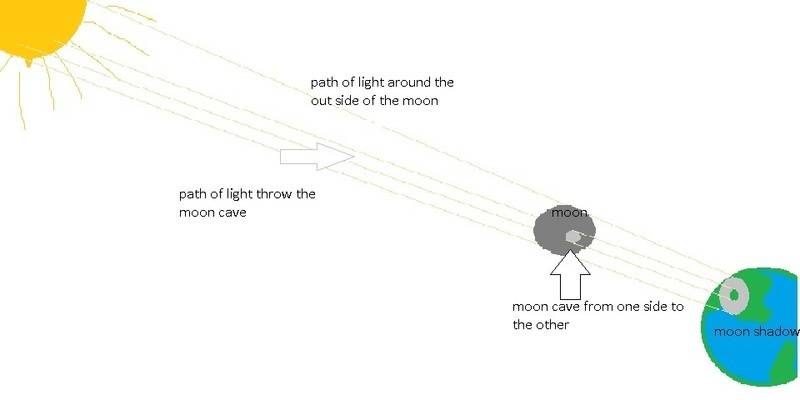
The discussion revolves around a hypothetical scenario involving light behavior during a solar eclipse, specifically considering the effects of a cave through the moon and the bending of light around the moon due to its mass. Participants explore the implications of these phenomena on the timing of light reaching Earth.
Discussion Character
- Exploratory
- Conceptual clarification
- Debate/contested
Main Points Raised
- One participant questions which light would reach the planet first: the light passing through a hypothetical cave in the moon or the light bending around it, noting that the time difference would be minimal.
- Another participant explains that the question is complex and cannot be easily answered at a basic level, citing two effects: the curvature of space due to the moon's mass and gravitational redshift affecting light travel times.
- This participant suggests that the light bending around the moon may take longer due to a longer path, while the light passing through the cave may be delayed more due to deeper gravitational effects, but emphasizes that detailed calculations are necessary to determine the overall impact.
- One participant expresses appreciation for the explanation provided, highlighting the importance of understanding general physics concepts for younger learners.
- Another participant suggests that a drawing tool for diagrams in replies would enhance understanding for those struggling with complex descriptions.
- A further participant agrees that such a tool would be beneficial, particularly for visualizing mathematical coordinates and equations.
Areas of Agreement / Disagreement
Participants express varying opinions on the effects of light travel in the scenario, with no consensus reached on which light would arrive first. The discussion remains unresolved regarding the relative impacts of the two effects mentioned.
Contextual Notes
The discussion includes assumptions about the effects of gravitational redshift and space curvature, which are not fully explored or quantified. The need for detailed mathematical analysis is acknowledged but not provided.