The Mystery of Ideal Miller Integrator: Formula Breakdown and Analysis

  • Thread starter Thread starter ntetlow
  • Start date Start date
Click For Summary

Discussion Overview

The discussion revolves around the analysis of an ideal Miller integrator, specifically focusing on the derivation of the formula for the output voltage \( V_2 \) in relation to the input current \( I_I \). Participants are exploring circuit analysis techniques, including nodal analysis and the implications of feedback in the circuit design.

Discussion Character

  • Technical explanation
  • Debate/contested
  • Mathematical reasoning

Main Points Raised

  • One participant requests clarification on how the formula \( \frac{V_2}{I_I} \) is derived, indicating difficulty with nodal analysis.
  • Another participant suggests writing the equation using the traditional differential equation for capacitors, questioning if the confusion lies in the s-domain representation.
  • A participant expresses uncertainty about the specific aspects of the circuit that are confusing, prompting others to share their background knowledge in circuit analysis.
  • One participant challenges the characterization of the integrator as "ideal," stating that this only holds theoretically when the gain \( K_v \) approaches infinity.
  • Another participant shares their confusion regarding the equation \( V_2/I_I = -K/(1+KSC) \) and the elimination of resistance \( R_1 \) from their analysis.
  • Several participants request additional circuit details, including schematics and netlists, to facilitate understanding and discussion.
  • One participant suggests replacing \( I_I \) with a sine wave input for clarity in simulation, while another mentions Thevenin/Norton transformations as a potential next step in analysis.
  • A participant points out discrepancies in feedback polarity between different schematics shared in the thread, highlighting the importance of accuracy in circuit representation.
  • Another participant warns against accepting online circuit examples without skepticism, citing a specific example that may not be valid for the discussed circuit.

Areas of Agreement / Disagreement

Participants do not appear to reach consensus on the characterization of the Miller integrator or the validity of certain equations. Multiple competing views and uncertainties remain regarding the analysis methods and circuit details.

Contextual Notes

Participants express limitations in their understanding of nodal analysis and circuit feedback, and there are unresolved questions regarding the implications of different circuit configurations and assumptions about ideal behavior.

ntetlow
Messages
21
Reaction score
2
Hello,
attached is a screenshot showing a schematic of an ideal miller integrator. Can anyone describe how the formula for V2/II is arrived at, can't work it out thru nodal analysis myself. Thanks in advance.
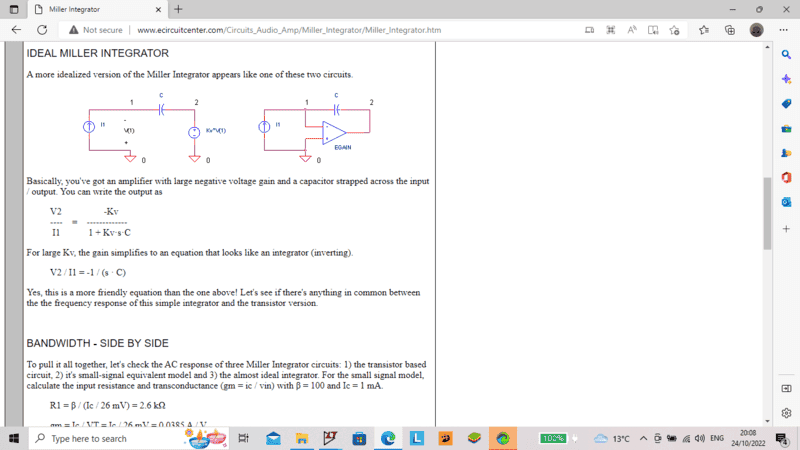
Screenshot (10).png
 
Last edited by a moderator:
Engineering news on Phys.org
Can you write the equation for ##\frac{V_2}{I_I}## using the traditional differential equation for the current and voltage for a capacitor? Is it just the s-domain part that is confusing for you?
 
It's hard to know how to respond without knowing what part is confusing you or what your background knowledge in circuit analysis is. Try your nodal analysis and post it, then we'll know more about what to say.
 
It is not an "ideal" Miller integrator. This would only be the case (theoretically) for Kv approaching infinity.
 
  • Like
Likes   Reactions: berkeman
it's how you get to the equation V2/II= -K/(1+KSC) where I'm confused.
Analysis gives II = V/R1 + (V1 - V2),S,C where V is the voltage over R1.
Also V2 = V1.K.
In order to get the right equation from the above I'd have to eliminate R1 which I cant.
 
ntetlow said:
(V1 - V2),S,C
What does this mean?

ntetlow said:
V is the voltage over R1.
Show us the circuit with RI (and all the other stuff).
 
  • Like
Likes   Reactions: berkeman
attached is screenshot of the spice netlist for the schematics in the URL Under "ideal integrator" you will see RIN (sorry, I've called it R1). It is the resistance under the number 1 in the first screenshot that is not shown.
Screenshot (19).png
 
ntetlow said:
attached is screenshot of the spice netlist for the schematics in the URL Under "ideal integrator"
Can you switch to schematic view and take a screenshot of that? Thanks.
 
Attached is the ltspice schematic as per the netlist. I think it will be easier understanding if II is replaced by say SINE (0 1 1000).
Screenshot (20).png
 
  • #10
ntetlow said:
I think it will be easier understanding if II is replaced by say SINE (0 1 1000).
OK thanks. Yes, or you can just leave it as an independent variable ##Il##.

Do you know about Thevenin/Norton transformations for sources yet? That would be my next step. But, if not, that's OK too.

So, this is just a network solution like the others you've done in the past. Define all of the stuff you need to make your node and loop equations (all of the currents and node voltages). Write them all down, loops of voltages for KVL, nodes with currents for KCL and show us that. After that you'll simplify/solve a set of equations.
 
  • #11
The schematic you show in post #9 (your simulation) does not represent the schematic in post #1.

Please pay attention to the feedback polarity, one of them shows Positive feedback, the other shows Negative feedback.

Cheers,
Tom

p.s. A few decades ago, the standards changed for the position of the "+" and "-" inputs of op-amps, especially in simulation programs. The transition for us engineers was, shall we say, painful!
 
  • Like
Likes   Reactions: berkeman
  • #12
Attached is a screenshot showing my workings out so far. I cannot get the correct answer from these, however.
Screenshot (21).png
 
Last edited by a moderator:
  • #13
ntetlow said:
attached is a screenshot showing a schematic of an ideal miller integrator. Can anyone describe how the formula for V2/II is arrived at, can't work it out thru nodal analysis myself

Be skeptical of things you find online because they could be wrong

like this example http://www.ecircuitcenter.com/Circuits_Audio_Amp/Miller_Integrator/Miller_Integrator.htm

Circuit-13.jpg

$$\text{If}~~~~\frac {V_2}{I}=\frac {-k}{1+ksc} ~~~~~~~~~~~\text{then}~~~V_2=-kI~~~~~~\text{when}~~c=0 $$

$$\text{But for this circuit, this conclusion is obviously not valid}$$
 
Last edited:

Similar threads

  • · Replies 9 ·
Replies
9
Views
2K
  • · Replies 9 ·
Replies
9
Views
2K
  • · Replies 13 ·
Replies
13
Views
3K
  • · Replies 2 ·
Replies
2
Views
2K
  • · Replies 15 ·
Replies
15
Views
4K
  • · Replies 7 ·
Replies
7
Views
2K
Replies
21
Views
6K
Replies
4
Views
3K
Replies
9
Views
5K