The power spectrum of Poisson noise

Click For Summary

Discussion Overview

The discussion revolves around the power spectrum of Poisson noise, specifically addressing concerns about the observed high power at zero frequency and the overall shape of the spectrum. Participants explore the implications of DC offsets and data structure on the power spectrum, as well as computational considerations when using FFT.

Discussion Character

  • Technical explanation, Debate/contested, Experimental/applied

Main Points Raised

  • One participant expresses confusion over the high power at zero frequency in their power spectrum of Poisson noise with an expected value of λ=2.
  • Another participant identifies a significant DC offset in the data, suggesting it should average close to zero to eliminate the zero frequency power.
  • A participant asks if it is acceptable to replace the power at zero frequency with zero, to which another participant agrees and suggests a flat spectrum is expected.
  • Further advice is given regarding the structure of the input data, with a suggestion to increase the number of points and pulses for better detail in the spectrum.
  • Participants discuss the use of FFT for spectrum computation, noting that using an even number of input data cells can optimize computation speed.

Areas of Agreement / Disagreement

There is no clear consensus on the correct shape of the power spectrum or the best approach to address the high power at zero frequency. Multiple viewpoints regarding the handling of DC offsets and data structure remain present.

Contextual Notes

Limitations include uncertainty about the structure of the input data and the effects of DC offsets on the power spectrum. The discussion does not resolve the mathematical implications of these factors.

arcTomato
Messages
104
Reaction score
27
TL;DR
Poisson noise
Dear all.
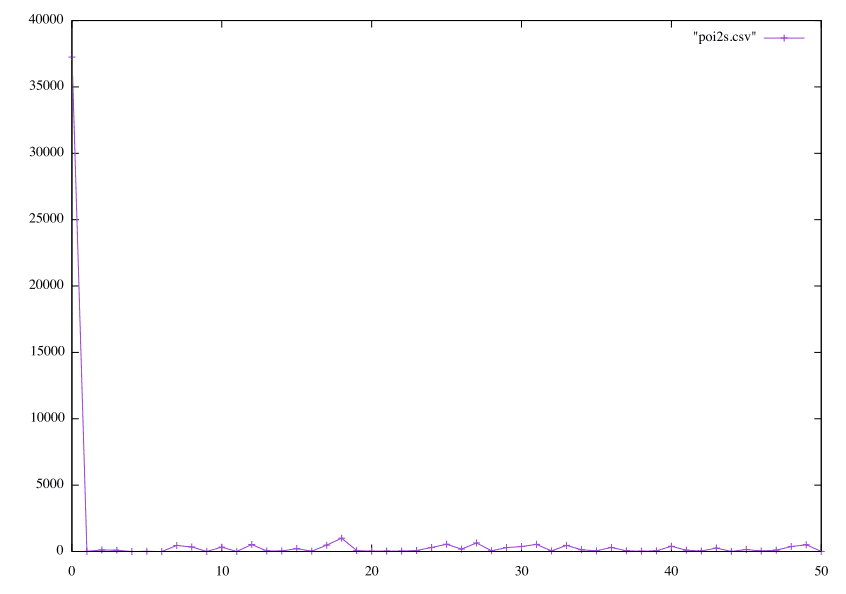
I have made the power spectrum of Poisson noise(expected value ##λ=2##), and it becomes like this
1575036752663.png

I think this is not good. I don't know why the power is so high when Random variable(x axis) is 0.
I tried another expected value version ,but the result didn't change.
so I would like to know the correct shape of the power spectrum of Poisson noise.
If you can help me, please🙇‍♂️
Thank you.
 
Engineering news on Phys.org
There is a huge DC offset in your data.
It needs to average close to zero to eliminate the zero frequency power.
 
Thanks @Baluncore!
Can I just replace the power with zero?like this?
1575038809288.png
 
Yes.
I would expect a flat spectrum.
 
Thank you @Baluncore!
If you don't mind, Could you teach me why does it happen? or show me some links?
 
You use auto-scale, so the huge DC offset attenuated the data.
I do not know the structure of your input data. I expect it is randomly located positive pulses?

You should increase the number of points and the number of pulses to get better detail.
You might plot several on the same graph to see any repeated pattern.
You might accumulate the power spectrum to average out the structure of the spectrum.

Google “shot noise spectrum”.
 
  • Like
Likes   Reactions: arcTomato
yes I used this data.
1575040102032.png

I appreciate for your kindness,@Baluncore !
 
If you use an FFT to compute the spectrum you should have 2integer input data cells to get the optimum speed of computation. I would start with 1024 points, giving 512 frequencies.
 
  • Like
Likes   Reactions: arcTomato

Similar threads

  • · Replies 19 ·
Replies
19
Views
3K
  • · Replies 1 ·
Replies
1
Views
2K
  • · Replies 10 ·
Replies
10
Views
2K
  • · Replies 7 ·
Replies
7
Views
3K
  • · Replies 0 ·
Replies
0
Views
2K
  • · Replies 6 ·
Replies
6
Views
3K
  • · Replies 21 ·
Replies
21
Views
4K
  • · Replies 15 ·
Replies
15
Views
2K
  • · Replies 7 ·
Replies
7
Views
4K
  • · Replies 1 ·
Replies
1
Views
2K