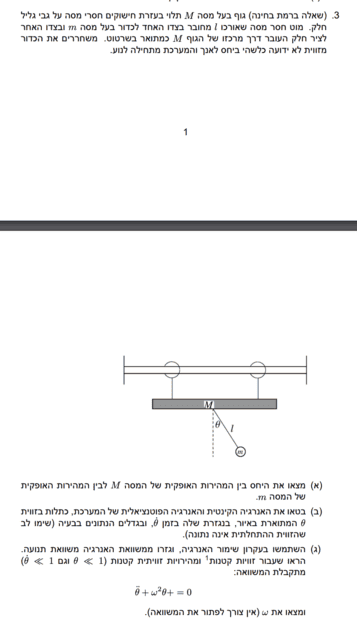
The ratio between two horizontal speeds in this pendulum arrangement

Click For Summary
The discussion focuses on deriving the torque equations for a pendulum system based on the forces acting on it. The user understands the normal force and tension equations but struggles with formulating the torque equations. Another participant requests clarification on the setup and asks for the text from an attachment to better assist. The conversation highlights the need for clear communication of the pendulum's configuration to facilitate problem-solving. Overall, the thread emphasizes the importance of understanding both forces and torques in analyzing pendulum dynamics.
billtodd
Messages
136
Reaction score
33
Homework Statement
To find the ratio between the horizontal speed of the stick with mass ##M## and the small point with mass ##m##.
Relevant Equations
Force equation and torque.
From the forces equation I can only understand from it that the forces' equations are:##N=Mg## and ##T\sin \theta=m\ell \ddot{\theta}##.

But I don't know how to find the Torques' equations.

Any help is appreciated.


N=Mg ##Tcos⁡θ+N=mg
צילום מסך 2024-03-24 ב-11.55.30.png
 
Physics news on Phys.org
Could you please type out the text from your attachment, and explain that setup? Thanks.
 
  • Like
Likes Vanadium 50 and kuruman
The book claims the answer is that all the magnitudes are the same because "the gravitational force on the penguin is the same". I'm having trouble understanding this. I thought the buoyant force was equal to the weight of the fluid displaced. Weight depends on mass which depends on density. Therefore, due to the differing densities the buoyant force will be different in each case? Is this incorrect?

Similar threads

  • · Replies 24 ·
Replies
24
Views
2K
Replies
1
Views
1K
  • · Replies 20 ·
Replies
20
Views
2K
  • · Replies 9 ·
Replies
9
Views
2K
Replies
2
Views
2K
Replies
3
Views
449
Replies
46
Views
4K
  • · Replies 1 ·
Replies
1
Views
911
  • · Replies 21 ·
Replies
21
Views
3K
Replies
6
Views
2K