The uncertainty principle in quantum gravity

Click For Summary
SUMMARY

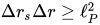
The discussion centers on the role of the uncertainty principle in quantum gravity, specifically its application at the Planck scale. The uncertainty principle, akin to Heisenberg's uncertainty principle, relates momentum and coordinate measurements, incorporating constants such as the gravitational constant, body mass, speed of light, and reduced Planck constant. This formulation suggests the emergence of phenomena like virtual black holes and wormholes, also referred to as quantum foam, at the Planck scale. The conversation highlights ongoing speculation regarding the fundamental significance of the Planck length in quantum gravity theories.

PREREQUISITES
  • Understanding of Heisenberg's uncertainty principle
  • Familiarity with Planck scale physics
  • Knowledge of gravitational constants and their implications
  • Basic concepts of quantum gravity theories
NEXT STEPS
  • Research the implications of the Planck length in quantum gravity theories
  • Study the relationship between momentum and coordinate measurements in quantum mechanics
  • Explore the concept of quantum foam and its significance in theoretical physics
  • Investigate the role of virtual black holes in modern physics
USEFUL FOR

Physicists, researchers in quantum gravity, and students of theoretical physics seeking to understand the implications of the uncertainty principle at the Planck scale.

Bure
Messages
1
Reaction score
0
The main role in quantum gravity can be played by the uncertainty principle
{\displaystyle \Delta r_{s}\Delta r\geq \ell _{P}^{2}}
, where
r_{s}
is the gravitational radius,
r
is the radial coordinate,
\ell _{P}
is the Planck length. This uncertainty principle is another form of Heisenberg's uncertainty principle between momentum and coordinate as applied to the Planck scale. Indeed, this ratio can be written as follows:

{\displaystyle \Delta (2Gm/c^{2})\Delta r\geq G\hbar /c^{3}}
, where
G
is the gravitational constant,
m
is body mass,
c
is the speed of light,
\hbar
is the reduced Planck constant. Reducing identical constants from two sides, we get the Heisenberg's uncertainty principle

{\displaystyle \Delta (mc)\Delta r\geq \hbar /2}
. Uncertainty principle
{\displaystyle \Delta r_{s}\Delta r\geq \ell _{P}^{2}}
predicts the appearance of virtual black holes and wormholes (quantum foam) on the Planck scale.
Is such a form of Heisenberg's uncertainty principle possible?
 
Physics news on Phys.org
Bure said:
This uncertainty principle is another form of Heisenberg's uncertainty principle between momentum and coordinate as applied to the Planck scale.

I don't see how since ##r_s## is not a momentum.

It's a common speculation that the Planck length will play some fundamental role in quantum gravity theory, but right now that's all it is, a speculation.
 

Similar threads

  • · Replies 6 ·
Replies
6
Views
4K
  • · Replies 21 ·
Replies
21
Views
2K
  • · Replies 8 ·
Replies
8
Views
2K
  • · Replies 6 ·
Replies
6
Views
3K
  • · Replies 5 ·
Replies
5
Views
3K
  • · Replies 4 ·
Replies
4
Views
4K
  • · Replies 2 ·
Replies
2
Views
2K
  • · Replies 36 ·
2
Replies
36
Views
9K
  • · Replies 3 ·
Replies
3
Views
2K
  • · Replies 31 ·
2
Replies
31
Views
4K