The voltage between two points

Click For Summary

Discussion Overview

The discussion revolves around understanding the voltage difference in an electrical circuit containing three resistors and a battery connected in series, particularly focusing on the voltage reading between a ground point and the positive terminal of the battery. Participants explore concepts related to voltage measurement, circuit configuration, and the implications of grounding.

Discussion Character

  • Exploratory, Technical explanation, Debate/contested, Conceptual clarification

Main Points Raised

  • Some participants question why the voltage difference between the ground point and the positive terminal of the battery is not 10 volts, suggesting that the voltmeter reading should reflect the battery voltage.
  • Others propose that the voltage reading is affected by the voltage drops across the resistors in the circuit, referencing Kirchhoff's voltage law and the concept of a voltage divider.
  • One participant emphasizes that the ground point's relevance is questionable, arguing that the voltage measurement is only valid across components directly connected in the circuit.
  • Another participant mentions the need for a schematic to clarify the circuit configuration and component values, indicating that without this information, understanding the voltage readings is challenging.
  • Some participants express confusion over the terminology used, particularly regarding the identification of points in the circuit, and the implications of measuring voltage between arbitrary points.
  • There are suggestions for calculating current and voltage drops across individual resistors using Ohm's law, indicating a more analytical approach to the problem.

Areas of Agreement / Disagreement

Participants do not reach a consensus on the voltage readings or the relevance of the ground point. Multiple competing views remain regarding the interpretation of the circuit and the implications of grounding on voltage measurements.

Contextual Notes

Participants highlight the importance of circuit context and component arrangement in understanding voltage readings. There is an acknowledgment that assumptions about grounding and circuit completeness can significantly affect interpretations.

Who May Find This Useful

This discussion may be useful for individuals interested in electrical engineering, circuit analysis, and the principles of voltage measurement in series circuits.

dev_maghraby
Messages
2
Reaction score
0
TL;DR
An electrical circuit with three resistors and a battery connected in series. After the first two resistors, there is a point connected to the ground. Why is the voltage difference between the ground point and the positive of the battery not 10 volts?
In electrical circuit there are three resistors and a battery connected in series. After the first two resistors, there is a point connected to the ground. Why is the voltage difference between the ground point and the positive of the battery not 10 volts?

In that circuit, I think that the voltage of point B is 0 volts because it is touching the ground, and also the voltage of point S is 10 volts because it is connected directly to the battery, but why is the voltmeter reading not equal to 10 volts What is the difference between the voltage of points S and B?
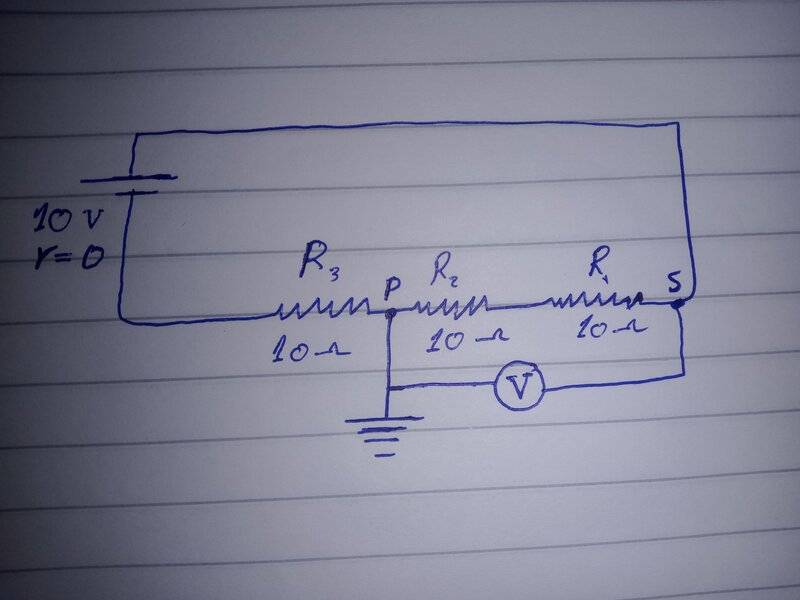
IMG20240412081310.jpg
 
Last edited:
Physics news on Phys.org
dev_maghraby said:
TL;DR Summary: An electrical circuit with three resistors and a battery connected in series. After the first two resistors, there is a point connected to the ground. Why is the voltage difference between the ground point and the positive of the battery not 10 volts?

In electrical circuit there are three resistors and a battery connected in series. After the first two resistors, there is a point connected to the ground. Why is the voltage difference between the ground point and the positive of the battery not 10 volts?
IDK, why isn't it 137V? 4V? -17V? How would we know?
Schematic please, with component values. You can just draw it on paper, take a (readable) photo and post it.
Seriously, reread your question and consider if it's understandable. We are not clairvoyant.

'They' say there's no bad questions... 'They' didn't see this one, I guess.
 
  • Like
Likes   Reactions: davenn and phinds
DaveE said:
IDK, why isn't it 137V? 4V? -17V? How would we know?
Schematic please, with component values. You can just draw it on paper, take a (readable) photo and post it.
Seriously, reread your question and consider if it's understandable. We are not clairvoyant.

'They' say there's no bad questions... 'They' didn't see this one, I guess.
I have edited and added details.
 
Given the exact drawing you have presented, the 10v reading does not make any sense, BUT ... without context, it is impossible to say that the drawing does or does not represent the "normal" assumption that the negative side of a power source is connected to ground.

If it is indeed a battery, then no connection to ground should be assumed and, as I said, the 10v reading would make no sense since the connection to ground is not part of any complete circuit and therefore has no current flowing through it.
 
phinds said:
Given the exact drawing you have presented, the 10v reading does not make any sense, BUT ... without context, it is impossible to say that the drawing does or does not represent the "normal" assumption that the negative side of a power source is connected to ground.

If it is indeed a battery, then no connection to ground should be assumed and, as I said, the 10v reading would make no sense since the connection to ground is not part of any complete circuit and therefore has no current flowing through it.
The ground symbol in schematics is an arbitrary name for a circuit node. If there is only one drawn then it is meaningless.
 
  • Like
Likes   Reactions: davenn
dev_maghraby said:
I have edited and added details.
Excellent, thank you!

The battery will cause current to flow through the resistors. Each resistor will have a voltage drop across it according to Ohm's law. Kirchhoff's voltage law says that the voltages around any loop must sum to zero. Your voltmeter isn't measuring just the battery voltage, it's measuring the battery voltage minus the voltage across R3, which, by KVL, is also equal to the sum of the voltages across R1 and R2. This circuit is often called a "voltage divider", if you want to search for more info.

So,
step 1 : What is the current flowing around that circuit loop?
step 2 : What is the voltage across each of the resistors due to that current flow?

There are some excellent tutorial videos at Khan Academy, check those out.
 
@DaveE, I am confused. You show skepticism of my reply and then you give the same reply. Huh?
 
phinds said:
@DaveE, I am confused. You show skepticism of my reply and then you give the same reply. Huh?
Sorry, I misunderstood your reply, I think. I'll undo it.
"the same reply"... Not exactly.
 
  • Like
Likes   Reactions: phinds
dev_maghraby said:
I have edited and added details.
I can't see any points A and B . . . . . yet.

Voltage is Potential Difference; the difference on potential between two points. Any chosen point on a circuit has no 'Volts' until referred to another point.
 
  • #10
sophiecentaur said:
I can't see any points A and B . . . . . yet.

Voltage is Potential Difference; the difference on potential between two points. Any chosen point on a circuit has no 'Volts' until referred to another point.
I think that's covered by
dev_maghraby said:
but why is the voltmeter reading not equal to 10 volts
 
  • #11
phinds said:
I think that's covered by
Some things require a lot of repetition. water dripping on a stone.
 
  • Like
Likes   Reactions: phinds
  • #12
dev_maghraby said:
TL;DR Summary: An electrical circuit with three resistors and a battery connected in series. After the first two resistors, there is a point connected to the ground. Why is the voltage difference between the ground point and the positive of the battery not 10 volts?
The ground point is irrelevent - have it there, remove it, the voltage isnt going to change
why isnt it 10V .... because the voltmeter ISNT directly across the battery -
and that is the ONLY place you will measure 10V difference

dev_maghraby said:
In that circuit, I think that the voltage of point B is 0 volts because it is touching the ground,

I assume you meant point "P" not "B" as there is no "B"
again, irrelevent as nothing else anywhere else in the circuit is commected to ground

dev_maghraby said:
and also the voltage of point S is 10 volts because it is connected directly to the battery,

No, as the other side of the meter ISNT connected to the other side of the battery

again, between "P" and "S" cannot read 10V because of the voltage drop in the resistors

Did you check out that link suggested by @DaveE

as a hint make the circuit easier .... combine R1 and R2 10Ω + 10Ω = 20Ω
so now you have 10Ω + 20Ω in series = 30Ω in total

Knowing that now you can use Ohms Law to work out the current flowing

I = V / R total =

and from that the individual voltage drops across the 20 and 10 Ohm resistors

circuit.GIF


Questions for you to answer.....

1) what is the current flowing in the circuit?
2) what is the voltage on the voltmeter across the battery ?
3) what is the voltage across the 20 Ohm resistor ?
4) what is the voltage across the 10 Ohm resistor

see how ya go
 

Similar threads

  • · Replies 21 ·
Replies
21
Views
4K
  • · Replies 5 ·
Replies
5
Views
2K
  • · Replies 58 ·
2
Replies
58
Views
5K
  • · Replies 7 ·
Replies
7
Views
2K
  • · Replies 3 ·
Replies
3
Views
2K
  • · Replies 11 ·
Replies
11
Views
1K
  • · Replies 7 ·
Replies
7
Views
2K
  • · Replies 8 ·
Replies
8
Views
3K
  • · Replies 1 ·
Replies
1
Views
2K
  • · Replies 28 ·
Replies
28
Views
4K