Thermodynamics Energy balance equation for Non - Steady Flow

Click For Summary
SUMMARY

The discussion focuses on the energy balance equation for non-steady flow in thermodynamics, specifically addressing the relationship between internal energy (u) and enthalpy (h) in control volume analyses. It clarifies that the energy term can be expressed as either (m1u1 - m2u2) or (m1h1 - m2h2) depending on the perspective of the system. The conversation highlights the distinction between shaft work and the work required to move material into and out of the control volume, emphasizing that shaft work is included when flow interacts with turbines. This understanding resolves confusion regarding the application of these concepts in practical scenarios.

PREREQUISITES
  • Understanding of the First Law of Thermodynamics
  • Familiarity with control volume analysis
  • Knowledge of internal energy (u) and enthalpy (h)
  • Concept of shaft work in thermodynamic systems
NEXT STEPS
  • Study the First Law of Thermodynamics in open systems
  • Learn about control volume analysis techniques
  • Explore the differences between internal energy and enthalpy in thermodynamic equations
  • Investigate the role of shaft work in energy conversion processes
USEFUL FOR

Students and professionals in thermodynamics, mechanical engineers, and anyone involved in energy systems analysis will benefit from this discussion.

SWJ
Messages
5
Reaction score
0
Hi,
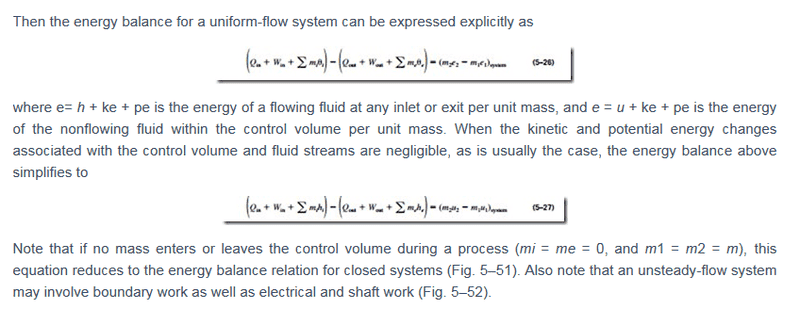
I am currently studying Thermodynamics and stumbled upon this equation and is slightly confused as to how this works. Hopefully someone can help me with the understanding.
thermo.png


According to this text here, if I am not wrong e can be h + ke + pe or u + ke + pe depending on where i am looking the system at. So does that mean the final equation can be equal to (m1u1 - m2u2) or (m1h1 - m2h2) depending on where i am looking the system at? Or i should just ask when would it be mh rather than mu?

Thank you very much.
 
Engineering news on Phys.org
Most developments of the open system (control volume) version of the first law of thermodynamics separate the work into two parts:

1. The work needed to force material (in the inlet and exit streams) into and out of the control volume

2. All other work (which is usually referred to as "shaft work.")

In these typical developments, the work in the equations is the shaft work, which is usually signified by a subscript s. The work needed to force the material into and out of the control volume is usually included in the energy term, and the term would then involve enthalpy h rather than internal energy u.

In the particularly development that you have cited, this separation of the work into two parts is not done. So the work in your equations includes the work needed to force material into and out of the control volume. As a result, the energy term involves internal energy u, and not enthalpy h. This approach is very unconventional.
 
Ah I see what u meant. Then are these "Shaft Work" included when say the flow is turning a turbine before exiting?
 
SWJ said:
Ah I see what u meant. Then are these "Shaft Work" included when say the flow is turning a turbine before exiting?
Yes. Shaft work includes that.
 
Alright! Thank you very much for the clarification now I have cleared up the confusion I had. :biggrin:
 

Similar threads

  • · Replies 2 ·
Replies
2
Views
2K
Replies
2
Views
2K
Replies
3
Views
2K
  • · Replies 1 ·
Replies
1
Views
2K
  • · Replies 8 ·
Replies
8
Views
3K
  • · Replies 1 ·
Replies
1
Views
1K
  • · Replies 19 ·
Replies
19
Views
3K
  • · Replies 5 ·
Replies
5
Views
3K
  • · Replies 9 ·
Replies
9
Views
2K
  • · Replies 1 ·
Replies
1
Views
4K