Thevenin's Theorem: AC Circuits with Different Frequencies

Click For Summary
SUMMARY

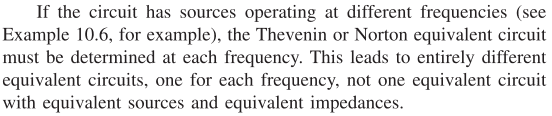
The discussion focuses on calculating the Thevenin equivalent in AC circuits with different frequencies, specifically using voltage sources v1(t)=10cos(5t) and v2(t)=10cos(2t). It is established that when applying superposition, one must consider only the voltage source of interest while shorting the other, resulting in distinct circuits for each frequency. The open circuit voltages derived from these sources will differ, as they cannot be combined due to their unique frequency components, with 5t representing radians per second, not hertz.

PREREQUISITES
  • Understanding of Thevenin's Theorem
  • Knowledge of AC circuit analysis
  • Familiarity with superposition principle in circuit theory
  • Basic concepts of angular frequency and its relation to frequency
NEXT STEPS
  • Study the application of Thevenin's Theorem in AC circuits
  • Learn about the superposition principle in electrical engineering
  • Explore the concept of angular frequency and its calculations
  • Investigate examples of open circuit voltage calculations in AC circuits
USEFUL FOR

Electrical engineering students, circuit designers, and professionals working with AC circuit analysis and Thevenin equivalents.

Vishera
Messages
72
Reaction score
1
My textbook has this excerpt:

Ob0DIuP.png


I am not sure why it refers to Example 10.6 as that is unrelated. I don't understand to be honest. How can you calculate the Thevenin equivalent at different frequencies? Let us say that you have two voltage source: v1(t)=10cos(5t) and v2(t)=10cos(2t). So how do you calculate the Thevenin equivalent at the first frequency of 5 Hz? Do you change v2's frequency to 5 Hz?
 
Engineering news on Phys.org
I think they mean when you use superposition, you use the voltage source you're intersted in and short the other one.

You will then have two different circuits, each with it's own voltage source and frequency.

Then when you go to find your open circuit voltage...you will end up with two different open circuit voltages with two different frequencies from two different sources. You cannot add different frequencies together.

One open circuit voltage will contain (5t) and the other open circuit voltage wil contain (2t).
You would never interchange these like you suggested and also the 5 in 5t is not hertz...it's 5 radians per second...

Just my first guess...or 2nd or third...
 
Last edited:
  • Like
Likes   Reactions: 1 person

Similar threads

  • · Replies 1 ·
Replies
1
Views
2K
  • · Replies 7 ·
Replies
7
Views
4K
  • · Replies 8 ·
Replies
8
Views
2K
  • · Replies 3 ·
Replies
3
Views
15K
Replies
2
Views
3K
Replies
4
Views
2K
  • · Replies 4 ·
Replies
4
Views
2K
  • · Replies 3 ·
Replies
3
Views
2K
  • · Replies 8 ·
Replies
8
Views
3K
Replies
8
Views
2K