This is How do I solve the nodes and antinodes for this problem?

  • Thread starter Thread starter riseofphoenix
  • Start date Start date
  • Tags Tags
    Nodes
Click For Summary
To solve for nodes and antinodes in a fixed string problem, the correct approach involves understanding the harmonic series. For a third harmonic, there are four nodes and three antinodes, with nodes located at fixed ends and equally spaced in between. The nodes are at 0m, 3m, 6m, and 9m, while the antinodes are positioned at 1.5m, 4.5m, and 7.5m. The wavelength of the standing wave is half that of the traveling wave, leading to a wavelength of 3m for the standing wave. The frequency can be calculated using the formula f = √(T/(M/L))/(2L).
riseofphoenix
Messages
294
Reaction score
2
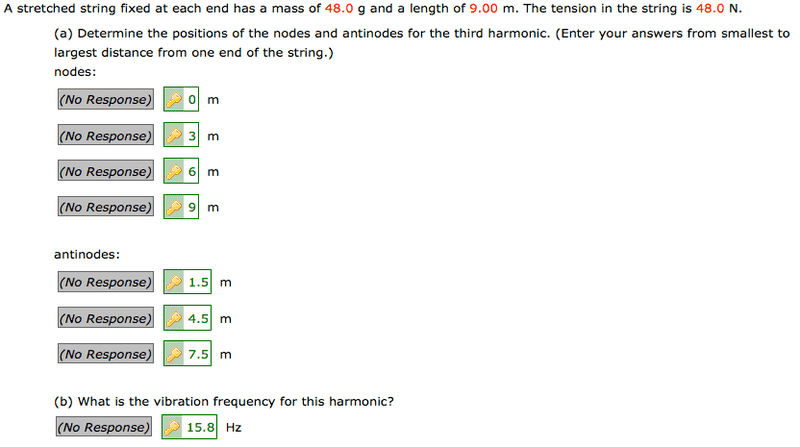
HELP! This is URGENT! How do I solve the nodes and antinodes for this problem??
41.png


For nodes, I tried doing λ = 2L/n but it's not giving me the answers they got... please help!
 
Last edited:
Physics news on Phys.org


Okay so check this diagram out
http://www.physicsclassroom.com/mmedia/waves/h3.gif
Thats a 3rd harmonic...
So you've got 4 nodes where the string is not moving at all, and 3 antinodes of maximum displacement.
Its fixed at each end, so 0m and 9m must be nodes! They can't move if there being held there. So youve got 2 in between , they must be equally spaced so theyve got to be at 3m and 6m. (Maths way to do this is length/harmonic = 9/3 = 3, got to be spaced 3m apart)
You know that the antinodes must be halfway between these nodes, so they have to be at 1.5, 4.5 and 7.5! This is length/2*harmonic.

For the frequency...
velocity = root(tension/(mass/length))
and then to get the frequency this must be divided by twice the length :)
Hope you understood all that!


sorry that's v = \sqrt{\frac{T}{M/L}}

so

f = \frac{\sqrt{\frac{T}{M/L}}}{2L}


riseofphoenix said:
41.png


For nodes, I tried doing λ = 2L/n but it's not giving me the answers they got... please help!

That equation gives you the correct answer, but you then interpreted incorrectly.

The modes of vibration of a string represent STANDING WAVES on the string. The wavelength of a standing wave is 1/2 the wavelength of the traveling wave "causing" the standing wave.

Your formula gives λ = 6m. That is the traveling wave λ

So the wavelength of the standing wave is 3m

The first node is at the fixed end where you start. The next ones are every 3 m from there - until you have reached the other end.

The anti-nodes are halfway between each of those nodes
 
The book claims the answer is that all the magnitudes are the same because "the gravitational force on the penguin is the same". I'm having trouble understanding this. I thought the buoyant force was equal to the weight of the fluid displaced. Weight depends on mass which depends on density. Therefore, due to the differing densities the buoyant force will be different in each case? Is this incorrect?

Similar threads

  • · Replies 1 ·
Replies
1
Views
3K
  • · Replies 5 ·
Replies
5
Views
3K
  • · Replies 4 ·
Replies
4
Views
4K
  • · Replies 1 ·
Replies
1
Views
2K
Replies
16
Views
3K
  • · Replies 2 ·
Replies
2
Views
5K
  • · Replies 5 ·
Replies
5
Views
6K
Replies
4
Views
3K
  • · Replies 4 ·
Replies
4
Views
1K
  • · Replies 7 ·
Replies
7
Views
2K