SUMMARY
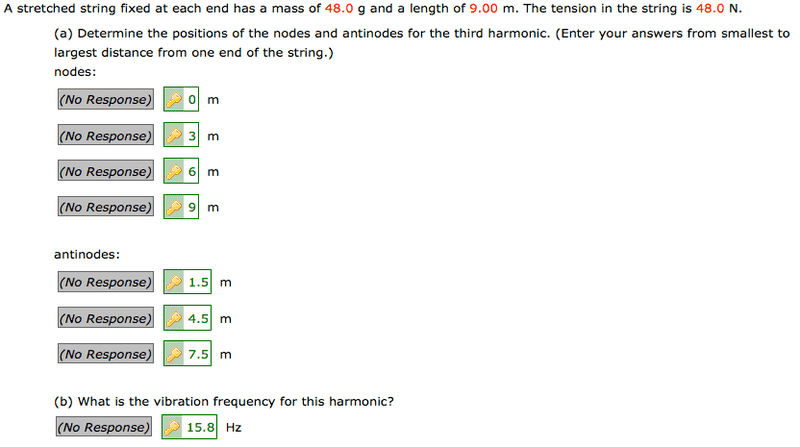
The discussion focuses on solving for nodes and antinodes in a string fixed at both ends, specifically in the context of the third harmonic. The correct formula for nodes is λ = 2L/n, leading to nodes at 0m, 3m, 6m, and 9m, while antinodes are located at 1.5m, 4.5m, and 7.5m. The frequency is derived using the equation f = √(T/(M/L))/(2L), where T is tension, M is mass, and L is length. The wavelength of the standing wave is confirmed to be 3m, which is half of the traveling wave's wavelength of 6m.
PREREQUISITES
- Understanding of harmonic motion and standing waves
- Familiarity with wave equations and their applications
- Knowledge of basic physics concepts such as tension, mass, and length
- Ability to interpret diagrams related to wave patterns
NEXT STEPS
- Study the properties of standing waves in fixed strings
- Learn about wave frequency and its relationship to tension and mass
- Explore the concept of harmonics and their mathematical representations
- Investigate the effects of different boundary conditions on wave behavior
USEFUL FOR
Students and educators in physics, particularly those focusing on wave mechanics, as well as anyone interested in understanding the behavior of standing waves in fixed strings.