Tips for Making Exercise Easy and Enjoyable

  • Context: Comp Sci 
  • Thread starter Thread starter Dan78
  • Start date Start date
  • Tags Tags
    Exercise Tips
Join the discussion
Ask a follow-up here, or get your own question answered by working scientists, mathematicians and engineers — people, not an autocomplete.
Real named experts · corrections over time · the nuance an AI answer skips
9 replies · 2K views
Dan78
Messages
6
Reaction score
1
Homework Statement
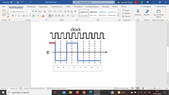
Using the grid below, sketch a waveform to show how the data 10101000 would be transmitted to line using Non-return-to-zero inverted (NRZI) line encoding. Assume the signal level is initially high as shown.
Relevant Equations
None
2022-04-20.png
 
Physics news on Phys.org
You need to show your attempt at this problem. I thought that I made that clear in my previous PM to you...
 
Sorry. What i have is this
 

Attachments

  • 2022-04-20 (1).png
    2022-04-20 (1).png
    27.8 KB · Views: 197
Dan78 said:
Sorry. What i have is this
That looks close, but the "Inverted" part of NRZI means that you should invert that plot, no?

From the Google search preview:

1650487492348.png
 
berkeman said:
That looks close, but the "Inverted" part of NRZI means that you should invert that plot, no?
I think the "I" is more complicated than that - it doesn't just invert the levels of NRZ, it is a completely different (and poorly named) edge-based system (an edge of either sign is a 1 and the absence of a signal edge on a clock pulse signifies a 0).

https://en.wikipedia.org/wiki/Non-return-to-zero#Non-return-to-zero_inverted
Edit: I don't normally like videos but this one is really clear:
 
Last edited:
pbuk said:
I think the "I" is more complicated than that - it doesn't just invert the levels of NRZ, it is a completely different (and poorly named) edge-based system
Interesting. I only briefly looked at the Wikipedia article for NRZI, which looked like simple inversion. I wonder if NRZ-I is different from NRZI... Guess I need to do some more reading...
 
  • Like
Likes   Reactions: pbuk
berkeman said:
Interesting. I only briefly looked at the Wikipedia article for NRZI, which looked like simple inversion. I wonder if NRZ-I is different from NRZI... Guess I need to do some more reading...
As I understand it NRZ-I and NRZ(I) are the same thing as NRZI: I have only ever seen it called NRZI (e.g. in the USB 2.0 specification) and importantly the "I" originally stood for IBM and was nothing to do with inversion (see http://ibm-1401.info/223-6988-729-MagTapeCE-InstRef-62-r.pdf).

This is totally different from NRZ, also called "on-off keying" where 1 is normally represented by a high voltage and 0 a low voltage: I am not aware of the opposite convention having a specific name, I suppose you could call it "Inverted NRZ" but that would just add to the confusion!

In summary

Data 0
Data 1
L​
H​
NRZ​
H​
L​
NRZ​
No transition​
Transition (H-L or L-H)​
NRZI​
NRZ IBM​
Transition (H-L or L-H)​
No transition​
NRZI​
USB, USB 2​
 
What about now.
I have a starting point which is higher voltage level and every time when I encounter a 1 i have to change a voltage level. Hope is good now.
 

Attachments

  • 2022-04-24.png
    2022-04-24.png
    29.6 KB · Views: 190
  • Like
Likes   Reactions: pbuk