Torque Switching and Directional Tension in Pulleys

  • Thread starter Thread starter cjavier
  • Start date Start date
  • Tags Tags
    Torque
Click For Summary
SUMMARY

The discussion centers on the mechanics of tension in pulleys, specifically how tension forces interact with weights. When a weight is applied to a pulley, the tension acts upward on the mass while simultaneously acting downward on the pulley. This directional switch occurs because tension forces always pull away from the objects they act upon, creating a balance between the weight and the tension. Understanding this principle is crucial for analyzing systems involving multiple weights and pulleys.

PREREQUISITES
  • Basic understanding of Newton's laws of motion
  • Familiarity with the concept of tension in physics
  • Knowledge of pulley systems and their mechanics
  • Experience with free body diagrams for visualizing forces
NEXT STEPS
  • Study the principles of static equilibrium in pulley systems
  • Explore the concept of torque and its application in mechanical systems
  • Learn about free body diagram techniques for analyzing forces
  • Investigate the effects of multiple weights on pulley tension dynamics
USEFUL FOR

Physics students, mechanical engineers, and anyone interested in understanding the mechanics of pulleys and tension forces in physical systems.

cjavier
Messages
17
Reaction score
0
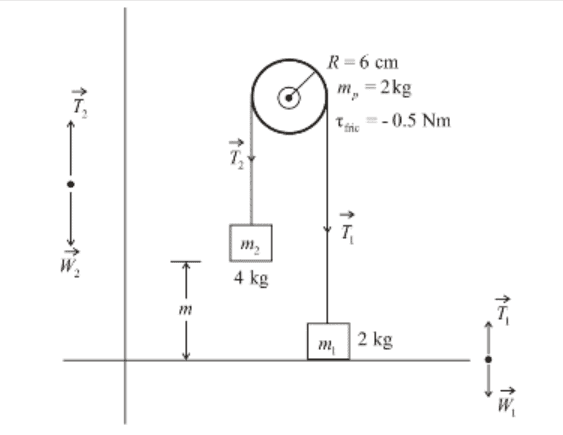
In the attached picture, one sees a pulley with a mass which is holding two different weights. In chegg, the tension due to a weight is represented as a downward direction. Then, when the tension is working on the pulley, the directions switch. WHY IS THIS?!

Thanks,
Cameron
pulley.png
 
Last edited:
Physics news on Phys.org
cjavier said:
In the attached picture, one sees a pulley with a mass which is holding two different weights. In chegg, the tension due to a weight is represented as a downward direction. Then, when the tension is working on the pulley, the directions switch. WHY IS THIS?!

Thanks,
Cameron

View attachment 56910
Tension forces always pull away from the objects on which they act. The cable tension force on the mass acts up. The cable tension force on the pulley acts down.
 
Tension and the force/load/weight always act opposite in direction. Think of tension as a load that balances the weight.
So when the tension is due to the mass m1 (which directs weight downwards) it is in the upper direction which will take a U-turn after the pulley.
 

Similar threads

  • · Replies 4 ·
Replies
4
Views
5K
  • · Replies 10 ·
Replies
10
Views
5K
  • · Replies 12 ·
Replies
12
Views
1K
Replies
15
Views
2K
  • · Replies 5 ·
Replies
5
Views
2K
Replies
7
Views
2K
  • · Replies 3 ·
Replies
3
Views
2K
  • · Replies 22 ·
Replies
22
Views
3K
  • · Replies 12 ·
Replies
12
Views
3K
  • · Replies 3 ·
Replies
3
Views
2K