Pulley Problem With Tension Direction

Click For Summary

Homework Help Overview

The discussion revolves around a pulley system involving two weights and the direction of tension in the ropes. The original poster, Cameron, expresses confusion regarding the representation of tension as downward for a weight and then switching direction when considering the pulley.

Discussion Character

  • Conceptual clarification, Assumption checking

Approaches and Questions Raised

  • Participants inquire about the specific problem from Chegg that Cameron is referencing and seek clarification on the mechanics of tension in the context of the pulley system.

Discussion Status

Some participants have provided insights into the nature of tension as a force and its relationship with weights and the pulley. There is ongoing exploration of the concepts involved, with no explicit consensus reached yet.

Contextual Notes

The problem involves a pulley with specific dimensions and mass, as well as friction affecting the system. The original poster's question highlights a potential misunderstanding of the forces at play in the setup.

cjavier
Messages
17
Reaction score
0
In the attached picture, one sees a pulley with a mass which is holding two different weights. In chegg, the tension due to a weight is represented as a downward direction. Then, when the tension is seen in relation to the pulley, the direction switches for both weights. WHY IS THIS?!
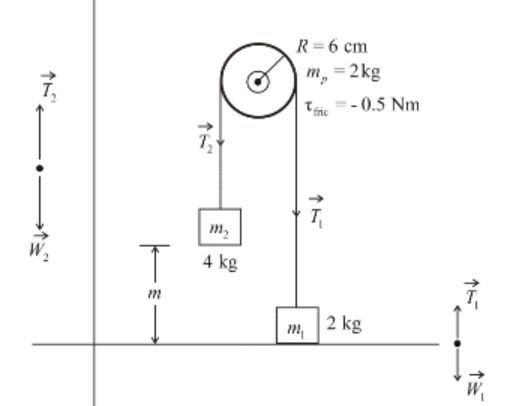
pulley2.jpg


Thanks,
Cameron
 
Physics news on Phys.org
What problem is it? Can you tell me what it is or what problem from chegg you are trying to understand?
 
LoadedAnvils said:
What problem is it? Can you tell me what it is or what problem from chegg you are trying to understand?

The two blocks in the figure are connected by a massless rope that passes over a pulley. The pulley is 12cm in diameter and has a mass of 2kg. As the pulley turns, friction at the axle exerts a torque of magnitude 0.5Nm. If the blocks are released from rest, how long does it take the 4 kg block to reach the floor?
 
It's standard action and reaction. A weight pulls down on a string with an equal and opposite force to that with which the string pulls up on the weight. Similarly between string and pulley, and between each little section of string and its neighbours.
 
Hi Cameron! :smile:
cjavier said:
… the tension due to a weight is represented as a downward direction. Then, when the tension is seen in relation to the pulley, the direction switches for both weights. WHY IS THIS?!

Tension is a force.

The tensions at the two ends of a rope are opposite (and equal in magnitude if the rope is massless). :wink:
 

Similar threads

  • · Replies 10 ·
Replies
10
Views
5K
  • · Replies 2 ·
Replies
2
Views
2K
  • · Replies 12 ·
Replies
12
Views
2K
  • · Replies 3 ·
Replies
3
Views
2K
  • · Replies 15 ·
Replies
15
Views
7K
  • · Replies 1 ·
Replies
1
Views
2K
  • · Replies 22 ·
Replies
22
Views
3K
  • · Replies 3 ·
Replies
3
Views
2K
  • · Replies 17 ·
Replies
17
Views
3K
  • · Replies 22 ·
Replies
22
Views
2K