Torques on a vertical wheel due to 3 masses spaced along the wheel rim

Click For Summary

Homework Help Overview

The discussion revolves around the application of torques on a vertical wheel due to three masses positioned along the wheel's rim. Participants are exploring the concepts of rotational equilibrium and the components of forces acting on the system.

Discussion Character

  • Conceptual clarification, Assumption checking, Mathematical reasoning

Approaches and Questions Raised

  • Participants are questioning the use of cosine versus sine in torque calculations, particularly regarding the components of forces and the radius. There are discussions about the angles involved and how they relate to the torque equation.

Discussion Status

Several participants are actively engaging in clarifying the definitions and components of forces in relation to torque. Some have provided insights into the geometry of the problem, while others are seeking further clarification on specific components and angles. The conversation reflects a mix of understanding and confusion, with no clear consensus yet.

Contextual Notes

There are references to a diagram that is crucial for understanding the problem, and some participants express difficulty in visualizing the setup. The discussion also touches on the importance of the lever arm in torque calculations.

paulimerci
Messages
287
Reaction score
47
Homework Statement
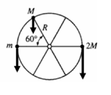
A wheel of radius R and negligible mass is mounted on a horizontal frictionless axle so that the wheel is in a vertical plane. Three small objects having masses m, M, and 2M, respectively, are mounted on the rim of the wheel, as shown. If the system is in static equilibrium, what is the value of m in terms of M ?
Relevant Equations
Rotational equilibrium:
T = F × r × sinθ. T = torque. F = linear force. r = distance measured from the axis of rotation to where the application of linear force takes place.
Applying rotational equilibrium at the center pivot we get:
+mg(R) + Mg(Rcos60°)–2Mg(R) = 0.Using cos60° = ½ we arrive at the answer 3M/2

I don't understand why cosine is used instead of sine in the above equation. I see the y component mg is acting perpendicular to the x component and so from the equation of Torque we understand that the force perpendicular to "r" is taken into consideration. I would really appreciate if anyone could explain.
 

Attachments

  • Screen Shot 2022-10-28 at 2.15.46 PM.png
    Screen Shot 2022-10-28 at 2.15.46 PM.png
    18.1 KB · Views: 161
Physics news on Phys.org
Please post the image. We cannot help you unless we have the appropriate problem statement.
 
  • Like
Likes   Reactions: topsquark
Thanks, I forgot to insert the picture. I've just uploaded it for your reference .
 
There are two ways to think of it:
1. R x the component of Mg perpendicular to R, ##RMg\cos(60)##
2. Mg x the component of R perpendicular to Mg, ##MgR\cos(60)##
Where do you disagree?
 
  • Like
Likes   Reactions: topsquark and paulimerci
Thanks, I find it hard visualizing it.
Why sin 60 is not used in the equation?
 
paulimerci said:
Why sin 60 is not used in the equation?
What is the x-component of the radius from the center to mass ##M##? Is it ##R\cos(60^o)## or ##R\sin(60^o)##?
 
  • Like
Likes   Reactions: topsquark
Well its R cos 60.
 
kuruman said:
What is the x-component of the radius from the center to mass ##M##? Is it ##R\cos(60^o)## or ##R\sin(60^o)##?
While calculating torque for m, which is to the left we take it as sin 90 and thereby for calculating M which is at the top of the circle why cannot we take that as sin 60?
 
paulimerci said:
from the equation of Torque we understand that the force perpendicular to "r" is taken into consideration.

1666994436960.png


What is the value of the angle ##\theta## shown in the figure above? How would you use that to find the component of the force perpendicular to ##r##?
 
  • Like
Likes   Reactions: paulimerci and topsquark
  • #10
Theta is 60. The angle between r and F is 30. I will resolve F into x and y components. Y component is parallel to r and x component looks perpendicular to r. Was it right?
 
  • #11
  • Like
Likes   Reactions: paulimerci
  • #12
Thank you all
TSny said:
View attachment 316304

What is the value of the angle ##\theta## shown in the figure above? How would you use that to find the component of the force perpendicular to ##r##?
Thank you TSny! This diagram helped me to figure it out.
 
  • Like
Likes   Reactions: Lnewqban and TSny
  • #13
  • #14
paulimerci said:
T = F × r × sinθ.
The angle ##\theta## in that equation is the angle between the vectors ##F## and ##r##. (reference)

In your case, it's 30° (= 90° - 60°) and sin30° = ½, just like cos60°.
 
  • Like
Likes   Reactions: paulimerci

Similar threads

  • · Replies 5 ·
Replies
5
Views
2K
  • · Replies 5 ·
Replies
5
Views
3K
Replies
7
Views
2K
Replies
9
Views
2K
  • · Replies 8 ·
Replies
8
Views
2K
  • · Replies 12 ·
Replies
12
Views
2K
Replies
6
Views
3K
  • · Replies 9 ·
Replies
9
Views
1K
  • · Replies 97 ·
4
Replies
97
Views
6K
Replies
4
Views
3K