Torsion in statically indetermined beam

  • Thread starter Thread starter Dell
  • Start date Start date
  • Tags Tags
    Beam Torsion
Click For Summary
SUMMARY

The discussion focuses on analyzing torsion in a statically indeterminate beam subjected to a central torque of Mt=10 kNm with a shear modulus G=80 GPa. The key challenge is determining the distribution of torque between the two components of the central cross-section. The approach involves using the relationship T1 + T2 = Mt and the angle of twist, but the participants highlight the importance of considering reactions and symmetry in the problem. Ultimately, the symmetry of the beam suggests that T1 and T2 will be equal, simplifying the calculations.

PREREQUISITES
  • Understanding of torsion in beams
  • Familiarity with statically indeterminate structures
  • Knowledge of shear modulus and its implications
  • Ability to apply the angle of twist formula
NEXT STEPS
  • Study the principles of torsion in statically indeterminate beams
  • Learn about calculating reactions in beam structures
  • Explore the concept of symmetry in structural analysis
  • Investigate the angle of twist and its applications in engineering
USEFUL FOR

Structural engineers, civil engineering students, and professionals involved in analyzing torsional effects in beam structures will benefit from this discussion.

Dell
Messages
555
Reaction score
0
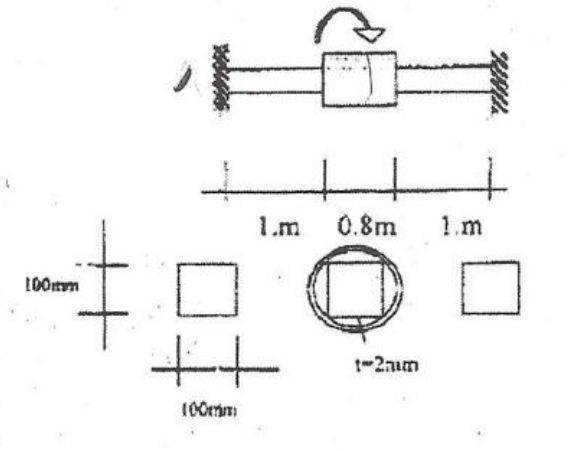
the beam below is subjected to a single torque of Mt=10KNm at its centre, G=80GPa

find the distribution of the torque between the 2 components of the central cross section
Capture.JPG


what i have done in similar questions (where i have had one free end) i have chosen T1 and T2 - the relative torque in each of the components and solved using dϕ/dx,- using the fact that the angle of twist from x=1m to x=0.8m must be the same for both components i could solve for T1 and T2 because in all the cases i have solved i knoew that T1+T2=Mt,
in this question i am not sure this is the case since Mt is not the internal Torque in this cross section,
 
Physics news on Phys.org
Have you considered the reactions, and the observation that the problem has symmetry?
 

Similar threads

  • · Replies 15 ·
Replies
15
Views
2K
  • · Replies 6 ·
Replies
6
Views
4K
Replies
2
Views
2K
Replies
1
Views
2K
  • · Replies 1 ·
Replies
1
Views
2K
Replies
10
Views
3K
  • · Replies 1 ·
Replies
1
Views
2K
  • · Replies 13 ·
Replies
13
Views
4K
  • · Replies 3 ·
Replies
3
Views
2K