Total % of Photons Redshifted While Moving Away From a Black Hole?

Click For Summary

Discussion Overview

The discussion revolves around the effects of gravitational redshift and relativistic aberration on photons emitted from spacecraft moving away from a hypothetical black hole with a radius equal to that of the observable universe. Participants explore how varying kinetic energy of the spacecraft might influence the percentage of photons that become redshifted as they travel between the spacecraft.

Discussion Character

  • Exploratory
  • Technical explanation
  • Debate/contested
  • Mathematical reasoning

Main Points Raised

  • Some participants question the feasibility of a black hole with a radius equal to that of the observable universe, suggesting that the hypothetical scenario needs clearer definitions.
  • There is contention regarding the relationship between relativistic aberration and gravitational redshift, with some asserting that aberration does not affect redshift, while others propose that it might influence the percentage of redshifted photons.
  • One participant argues that gravitational redshift is a property of spacetime geometry and is independent of the motion of the spacecraft, while another suggests that the Doppler effect could also play a role depending on the relative motion of the light source and observer.
  • Participants discuss the implications of observers being in a comoving frame, with some suggesting that this would eliminate aberration and Doppler shifts, while others argue that gravitational redshift would still occur.
  • There is confusion regarding the terminology used, particularly the concept of "gravitational Doppler effect," which some participants clarify does not exist as a distinct phenomenon.
  • One participant expresses uncertainty about how gravitational redshift is perceived by different observers, indicating a need for further clarification on the topic.

Areas of Agreement / Disagreement

Participants do not reach consensus on the relationship between relativistic aberration and gravitational redshift, with multiple competing views remaining. The discussion reflects a mix of agreement on certain technical definitions while also highlighting significant disagreement on the implications of the proposed scenario.

Contextual Notes

Limitations include the hypothetical nature of the black hole's size, the unclear definitions of the scenario, and unresolved questions regarding the interplay between different types of redshift and observer frames.

metastable
Messages
514
Reaction score
53
Suppose a black hole with a radius equal to the radius of the observable universe exists and a fleet of coasting spacecraft are moving directly away from the black hole (along a similar vector) at very close to the speed of light with an amount of kinetic energy A with respect to the singularity that is very much greater than is necessary for escape velocity. Each spacecraft is emitting flashes of light evenly in all directions at regular intervals at a pre-agreed frequency.

As the value of A = kinetic energy per craft increases to arbitrarily higher values in various scenarios, will a greater % of photons become redshifted by gravitational redshift in transit between spacecraft as a result of the relativistic aberration, compared to scenarios where the value of A is much lower or in fact 0?
 
Physics news on Phys.org
A black hole with such a large radius cannot exist in the current universe. You first have to specify how your hypothetical universe that can have such a large black hole is supposed to look before the question can be answered.

Even if we assume a smaller black hole your question is unclear. A sketch might help.
 
mfb said:
A black hole with such a large radius cannot exist in the current universe. You first have to specify how your hypothetical universe that can have such a large black hole is supposed to look before the question can be answered.

The craft are at a distance 2 times the radius of the event horizon.
 
You should show some effort here. This is essentially a homework problem, so you should make your own attempt and post it.
 
metastable said:
an amount of kinetic energy A with respect to the singularity

There is no such thing. The singularity is not a place in space. This error by you has been corrected in previous threads.

metastable said:
gravitational redshift in transit between spacecraft as a result of the relativistic aberration

Relativistic aberration has nothing to do with redshift.
 
PeterDonis said:
Relativistic aberration has nothing to do with redshift.
If I understand this correctly you are saying additional v won't cause additional % intercepted photons redshift.
 
metastable said:
If I understand this correctly you are saying additional v won't cause additional % intercepted photons redshift.

No, I'm saying that aberration has nothing to do with redshift. Aberration has to do with the direction of light, not its frequency.
 
PeterDonis said:
Aberration has to do with the direction of light, not its frequency.
Are you saying if additional v causes additional aberration (away from the black hole), a higher % of photons will be redshifted upon interception or not?
 
metastable said:
As the value of A = kinetic energy per craft increases to arbitrarily higher values in various scenarios, will a greater % of photons become redshifted by gravitational redshift

Gravitational redshift is a property of the spacetime geometry. Since the spacetime geometry is independent of how your spacecraft move, it would seem like the answer to this is "no".

However, gravitational redshift is not the only kind of redshift. But you have given no information that would allow you to assess any other kinds of redshift.
 
  • #10
metastable said:
Are you saying if additional v causes additional aberration (away from the black hole), a higher % of photons will be redshifted upon interception or not?

I don't understand why you keep asking about aberration when I've said twice now that aberration has nothing to do with redshift.
 
  • #11
PeterDonis said:
But you have given no information that would allow you to ...
Which is partly why I recommend that he try working the problem
 
  • #12
PeterDonis said:
I don't understand why you keep asking about aberration when I've said twice now that aberration has nothing to do with redshift.
https://en.wikipedia.org/wiki/Relativistic_aberration
"the rays of light from the source which reach the observer are tilted towards the direction of the source's motion (relative to the observer)"
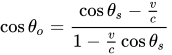
\cos \theta_o=\frac{\cos \theta_s-\frac{v}{c}}{1-\frac{v}{c} \cos \theta_s} \,


^If I understand this passage correctly, If the observer is farther away from the black hole than the fleet of ships, this excerpt means that when the ships travel with faster v away from the black hole, a greater % of photons which were initially emitted equally in all directions in the rest frame of a craft, will be directed away from the black hole by the aberration, and since a greater proportion of photons will be directed away from the black hole when the craft are moving faster, a greater % of photons will become redshifted when the craft move faster due to the gravitational doppler effect, unless I'm mistaken.

Similar reasoning why in a collision between a 20gev positron followed by a 20gev + 1ev electron* from the same gun in the same direction gives 2 photons traveling in almost the same direction from the lab frame.

*edit
 
  • #13
metastable said:
when the ships travel with faster v away from the black hole

Ok, so here ##v## is relative to an observer who is "hovering" at a constant altitude above the hole's horizon.

metastable said:
a greater % of photons which were initially emitted equally in all directions in the rest frame of a craft, will be directed away from the black hole by the aberration

If ##v## is interpreted as above, yes, this is true.

metastable said:
a greater % of photons will become redshifted when the craft move faster due to the gravitational doppler effect

There is no such thing as "gravitational doppler effect". There is gravitational redshift, but it has nothing to do with relative motion, which is what "doppler effect" refers to.

There will be gravitational redshift in this scenario, but there will also be doppler blueshift because the light source (the spaceship flying outward) is moving towards the observer. Which effect dominates will depend on the relative velocity and the altitude change from the spaceship to the observer.
 
  • #14
PeterDonis said:
There is no such thing as "gravitational doppler effect".
Sorry I thought I had originally typed "gravitational redshift..." either my memory is fuzzy or someone had edited it for me...
 
  • #15
PeterDonis said:
There will be gravitational redshift in this scenario, but there will also be doppler blueshift because the light source (the spaceship flying outward) is moving towards the observer.
I had intended for the only observers in the scenario to be the almost-comoving fleet of craft. Some at higher or lower altitudes above the black hole, some at similar altitudes, and a variety of separation distances between them. I wondered if the "common comoving" velocity upwards is arbitrarily high enough, if it could lead to a scenario where nearly all the flashes observed between ships could be redshifted, even if they are slightly moving towards each other, and especially as the separation distance between them increases...
 
  • #16
metastable said:
I had intended for the only observers in the scenario to be the almost-comoving fleet of craft.

Then there is no aberration or doppler shift because the observers are not moving relative to the source.

metastable said:
I wondered if the "common comoving" velocity upwards is arbitrarily high enough, if it could lead to a scenario where nearly all the flashes observed between ships could be redshifted

As I said before, gravitational redshift is a property of the spacetime geometry, which is unaffected by the motion of the ships.
 
  • #17
PeterDonis said:
Then there is no aberration or doppler shift because the observers are not moving relative to the source.

I thought I had read somewhere that unlike the velocity redshift where the observed redshift depends on the observers velocity, that the gravitational redshift was different somehow in that (in plain language) "all observers agree the photon is losing energy" as it climbs out of a gravity well, but after a quick search I couldn't find the reference.
 
  • #18
metastable said:
I thought I had read somewhere...but after a quick search I couldn't find the reference

Then there's nothing to discuss. You can always look in a GR textbook.
 
  • #19
metastable said:
Suppose a black hole with a radius equal to the radius of the observable universe exists and a fleet of coasting spacecraft are moving directly away from the black hole (along a similar vector) at very close to the speed of light with an amount of kinetic energy A with respect to the singularity that is very much greater than is necessary for escape velocity. Each spacecraft is emitting flashes of light evenly in all directions at regular intervals at a pre-agreed frequency.

As the value of A = kinetic energy per craft increases to arbitrarily higher values in various scenarios, will a greater % of photons become redshifted by gravitational redshift in transit between spacecraft as a result of the relativistic aberration, compared to scenarios where the value of A is much lower or in fact 0?
If we cut off some unessential stuff and some problematic stuff, then there is a gravity field and some free-fallers that send signals to each other. For those free-fallers everything works like there was no gravity field.

So the question has been answered. Free-fallers do not observe redshifts.

Well perhaps we, "outside observers", want to even better understand why the free-fallers did not observe redshift, although we can observe a redshift occurring by dangling some measuring devices at the locations where the signals are emitted and absorbed?
 
Last edited:
  • #20
metastable said:
a greater % of photons which were initially emitted equally in all directions in the rest frame of a craft, will be directed away from the black hole by the aberration

PeterDonis said:
If vvv is interpreted as above, yes, this is true.
jartsa said:
If we cut off some unessential stuff and some problematic stuff, then there is a gravity field and some free-fallers that send signals to each other. For those free-fallers everything works like there was no gravity field.

So the question has been answered. Free-fallers do not observe redshifts.

I’m confused by this point. In the scenarios when the craft are moving faster (for example .99999999999999999995c or greater), a very high % of total photons emitted by the craft will be moving away from the black hole as a result of the relativistic aberration, and since photons moving away from black holes become redshifted, I struggle to understand how, with such a very high % of the photons traveling on vectors away from the black hole they will not be redshifted in transit between distantly separated craft, in proportion to their separation distance.
 
  • #21
metastable said:
I struggle to understand how, with such a very high % of the photons traveling on vectors away from the black hole they will not be redshifted in transit between distantly separated craft, in proportion to their separation distance.

If the separation distance is small enough, all of the spaceships, since they are all in free fall, can be treated as being at rest in some local inertial frame during the flight time of any particular photon. This is the case that @jartsa is describing, and in this case, there is no gravitational redshift observable. (From the viewpoint of an observer who is hovering at a fixed altitude, the ships are close enough together that their altitude does not change significantly during the flight time of any particular photon.)

If the separation distance is not so small, then the ships will cover a large enough region of spacetime during the flight time of any particular photon that they cannot be treated as all being at rest in a single inertial frame during that flight time. In that case, gravitational redshift will be observable.
 
  • #22
metastable said:
I struggle to understand
Which is why I suggested working through the math.
 
  • #23
metastable said:
I’m confused by this point. In the scenarios when the craft are moving faster (for example .99999999999999999995c or greater), a very high % of total photons emitted by the craft will be moving away from the black hole as a result of the relativistic aberration, and since photons moving away from black holes become redshifted, I struggle to understand how, with such a very high % of the photons traveling on vectors away from the black hole they will not be redshifted in transit between distantly separated craft, in proportion to their separation distance.
I did not say photons do not become redshifted. I said free-fallers do not observe a redshift.How about if we (I mean you:smile:) calculate:

1) How much is light emitted by an object moving at speed .99999999999999999995c blueshifted?

(light is emitted to the direction of the motion)

2) How much is light absorbed by an object moving at speed .99999999999999999994c redshifted?

(object and light move to parallel directions)

That last one is the same calculation as how much is light emitted by an objectct moving at speed .99999999999999999994c redshifted when the light is emitted to the direction opposite to the motion of the object.3) The net effect of those two two shifts.

That net effect is probably quite large, like blueshift by a factor of 1.00001 or something. (Well if you expected a factor of 1.0000000000000000001 then 1.00001 is large)(And that blueshitft might cancel out gravitational redshift)
 
Last edited:
  • Like
Likes   Reactions: Dale
  • #24
PeterDonis said:
If the separation distance is not so small, then the ships will cover a large enough region of spacetime during the flight time of any particular photon that they cannot be treated as all being at rest in a single inertial frame during that flight time. In that case, gravitational redshift will be observable.

Actually, I'm not sure this is true if the ships are in free fall, since they will decelerate (relative to hovering observers) while each photon is in flight. I would have to do the math to see if this exactly cancels the gravitational redshift in the general case, but intuitively it seems like it ought to.
 
  • #25
PeterDonis said:
If the separation distance is not so small, then the ships will cover a large enough region of spacetime during the flight time of any particular photon that they cannot be treated as all being at rest in a single inertial frame during that flight time. In that case, gravitational redshift will be observable.
jartsa said:
I did not say photons do not become redshifted. I said free-fallers do not observe a redshift.
Is there still some disagreement about what the outcome would be?

Let me recap. In the scenario there is a black hole with a radius of the observable universe and a fleet of coasting, co-moving ships with a variety of heights above the black hole and a variety of separation distances between them, but they are in a region of space roughly 2 black hole radii from the geometric center of the black hole, and the co-moving velocity of the ships is on a vector directly away from the black hole at an arbitrarily high speed close to the speed of light (co-moving at 0.999999999999999995c or greater in various different scenarios) with respect to the black hole. The only observers are the co-moving astronauts on the ships, and the ships are emitting flashes at regular intervals, equally in all directions, on a pre-agreed frequency.

Questions:

Will the relativistic aberration cause a higher and higher % of total photons to travel on vectors which increase in distance from the black hole over time, as the ships co-moving velocity increases in different scenarios?

In a given scenario (for example if 99.99999999999999% of total photons are moving away from the black hole), will the photons become redshifted from gravitational redshift during their flight times between craft?

^If yes, Will the measured gravitational redshift increase (as measured by an observer on one of the craft) as the separation distance between the craft increases in different scenarios (longer flight times between craft)?
 
Last edited:
  • #26
metastable said:
Is there still some disagreement about what the outcome would be?

Since nobody has actually done the math, everything we've said about the outcomes is just our best guess. To know for sure what the outcome is, as has already been pointed out, you need to do the math.

metastable said:
Will the relativistic aberration cause a higher and higher % of total photons to travel on vectors which increase in distance from the black hole over time

From the point of view of an observer "hovering" at rest relative to the hole, yes. Aberration depends on relative velocity.

metastable said:
will the photons become redshifted from gravitational redshift during their flight times between craft?

As above, you need to do the math and see if you want to know for sure. But intuitively, we can look at it from two points of view:

From the point of view of the ships, they are all in free fall and are all at rest relative to each other, so there is no such thing as "gravitational redshift". However, if their separation is large enough, spacetime curvature might be detectable between them during the time of flight of a particular photon, which would mean the logic of the previous sentence wouldn't be quite right (since it assumes that the entire fleet can be contained within a single local inertial frame during the flight time of a photon).

From the point of view of an observer "hovering" at rest relative to the hole, since all of the spaceships are in free fall, they are decelerating, so while a photon will have gravitational redshift as it travels upward, the ship that receives it will have decelerated during its flight, which will cause a compensating blueshift (which is an effect I didn't think of when I originally posted about gravitational redshift). However, without doing the math, we don't know for sure that those two effects exactly cancel (though it seems intuitively like they should).
 
  • #27
PeterDonis said:
From the point of view of an observer "hovering" at rest relative to the hole, since all of the spaceships are in free fall, they are decelerating, so while a photon will have gravitational redshift as it travels upward, the ship that receives it will have decelerated during its flight, which will cause a compensating blueshift (which is an effect I didn't think of when I originally posted about gravitational redshift). However, without doing the math, we don't know for sure that those two effects exactly cancel (though it seems intuitively like they should).

Before I do the math for any case in particular, can it be generally said that as the initial "upward" coasting co-moving velocity increases in various scenarios, the change in velocity between any 2 particular ships during the flight time of the photon will decrease?
 
  • #28
metastable said:
Is there still some disagreement about what the outcome would be?
You should work the math. Then you wouldn’t have to worry about agreement. I find it somewhat concerning that you are so reluctant to even attempt this calculation.
 
  • #29
Dale said:
You should work the math. Then you wouldn’t have to worry about agreement. I find it somewhat concerning that you are so reluctant to even attempt this calculation.

I've tried something similar before:

metastable said:
Source: https://en.wikipedia.org/wiki/Relativistic_aberration

cos(angle observed to source) = (cos(motion path angle relative to the vector from the observer to the source at the time when the light is emitted)-(V/C))/(1-((V/C)*cos(motion path angle relative to the vector from the observer to the source at the time when the light is emitted)))

A = cos(motion path angle relative to the vector from the observer to the source at the time when the light is emitted)
B = V
C = C
D = cos(angle observed to source)

D = (A-(B/C))/(1-((B/C)*A))

A = -1*(((-1*B)-(D*C))/(C+(D*B)))

P = 299792457.608631081048 m/s = 10gev + 1ev electron velocity lab frame
Q = 299792457.608631080969 m/s = 10gev positron velocity lab frame
V = 299792457.6086310810085 = (P+Q)/2 = Velocity of Center of Mass observed from Lab Frame

A = cos(motion path angle relative to the vector from the observer to the source at the time when the light is emitted)
B = 299792457.6086310810085
C = C = 299792458m/s
D = cos(angle observed to source) = 0 = cos(90deg)

A = -1*(((-1*B)-(D*C))/(C+(D*B)))

A = -1*(((-1*299792457.6086310810085)-(0*299792458))/(299792458+(0*299792457.6086310810085)))

A = 0.9999999986945338064792 = cos(0.00292766)

0.00292766 degrees = motion path angle relative to the vector from the observer to the source at the time when the light is emitted

-----------------------------------------
Conclusions

The angle of the source motion path relative to the vector from the observer to the source at the time when the light is emitted is 0.00292766 degrees if the source momentum vector appears to be 90 degrees to the lab-frame-observed emission vector at the time of viewing from the lab frame

-------------------------------------

Verified:

aberration-angle.jpg
 
  • #30
metastable said:
can it be generally said that as the initial "upward" coasting co-moving velocity increases in various scenarios, the change in velocity between any 2 particular ships during the flight time of the photon will decrease?

No, because the deceleration due to gravity is independent of the outward speed.
 

Similar threads

  • · Replies 9 ·
Replies
9
Views
1K
  • · Replies 67 ·
3
Replies
67
Views
6K
  • · Replies 22 ·
Replies
22
Views
4K
  • · Replies 20 ·
Replies
20
Views
3K
  • · Replies 4 ·
Replies
4
Views
2K
  • · Replies 17 ·
Replies
17
Views
4K
  • · Replies 17 ·
Replies
17
Views
4K
  • · Replies 35 ·
2
Replies
35
Views
4K
  • · Replies 3 ·
Replies
3
Views
3K
  • · Replies 9 ·
Replies
9
Views
2K