Question 26.5: Triangle Circuit - Is My Drawing Correct?

  • Thread starter Thread starter Instinctlol
  • Start date Start date
  • Tags Tags
    Circuit Triangle
Click For Summary
The discussion centers on the correct configuration of a triangle circuit with a voltage source applied across points a and b. The user seeks confirmation on their drawing and the connections for the voltage sources Vbc and Vac. Feedback highlights that the voltage source must be accurately placed between nodes a and b, and there is a need to correctly label node a in the diagram. Clarification is provided regarding the connection of the 20-ohm resistor. The user expresses gratitude for the guidance received.
Instinctlol
Messages
79
Reaction score
0
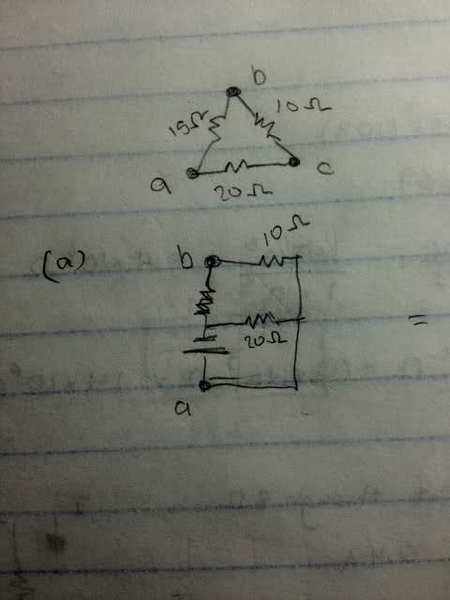
I am not sure how the configuration would look like if we add a voltage across these points. I have drawn out what I think it would look like after a potential is applied across Vab. My question is, is this drawing correct?? What about Vbc and Vac?

This is question 26.5.
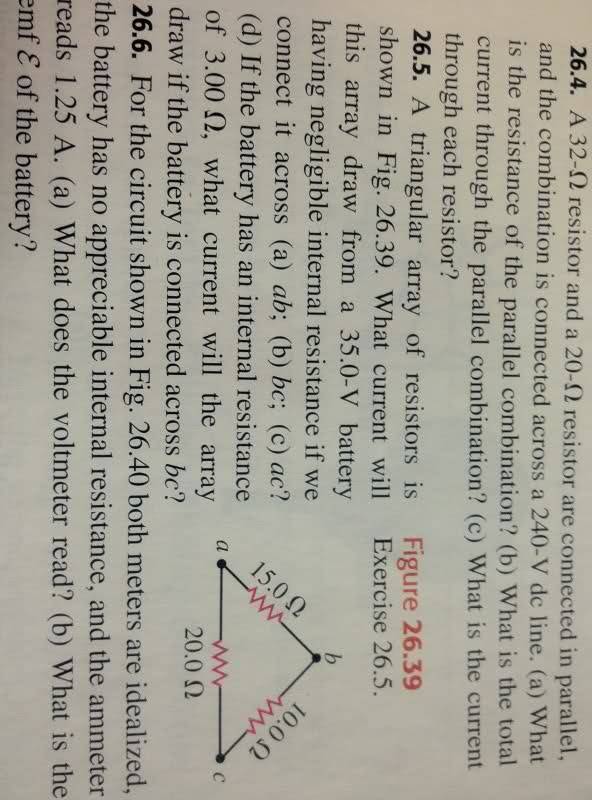
2vaimog.jpg


And here is my attempt for (a)

34656vt.jpg


Once I figure out the configuration, I can easily add up the R_eq and find the I from that. But I need to make sure my configuration is correct!
 
Physics news on Phys.org
For a diagram for part (a), the voltage source should be drawn between nodes a and b. You've not labeled node a correctly in the second diagram.
 
What should the 20ohm be connected to?
 
If the instructions say to put the voltage source between nodes a and b, then that's where you connect it!

attachment.php?attachmentid=40889&stc=1&d=1321140632.jpg
 

Attachments

  • Fig1.jpg
    Fig1.jpg
    7.5 KB · Views: 442
gneill said:
If the instructions say to put the voltage source between nodes a and b, then that's where you connect it!

attachment.php?attachmentid=40889&stc=1&d=1321140632.jpg

Ohhhhh, duh... Thanks!
 
The book claims the answer is that all the magnitudes are the same because "the gravitational force on the penguin is the same". I'm having trouble understanding this. I thought the buoyant force was equal to the weight of the fluid displaced. Weight depends on mass which depends on density. Therefore, due to the differing densities the buoyant force will be different in each case? Is this incorrect?

Similar threads

Replies
10
Views
1K
Replies
3
Views
829
  • · Replies 9 ·
Replies
9
Views
2K
  • · Replies 5 ·
Replies
5
Views
2K
Replies
3
Views
2K
  • · Replies 4 ·
Replies
4
Views
1K
  • · Replies 3 ·
Replies
3
Views
1K
Replies
14
Views
672
  • · Replies 6 ·
Replies
6
Views
3K
  • · Replies 1 ·
Replies
1
Views
1K