Tricky Spring-Mass Problem (Vibrations)

  • Thread starter Thread starter Saladsamurai
  • Start date Start date
  • Tags Tags
    Vibrations
Click For Summary
SUMMARY

The discussion focuses on a spring-mass problem in a vibrations course, specifically analyzing the effects of an applied force F(t)=Focos(w*t) at a point 25% from the fixed end of a spring. Participants clarify that different sections of the spring can have varying spring constants due to material and dimensional properties. The problem requires determining the equations of motion for the coupled system of springs and understanding the forces acting at the point of application. Key considerations include the equilibrium lengths of the spring segments and the relationship between the excitation force and the spring's natural frequency.

PREREQUISITES
  • Understanding of Newton's Second Law of Motion
  • Familiarity with spring constants and their dependence on material properties
  • Knowledge of coupled oscillatory systems
  • Basic concepts of free-body diagrams in mechanics
NEXT STEPS
  • Study the derivation of equations of motion for coupled spring systems
  • Learn about the effects of varying spring constants on system dynamics
  • Explore the concept of natural frequency in oscillatory systems
  • Investigate the application of free-body diagrams in complex mechanical systems
USEFUL FOR

Students in vibrations courses, mechanical engineers, and anyone studying dynamics of coupled oscillatory systems.

Saladsamurai
Messages
3,009
Reaction score
7
This is for a vibrations course. A force F(t)=Focos(w*t) is applied to a point on a spring located 25% of its length from the fixed end (at the ceiling).

I am trying to write out Newton's 2nd for the block. This requires that I find how much of F(t) is transmitted to the block.

I am a little confused as to where to start.

I am also confused as to why they labeled the different parts of the spring with different spring constants? (see figure below from solution) Why do different parts of the spring have different constants. Is k a function of length?
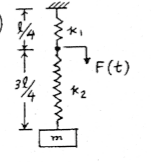
Picture7-2.png


Any ideas are appreciated.
 
Physics news on Phys.org
Spring constant is determined by the material and dimensional characteristics, e.g. wire diameter and its pitch (coils/unit length), so two springs could have different spring constants, k1 and k2.

In this problem the driving or excitation force is applied at the joint between the two springs.

One has to determine the equations of motion for each spring. It is a coupled system.

Does one consider the spring masses?

Are l/4 and 3l/4 the equilibrium lengths of the springs?
 
Astronuc said:
Spring constant is determined by the material and dimensional characteristics, e.g. wire diameter and its pitch (coils/unit length), so two springs could have different spring constants, k1 and k2.

In this problem the driving or excitation force is applied at the joint between the two springs.

One has to determine the equations of motion for each spring. It is a coupled system.

Does one consider the spring masses?

Are l/4 and 3l/4 the equilibrium lengths of the springs?

They are not two separate springs. It is one spring with a force applied .25L from the ceiling.

Mass of spring = 0

I am thinking that I should make a 'cut' at the point where F(t) is being applied.
I will call that point P and draw a free-body diagram.

I am confused as to how to determine the magnitude of the forces acting on P.
They both oppose the motion at all times (that is, they are negative).

One is a result of the top 25% is spring and one from the bottom .75%

And L is the length of the spring when the mass is at equilibrium.
 
Last edited:
One could write two equations using k1 = k2 = k. The response depends on the phase between F(t) and mg, which is affected by the frequency of the excitation force and the natural fequency of the spring.
 

Similar threads

Replies
3
Views
995
  • · Replies 18 ·
Replies
18
Views
2K
Replies
17
Views
2K
  • · Replies 8 ·
Replies
8
Views
2K
  • · Replies 10 ·
Replies
10
Views
1K
Replies
3
Views
2K
Replies
3
Views
1K
Replies
24
Views
4K
Replies
8
Views
6K