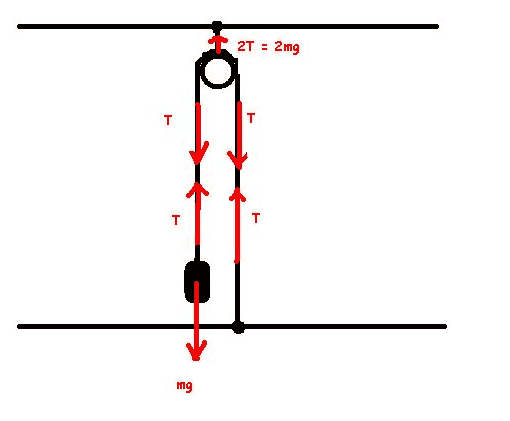
Doc Al said:
Every force has a third law pair. The "trick" is always to ask: What (A) is exerting a force on what (B)? Here it the rope (A) pulling down on the pulley (B). So the third law pair to that force is the pulley (B) pulling up on the ropes (A).Once again, if the rope (A) pulls up on the object (B), then Newton's 3rd law says that the object (B) must pull down on the rope (A).
Instead of the rope, imagine you were pulling up the object. Would you agree that if you are pulling the object up then you'd feel it pulling down on you? No way around that! There's no way for you (or the rope) to pull on anything without that thing pulling back on you (or the rope) with an equal force.
Thank you very much Doc Al and Chester, I truly appreciate the patience and effort you two have in helping me understand this concept. I'm not entirely sure how to reply to both of you in one of my own, but I am very grateful nonetheless. Sorry for the late reply, I decided to think about what has been said so far over the next day and kind of write my conclusions here so that hopefully I have a grasp on it by now.
So, imagine that we have an object that weighs 5 kilograms hanging from a cord/rope:
Since the object weighs
5 kilograms, the weight will be
49 Newtons. Similarly, the tension that the rope will experience will be
49 Newtons.
According to Newton's third law, since the rope pulls on the object with 49 Newtons (Tension), the object will also have to exert an equal and opposite force downwards on the rope of 49 Newtons. It turns out that this downwards force value is equal,
numerically, to the weight value of the object. But, that does
not mean that the weight and the tension are third law pairs because
A: They both act on the same object (the object) and
B: if the rope was cut, the weight would still exist however the tension would not, which means that the third law pair of the weight must be the gravitational attraction that the object has on the Earth (The Earth is so massive though, so this attraction to the object is hardly noticeable)
The reason why there is a downwards tension force acting on the pulley wheel in the first diagram (in post #1) is due to the downwards force of the box which thereby puts a downward force on the pulley itself, because the cord is obviously wrapped around the pulley wheel.
Now let's say that we have a pulley system that is not at rest like the one in the first diagram in post #1. Instead, both masses are suspended and one is heavier than the other, like this:
Lets say that:
m1 is
10 kilograms (98 Newtons)
m2 is
5 kilograms (49 Newtons)
Since the pulley is now moving, the tension that the rope experiences is not simply the weight of m2 (49 Newtons). The tension, I believe, should actually be
greater because now m2 is being accelerated upwards. This means that the apparent weight of the mass should increase by: w = m(g+a).
Lets say that the tension in this rope is
65 Newtons since the system is moving. That means that m2 must also exert an equal and opposite force downwards on the rope because the rope is pulling up m2. However, these two forces do not cancel each other out because
A: The pulley system will clearly move
B: They are acting on different objects
What I mean by B is that when we draw free body diagrams for the rope and m2, they will
only show the forces that influence their motion, right? It should look something like this for m2:
and something like this for the rope (that we assume is mass-less):
There is only
1 force acting on the rope because we assume that it is massless. Also, I believe that this force is not added to the weight force of the block because as I said earlier, the apparent weight of m2 should increase (I
think that is decent logic, right?)
I hope I am correct in most of this. I do realize that this should be an easy topic to grasp, and that it is quite laughable at the amount of effort I've put in, but I'm determined to comprehend this fully.
If you have time, please see if my conclusion is correct. Thank you so much.