Troubleshooting Nuclear Reactions: Decay, Gamma Rays & More

Click For Summary
SUMMARY

The discussion focuses on troubleshooting nuclear reactions, specifically the decay processes involving isotopes such as 115In and 116mIn. Participants clarify that the decay calculation for 120 minutes is necessary to determine the formation of daughter isotopes and their relationship to neutron flux. The daughter nuclide is relevant because it undergoes beta decay to produce stable isotopes, while the granddaughter nuclide does not contribute to the decay process. Understanding the yield of gamma rays, particularly gamma37, is essential for calculating neutron flux rates in these reactions.

PREREQUISITES
  • Nuclear decay processes and their mathematical modeling
  • Understanding of isotopes, specifically 115In and 116mIn
  • Knowledge of neutron flux and its role in nuclear reactions
  • Familiarity with gamma radiation and its significance in decay
NEXT STEPS
  • Study the mathematical modeling of radioactive decay using differential equations
  • Learn about neutron capture processes in nuclear reactions
  • Research the properties and applications of gamma37 in nuclear physics
  • Explore the relationship between neutron flux and isotope production rates
USEFUL FOR

Nuclear physicists, researchers in radiation safety, and students studying nuclear chemistry will benefit from this discussion, particularly those focusing on decay processes and neutron interactions in nuclear reactions.

Graham87
Messages
72
Reaction score
16
Homework Statement
See pictures
Relevant Equations
See pictures
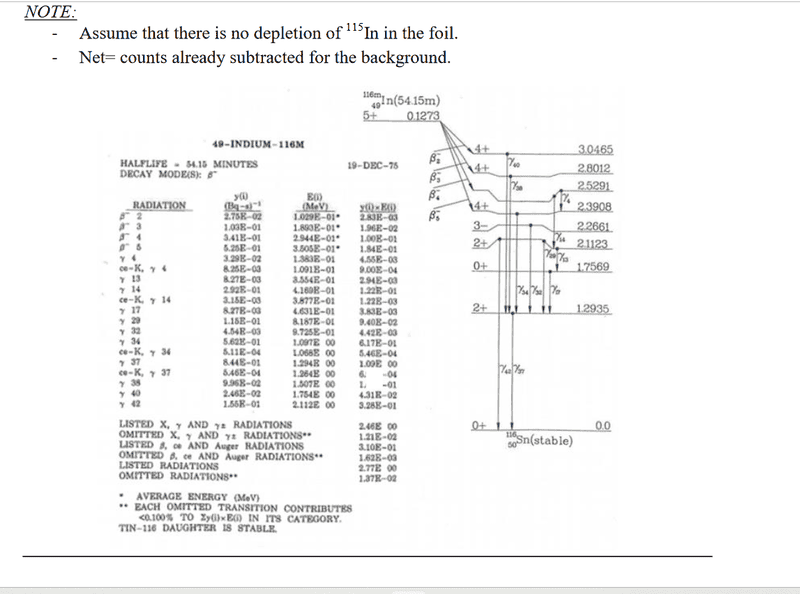
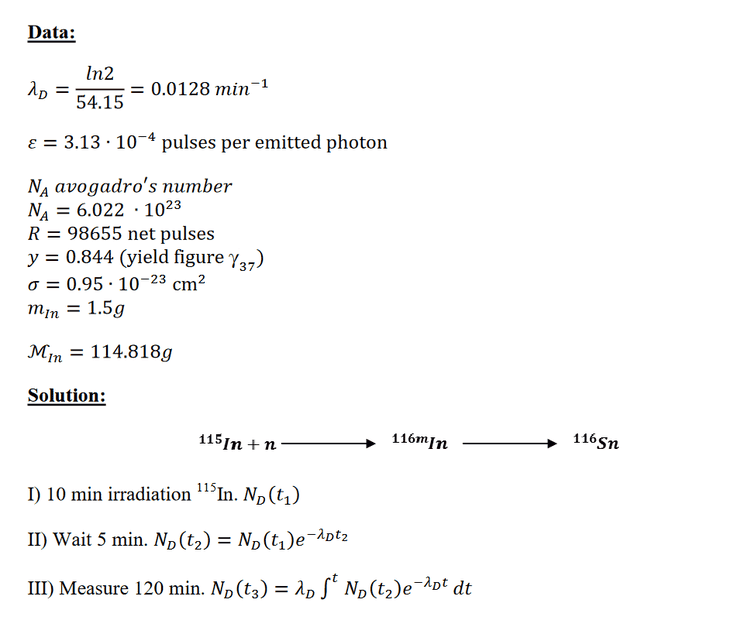
The problem comes with solutions. However, I dont get the 3 steps in the solutions. Why do they calculate decay for 120min in step 3? And why is only the daughter nuclide relevant and no granddaughter? There might be something lacking in my knowledge about nuclear reactions.
Also, I don't know what to use with the information "most likely gamma ray" in the question. I know it is gamma37, but what should I derive from knowing that?

Thanks!
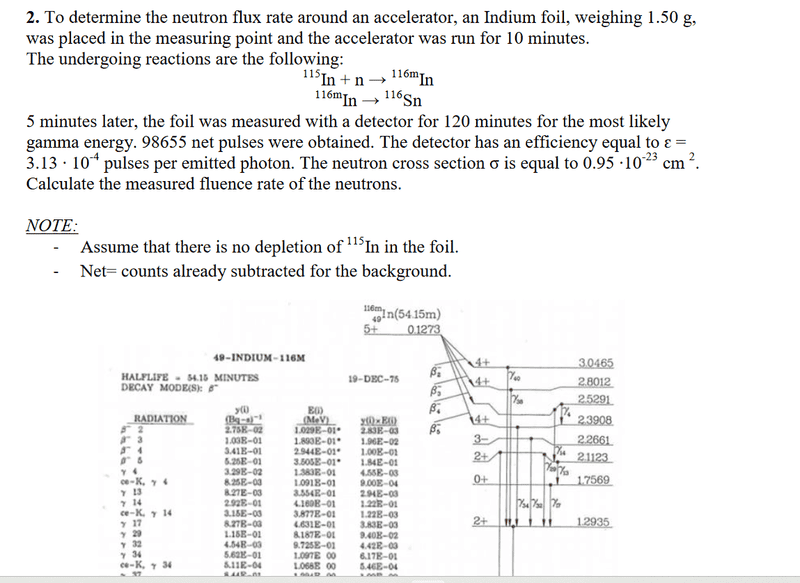
1.png
2.png
3.png
4.png
5.png
 
Last edited by a moderator:
Physics news on Phys.org
Graham87 said:
1 Why do they calculate decay for 120min in step 3?
2 And why is only the daughter nuclide relevant and no granddaughter?
3 Also, I don't know what to use with the information "most likely gamma ray" in the question. I know it is gamma37, but what should I derive from knowing that?
1. It says so in the problem statement : they measure from 5 to 125 min
2. that last one does not decay
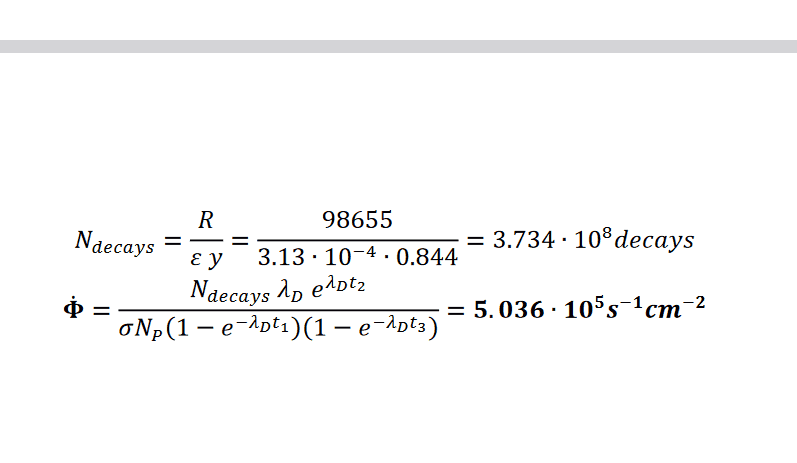
3. Its probability (yield) is used to divide by

And you'll learn about decay processes by doing exercises like this.. :smile:

##\ ##
 
  • Like
Likes   Reactions: Graham87
BvU said:
1. It says so in the problem statement : they measure from 5 to 125 min
2. that last one does not decay
3. Its probability (yield) is used to divide by

And you'll learn about decay processes by doing exercises like this.. :smile:

##\ ##
Regarding to calculate the fluence rate of the neutrons: how does the process of the neutrons in the reaction work? Are there neutrons decaying from the daughter particle? I cant see it. According to the reaction table the neutrons are coming from the parent particle 115(In) + n ? The daughter 116m(In) is an excited state but has no neutron decay?

So if we want to calculate the fluence rate of neutrons, why does the solution calculate the decay of the daughter, if it includes no neutrons?
Or does the daughter decay actually contribute neutrons? In that case I think I'm getting it :)
 
Neutrons don't play a role in the decay process that is described, only in the formation of the ##^{115}##In .
The flux of incoming neutrons is determined from the amount of ##^{115}##In that is found and the cross section.

##\ ##
 
  • Like
Likes   Reactions: Graham87
Oh, ok. I don't get step 3 - calculate the decay of the daughter for t3. What do we need that for to find the flux if the flux is from the incoming neutrons in the parent?

Thanks for the replies!
 
  • Like
Likes   Reactions: berkeman
Graham87 said:
Oh, ok. I don't get step 3 - calculate the decay of the daughter for t3. What do we need that for to find the flux if the flux is from the incoming neutrons in the parent?
The way to find out how much ##^{115}##In was formed in 10 minutes is to measure how many decays to Sn took place in 120 minutes.
Thanks for the replies!
You are welcome; that's what PF is for...
 
  • Like
Likes   Reactions: Graham87
BvU said:
The way to find out how much ##^{115}##In was formed in 10 minutes is to measure how many decays to Sn took place in 120 minutes.
You are welcome; that's what PF is for...
Aha, that clears it. But how is that so? So this is because the radioactive decay is proportional to the number of daughter isotopes, which in turn is proportional to the neutron flux rate since the daughter captures neutrons from the parent?
I think I got most of it now!
Big thanks! Really appreciate it.
 
  • Like
Likes   Reactions: BvU
One more small detail:

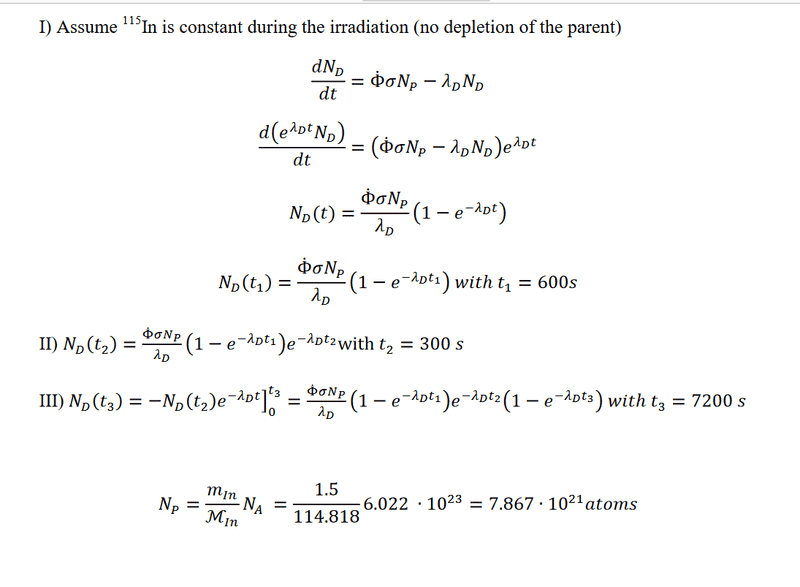
Looking at your solution step 1 I am puzzled by step 1. I think
1682692129807.png
is wrong:
$$\begin{align*}
{{\rm d} N_D\over {\rm d} t}&= \dot\Phi\sigma N_P - \lambda N_D \\ \ \\
{{\rm d} (e^{\lambda t} N_D )\over {\rm d} t}&= \lambda e^{\lambda t} N_D + e^{\lambda t} {{\rm d} N_D\over {\rm d} t} \\ \ \\
& = \lambda e^{\lambda t} N_D + e^{\lambda t} \dot\Phi\sigma N_P - e^{\lambda t} \lambda N_D \\ \ \\
& = e^{\lambda t} \dot\Phi\sigma N_P \tag 1
\end{align*}
$$and not ##\left (\dot\Phi\sigma N_P - \lambda N_D\right ) e^{\lambda t} ## as the solution states...

And then the next line in the solution follows from integrating left and right of ##(1)## from ##t=0## to ##t=t_1## :
we get $$\begin{align*}
e^{\lambda t_1} N_D(t_1) &= {\dot\Phi\sigma N_P\over \lambda} \ \left (e^{\lambda t_1} - 1\right ) \Leftrightarrow \\ \ \\
N_D(t_1) &= {\dot\Phi\sigma N_P\over \lambda} \ \left (1-e^{-\lambda t_1} \right )
\end{align*}
$$
 
  • Like
Likes   Reactions: Graham87
Graham87 said:
Aha, that clears it. But how is that so? So this is because the radioactive decay is proportional to the number of daughter isotopes, which in turn is proportional to the neutron flux rate since the daughter captures neutrons from the parent?

Correction:
BvU said:
The way to find out how much ##^{116m}##In was formed in 10 minutes is to measure how many decays to Sn took place in 120 minutes.
sorry about that. So the path is
1 flux ##\rightarrow## parents ##^{116m}##In
2 parents ##^{116m}_{\ \ 49}##In ##\rightarrow## ##\beta, \gamma## decay product ##^{116}_{\ \ 50}##Sn

The daughter does not capture a neutron from the parent. The daughter undergoes beta decay (i.e. one neutron emits an electron and becomes a proton) yielding an excited state of the ##^{116}_{\ \ 50}##Sn
This nucleus loses energy by emitting a gamma (photon)

##\ ##
 
  • Like
Likes   Reactions: Graham87

Similar threads

  • · Replies 12 ·
Replies
12
Views
2K
Replies
2
Views
2K
Replies
1
Views
1K
  • · Replies 6 ·
Replies
6
Views
3K
  • · Replies 1 ·
Replies
1
Views
2K
Replies
12
Views
2K
  • · Replies 7 ·
Replies
7
Views
2K
  • · Replies 1 ·
Replies
1
Views
2K
  • · Replies 1 ·
Replies
1
Views
3K
  • · Replies 15 ·
Replies
15
Views
4K