Trying to establish a connection between the 2 rotating quadrants

  • Context: Graduate 
  • Thread starter Thread starter bugatti79
  • Start date Start date
  • Tags Tags
    Polynomial
Join the discussion
Ask a follow-up here, or get your own question answered by working scientists, mathematicians and engineers — people, not an autocomplete.
Real named experts · corrections over time · the nuance an AI answer skips
2 replies · 1K views
bugatti79
Messages
786
Reaction score
4
TL;DR
establish connection between the 2 rotating quadrants
Hello All,

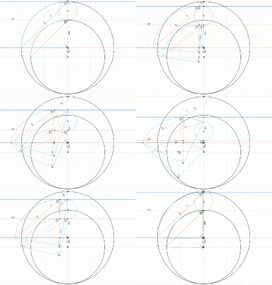
I struggled to find a closed form solution connecting the 2 quadrants via the angles alpha and beta. I filled the schematic with right angle triangles hoping to find a connection but to no avail.
In the end, I decided to create a polynomial function of beta in terms of alpha as I know the coordinates of the vertices. Could someone confirm that a closed form solution is not possible? Is there any way I could use a custom analytic function of beta in terms of alpha? Thanks!

mechanism_v1.gif


Relationship_between_alpha_beta_v1.png


mechanism_v1.gifRelationship_between_alpha_beta_v1.png
 
Last edited by a moderator:
Physics news on Phys.org
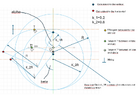
I find the following relation between ##\alpha## and ##\beta##: $$\sin \beta = \frac 1 {K_2} \left( 1 - \cos \alpha + \sin \alpha \right).$$ See if you can confirm this using the method sketched below.

1736366783251.png

In the figure, ##L## and ##L_2## are the lengths of the chords of the two quadrants: ##L = \sqrt 2 R## and ##L_2 = \sqrt 2 K_2 R##.

##\theta## and ##\phi## denote the angles that the two chords make with respect to the horizontal. You can show that ##\theta = \pi/4 - \alpha## and ##\phi = \pi/4 - \beta##.

Thus, ##\sin \theta = (\cos \alpha – \sin\alpha)/\sqrt 2## and ##\sin \phi = (\cos \beta – \sin\beta)/\sqrt 2##.

##A, B, C, D, ## and ##E## label various points. Note that $$AC +CE = AB + BD +DE $$ where

##AC = L \sin \theta##

##CE = R – K_2 R##

##AB = 2K_1R##

##BD = K_2R(1-\cos \beta)##

##DE = L_2 \sin \phi##

Use these relations along with ##K_1 + K_2 = 1##.
 
Last edited:
Reply
  • Like
Likes   Reactions: Baluncore, bugatti79 and renormalize
Hallo TSny,

Indeed the equation you derived is correct and matches the angles calculated from the program/sketch. Many thanks for your input. I neglected to consider in futher detail the segments on the vertical axis.
Much appreciated and Thanks!
 
Reply
  • Like
Likes   Reactions: TSny, Baluncore and berkeman