Trying to wrap my head around gas turbine thermodynamics

Click For Summary

Discussion Overview

The discussion revolves around the thermodynamics of gas turbines and related concepts, including the behavior of air under heat and pressure changes, the design of ramjets and turbojets, and the implications of thermal efficiency in gas turbines. Participants explore theoretical models and practical applications, with a focus on understanding the underlying principles rather than reaching definitive conclusions.

Discussion Character

  • Exploratory
  • Technical explanation
  • Debate/contested
  • Conceptual clarification

Main Points Raised

  • One participant proposes a scenario involving a low-pressure blower and a heated tube, questioning whether heating the air would increase its pressure or convert heat energy into velocity instead.
  • Another participant identifies the described system as a ramjet, noting that the design of the inlet and outlet ducts, along with inlet velocity, influences whether added energy converts to pressure, velocity, or both.
  • A later reply discusses the implications of removing a check valve in the proposed system, suggesting it could resemble a piston version of a ramjet and raises questions about the effects of backflow on the compressor and expander pistons.
  • Concerns are raised about the need for a fast cycle time for effective operation of the proposed piston-driven system, with speculation on how speed might affect the heating and expansion processes.
  • One participant introduces the concept of a turbojet, explaining the relationship between pressure in the combustion chamber and the compressor, including the phenomenon of compressor surge.
  • Another participant inquires about the relationship between thermal efficiency and gas turbine performance, questioning whether high thermal efficiency could lead to structural failure of turbine blades due to increased temperatures.

Areas of Agreement / Disagreement

Participants express various viewpoints on the thermodynamic processes involved in gas turbines and related systems. There is no consensus on the implications of heating air in the proposed scenarios, the effects of speed on performance, or the relationship between thermal efficiency and turbine blade integrity.

Contextual Notes

Participants discuss several assumptions regarding the behavior of air under different conditions, the design of engines, and the effects of thermal efficiency. The discussion includes references to specific cycles and processes, but these are not universally agreed upon and remain open to interpretation.

Who May Find This Useful

This discussion may be of interest to those studying thermodynamics, gas turbine design, and related engineering fields, as well as individuals exploring the principles of propulsion systems such as ramjets and turbojets.

jsh111
Messages
9
Reaction score
2
TL;DR
after air is heated from a source, is the thermal energy converted into pressure, velocity, or both?
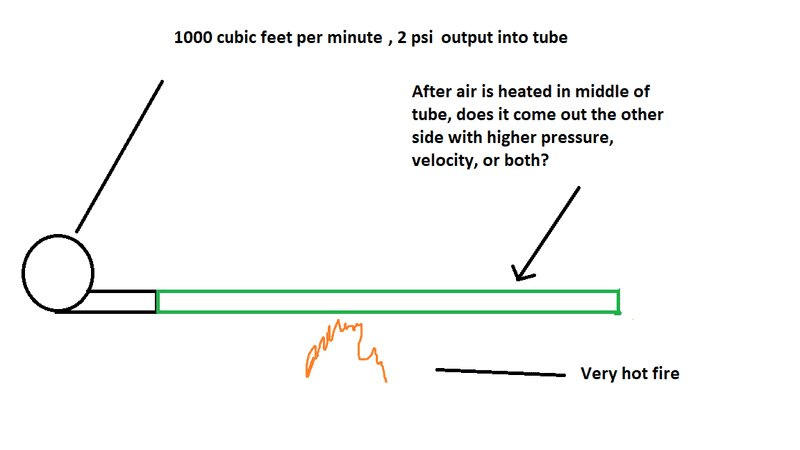
I created a crayon drawing to aid the discussion below:

Basically if you have a blower of low pressure, and you blow it through a tube which has a very hot center, when the heat is added to the air, does the pressure of the air increase after passing by the fire, or is that impossible since this is an Open end and no "trapped volume" , and then maybe the heat energy is transformed into velocity, and not pressure as a result. I know in a normal gas turbine the focus is on pressurizing the air prior to heating through combustion. Suppose you instead focused on a high velocity of air, and heated that. I'm sure there is a reason pressure is focused on but I don't understand. My idea is to pass a low pressure but high velocity quantity of air through such a tube, absorb a much thermal energy into it as possible and use it to drive a "Hillbilly turbine". I know this wouldn't be very efficient, or powerful, for now I'm just trying to understand the concepts.

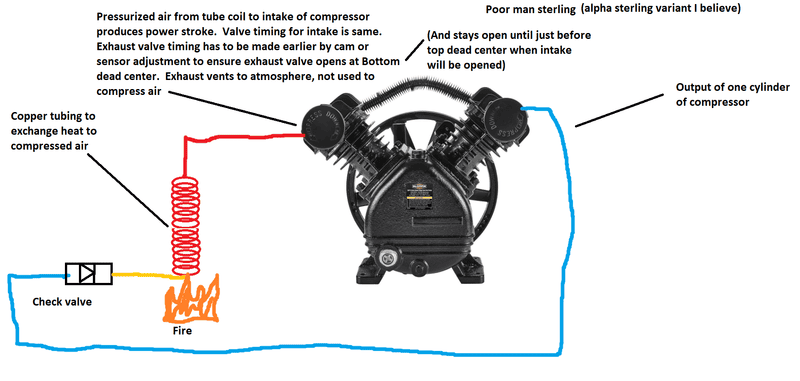
Another question related to this is, if one was to take a two piston system, where one piston is pushing air through a cylinder, past a heat source, and directly into an opposed cylinder which is being driven, I know this is an isochoric process since when one piston is compressing, the other is expanding. When the air is pushed into the heat source energy is added to it, which should pressurize it, but would the pressure not work on both pistons (compressor and expander piston) equally? A picture of this scheme is also below. I believe this is the ericcson cycle, and assumes that the pistons in the below drawing have what I believe is 180 degree phase angle (when one piston begins expanding, the other begins compressing


assumed
piston engine.png

thermodynamics.png
 
Science news on Phys.org
What you are describing is a ramjet and they do work as you expect in particular circumstances. The design of the inlet and outlet ducts - together with the inlet velocity - will determine if the added energy will be converted to pressure, velocity, or both.

1920px-Simple_ramjet_operation.svg.png


jsh111 said:
When the air is pushed into the heat source energy is added to it, which should pressurize it, but would the pressure not work on both pistons (compressor and expander piston) equally?
There is a check valve in your diagram to prevent backflow to the compressor.
 
  • Like
Likes   Reactions: jsh111
jack action said:
What you are describing is a ramjet and they do work as you expect in particular circumstances. The design of the inlet and outlet ducts - together with the inlet velocity - will determine if the added energy will be converted to pressure, velocity, or both.


There is a check valve in your diagram to prevent backflow to the compressor.
Thank you for your reply, I am going to go off and investigate ram jets much more deeply.

If you don't mind me asking another question, suppose in the above drawing the check valve were removed and back flow was now possible. Essentially what I would have now, I believe, is a piston version of the above ram jet. If the pistons were driven slowly, my suspicion is that the heat added would expand equally to both the compressor and expansion piston.

I suspect in order for this scheme to do anything useful you would need a very fast cycle time (and therefore rpm), perhaps unrealistically fast for a piston driven heat engine, but if this is so, what would going faster gain you?

Is it possible that if the pistons were driven fast enough, the delay in heating up the gas would impact the expansion piston more than the compressor piston to get net work out of the thermal system?
 
Last edited by a moderator:
jsh111 said:
suppose in the above drawing the check valve were removed and back flow was now possible. Essentially what I would have now, I believe, is a piston version of the above ram jet
What you would have is a turbojet:

Turbojet_operation-_axial_flow.png

You have a compressor and an expander (turbine) with a combustion chamber in between - which is just a duct. Once the pressure increases in the combustion chamber, it can go back into the compressor which, obviously, is at a lower pressure. And it sometimes does in certain conditions known as pressure surge:
https://en.wikipedia.org/wiki/Compressor_stall#Axi-symmetric_stall_or_compressor_surge said:
Axi-symmetric stall, more commonly known as compressor surge; or pressure surge, is a complete breakdown in compression resulting in a reversal of flow and the violent expulsion of previously compressed air out through the engine intake, due to the compressor's inability to continue working against the already-compressed air behind it.

jsh111 said:
but if this is so, what would going faster gain you?
Momentum. The faster the air goes in, the harder it is to slow it down, or possibly reverse its flow direction. Every compressor has a characteristic known as a surge line that relates the maximum pressure ratio across the compressor versus the mass airflow within the compressor. You can find it on a compressor map:

surge_line.jpg

You could make such a compressor map for your engine with pistons but your pressure ratio and mass flow would most likely be very low without any kind of valves (in the 1.0; 0.00 region on the previous graph).
 
  • Informative
  • Like
Likes   Reactions: jsh111 and berkeman
I am writing a scientific article, the question is: how does thermal efficiency affect a gas turbine? Could it be that with high thermal efficiency, the turbine blades will collapse due to an increase in temperature?
 
GAS said:
I am writing a scientific article, the question is: how does thermal efficiency affect a gas turbine? Could it be that with high thermal efficiency, the turbine blades will collapse due to an increase in temperature?
What? Can you elaborate on your logic?
 

Similar threads

  • · Replies 8 ·
Replies
8
Views
3K
  • · Replies 4 ·
Replies
4
Views
874
  • · Replies 22 ·
Replies
22
Views
6K
  • · Replies 3 ·
Replies
3
Views
2K
  • · Replies 4 ·
Replies
4
Views
2K
  • · Replies 5 ·
Replies
5
Views
3K
  • · Replies 5 ·
Replies
5
Views
2K
  • · Replies 8 ·
Replies
8
Views
2K
Replies
5
Views
2K
  • · Replies 3 ·
Replies
3
Views
4K