Turning the refraction formula into reflection: Negative index

Click For Summary
The discussion revolves around the mathematical transformation of the refraction formula into a reflection context by substituting the refractive index with a negative value. The participants explore how this substitution leads to the same image formation as in reflection, particularly in spherical surfaces, despite being derived from refraction principles. There is skepticism about the physical reality of negative refractive indices, which are primarily theoretical and applicable to artificial materials. The conversation emphasizes the importance of understanding sign conventions and their implications in optics, as well as the need for rigorous derivation in optical design rather than relying on shortcuts. Ultimately, the participants seek clarity on how these mathematical manipulations align with physical principles in optics.
Biker
Messages
416
Reaction score
52
In refraction of spherical surfaces, We derived the formula to be:

## u_2 L^{'} = u_1 L + (u_2 - u_1) R##​
Where ##L^{'}## is the reciprocal of the distance of the image.
##L## is the reciprocal of the distance of the object.
##u_2## is the refractive index of the medium that the light ray is going to
##u_1## is the refractive index of the medium that the light ray is originating from
##R## Reciprocal of radius​
And the sign convention is decided by the light ray direction where it is pointing is positive and the other side is negative.

Then in the book, We had reflection of spherical surfaces. It didn't derive it but merely said that substituting ##u_2 ## with ##-u_1## would do the trick.

I made sense of this as this:
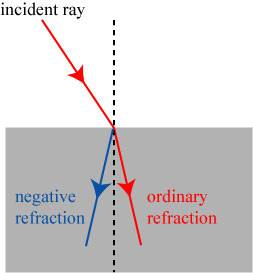
negativerefraction.jpg
Adding a minus sign will flip the direction of the refracted light, So Snell's law becomes
##u_1 sin(\theta_1) = (-u_2) sin(\theta_2)##​
and reflection is a special case where ##u_1 = u_2##, The image created by this law will be the same as if it was a reflective surface.

However, I didn't understand how the math will work out by substituting ##-u_1## in the refraction equation. After substituting:
## L^{'} + L= 2 R ##​
How does it give the correct answer even though that it is entirely different derivation? How does the math works out?

Side question: If one chooses a sign convention, Does he has to check that it applies to all situations?

Hopefully you can help me, Thanks in advance.
 

Attachments

  • negativerefraction.jpg
    negativerefraction.jpg
    6.3 KB · Views: 1,064
Last edited:
Science news on Phys.org
I'm afraid I can't understand your diagram in which there is reflection from the Normal. How can that happen?
Could you be muddling up the symbols? The u's in that post are refractive indices (yes?) and u is sometimes used for the object distance in the lens equation. It's in the lens equation that a sign convention is used.
 
sophiecentaur said:
I'm afraid I can't understand your diagram in which there is reflection from the Normal. How can that happen?
I am sorry, My fault I wasn't clear. If you extend the line backward, It will behave as if it was reflected right? So in a spherical medium with negative refraction index it will act as a mirror. The image in both situation are in the same place. (in case u1= u2)

Edit: u is the refractive index yes, is there is something wrong?
 
Last edited:
Biker said:
If you extend the line backward, It will behave as if it was reflected right?
You can draw any line you like but doesn't it need to relate to reality if you are dealing with Physics?
I don't understand where a negative refractive index comes into real life. Refractive Index is the ratio of c to the wave velocity. A negative c means going backwards. You'll need to cite a reference about this idea. Can you find it anywhere else apart from "the book"?
 
sophiecentaur said:
You can draw any line you like but doesn't it need to relate to reality if you are dealing with Physics?
I don't understand where a negative refractive index comes into real life. Refractive Index is the ratio of c to the wave velocity. A negative c means going backwards. You'll need to cite a reference about this idea. Can you find it anywhere else apart from "the book"?
It doesn't relate to real life at all, Except for some artificial made materials. The trick was that you can make the refractive index negative so that you can get the refracted light to be on the left side rather than the right side.

negativerefraction-jpg.jpg
So its extension backward will form an image (As same as formed by reflection from a spherical mirror if the two "mediums" have the same refractive index but different in sign). All this just to turn the equation of refraction into reflection. And that minus sign does the trick. I think of it as a mathematical trick rather than something real.

https://en.wikipedia.org/wiki/Negative-index_metamaterial

Thank you.
 

Attachments

  • negativerefraction-jpg.jpg
    negativerefraction-jpg.jpg
    6.3 KB · Views: 1,285
Biker said:
It doesn't relate to real life at all, Except for some artificial made materials. The trick was that you can make the refractive index negative so that you can get the refracted light to be on the left side rather than the right side.

View attachment 224777So its extension backward will form an image (As same as formed by reflection from a spherical mirror if the two "mediums" have the same refractive index but different in sign). All this just to turn the equation of refraction into reflection. And that minus sign does the trick. I think of it as a mathematical trick rather than something real.

https://en.wikipedia.org/wiki/Negative-index_metamaterial

Thank you.
Oh. Right. Pity you didn't introduce the full story at the beginning of the thread. I was chasing the spherical surface thing in my mind. The "spherical material" becomes a concave or concave mirror with this meta material . According to the wiki article, you can make it work at longer wavelengths than light for which you can manufacture cells with weird properties.
 
  • Like
Likes Biker
sophiecentaur said:
Oh. Right. Pity you didn't introduce the full story at the beginning of the thread. I was chasing the spherical surface thing in my mind. The "spherical material" becomes a concave or concave mirror with this meta material . According to the wiki article, you can make it work at longer wavelengths than light for which you can manufacture cells with weird properties.
Sorry my fault :frown:.

So back to the original question, Why does substituting it into the equation for refraction
## u_2 L^{'} = u_1 L + (u_2 - u_1) R##
works and gives out the correct answer for a spherical mirror?
Even though the equation was derived for ordinary refraction

What intrigues me in optics, That you first take a situation where you have for example a real object and image then derive an equation for it. After that you apply a sign convention and then it works for any other situation, And as here, It is even compatible for a medium with a negative refractive index. My original question was how does it all work out?
 
Biker said:
My original question was how does it all work out?
Not as you'd expect, I think and you (we) would need to understand the simpler case of a plane interface first. The animation in the wiki article attempts to show a single ray arriving at the interface and that makes sense but I don't think it explains what happens for a finite width beam of many 'rays'. If you extend your diagram, showing a single ray being reflected at the normal where the ray hits the interface and you look at another parallel ray hitting the interface. It is reflected at a different normal (obvs) so you cannot expect an ordinary image to be formed as you would with a regular reflecting surface. On a plane reflector, the phases of rays across a wave front are in step and that generates a new plane wave front in the (i = r) direction. The phase difference between adjacent rays would not produce such a wave front (normal to the reflected rays). The resultant wave front would slope in a different direction. Any virtual image would be seen at a different angle from where the individual rays 'come from'. That's hard to get the head round and isn't shown (imo) by the animation.
It would be a relief if you could find out otherwise and prove me wrong but I think I have a valid point here. If there has been evidence of this idea working at viable frequencies (microwaves, for instance) then that would do, of course.
 
I have previously seen Snell's law for refraction written as ## n_1 \hat{u}_1 \times \hat{n}=n_2 \hat{u}_2 \times \hat{n} ##. In a couple of computations for the vector ## \hat{u}_2 ##, either for the refractive or reflective case, I have found it useful. To get the direction of the vector of the specular reflection, the same equation can be written with ## n_1=n_2 ##. (There are two solutions=there is also the case where ## \vec{u}_2=\vec{u}_1 ## for ## n_1=n_2 ##). ## \\ ## Some of these results that work with these optical formulas by making the indices of refraction the same and possibly introducing a change of sign are a little bit of mathematical trickery. Sometimes things like that are found to work, but they really need to be examined case by case to see whether it works or not. I actually found using results like this hard to digest when I first studied optics: The professor would always have a "sign convention" depending on whether the image was real or virtual, etc. There was a "+" sign for one direction of curvature, and a ## "-" ## for another. It really was a headache and a half.## \\ ## It really is better physics to work from first principles than to try to take shortcuts with formulas, by trying to rearrange a formula to work for a slightly different case.
 
Last edited:
  • Like
Likes sophiecentaur
  • #10
@Charles Link : Do you see my problem about the reflection in a negative refractive index? There is no actual plane for a simple specular reflection to occur in.
 
  • #11
sophiecentaur said:
@Charles Link : Do you see my problem about the reflection in a negative refractive index? There is no actual plane for a simple specular reflection to occur in.
The OP basically has what becomes the lens maker's formula , and in this case, the formula is applied to a single interface. When an image upon reflection is formed by ray trace methods from a spherical surface, angle of incidence is equal to angle of reflection at all points, and with a couple of modifications, the same formula applies to an image that gets formed from reflections as one that gets formed from refractions. ## \\ ## For getting an ## "A" ## on an exam in a basic physics course that covers this elementary optics, it may be necessary to try to figure out how these various shortcuts apply to these formulas, but, in general, that is not how things would be done if you were an optical design engineer. For the latter case, you would do a complete and lengthy derivation, and check it 3 or 4 times to make sure you got it right. You wouldn't want to choose an optical component in your system that may cost upwards of $10,000 and more based on a formula where you needed to have the right "sign convention" to get the right answer.
 
  • Like
Likes Biker and sophiecentaur
  • #12
I am really sorry for the late reply, I had a couple of exams and was extremely busy.

sophiecentaur said:
Not as you'd expect, I think and you (we) would need to understand the simpler case of a plane interface first. The animation in the wiki article attempts to show a sing...
I really didn't grasp what you said, Really sorry for that.

I don't expect it to behave exactly as a reflector but merely for a spherical surface, The image produced in both cases( reflection and refraction with a negative refractive index) would be the same distance away from the surface. It will have the same solution. Do we agree on this?

Charles Link said:
I have previously seen Snell's law for refraction written as ## n_1 \hat{u}_1 \times \hat{n}=n_2 \hat{u}_2 \times \hat{n} ##. In a couple of computations for the vector ## \hat{u}_2 ##, either for the refractive or reflective case, I have found it useful. To get the direction of the vector of the specular reflectio...

Exactly, It is not as much as a headache as it is difficult to see why this sign convention work on all cases. You have to assume that they had to check every situation possible for the sign convention to work and if you ask why the sign convention work even though every situation is different the answer is the math works it out by switching signs. Moreover, the math still works out with negative indices which the equation surely didnt account for. There is nothing more to it but I think this way doesn't give deep understanding of the subject.
 
  • Like
Likes Charles Link
  • #13
Biker said:
I don't expect it to behave exactly as a reflector but merely for a spherical surface,
This means nothing to me if it can't be related to a simpler plane surface. That diagram doesn't predict where an image will be formed. It just shows a single ray.
Forget the sign convention thing if the basic setup hasn't been specified. What ray diagram would you apply to this process?
 
  • #14
sophiecentaur said:
This means nothing to me if it can't be related to a simpler plane surface. That diagram doesn't predict where an image will be formed. It just shows a single ray.
Forget the sign convention thing if the basic setup hasn't been specified. What ray diagram would you apply to this process?
Excuse me if I am being ignorant here, What do you mean by what ray diagram would I apply?

I can make a picture showing a plane mirror and a plane surface of a negative index material and show that they form the same image (one of course will be real and the other virtual), Would that be good?
 
  • #15
The diagram I mean is the only one you posted showing reflection of a sort in the normal. How will that relate to the spherical or plane mirror case?
This thread needs a proper reference.
 
  • #16
The problem is I couldn't find any references, and if I did they would just use the trick without explanation.

Here is a sketch of what I am saying: https://i.imgur.com/KPd0eBp.png

Instead of refracting as normal, The negative sign in the index will flip the ray into the other direction. So the equation will be,
## u_1 sin(i) = (-u_2) sin(r) ##
Where ##u_2## is a positive number, If you make ## u_1 = u_2 ##, You will get that i = r. (absolute value) Which means that the extension of the refracted ray acts as a reflected ray. Thus the solution of the image in both cases will be the same.

Was that clear?
 
  • #17
I can see what the OP's problem is, which I think I already answered in posts 9 and 11, but I'll add a little more here. Some of the basic Optics instruction regarding various lenses and mirrors (and applying a formula with the correct inputs including the correct signs) is done in what I consider to be a somewhat poor manner, but I don't think the way some of it is taught with using sign conventions and unphysical negative indices in the formulas to get them to apply for different cases is going to change anytime soon. ## \\ ## There was just another posting that came up about a week ago regarding the difficulty the OP is having trying to figure out all the different sign conventions that apply in this elementary optics. I left the question alone, because I don't know that I could offer much help to make it any easier for them to try to make heads and tails of it. I didn't like the way it was presented by the prof's in the first year physics sequence when I was a sophomore in college 40+ years ago either. Most of their physics was quite good, but for this part, it seems like the purpose of learning in this manner was simply to make sure that the student learned the different sign conventions for the formulas well enough to work very quickly (as they were always pressed for time) any problem they might give you on the midterm or final exam=Anyway here is that PF thread: https://www.physicsforums.com/threads/lens-and-mirror-equation.946422/#post-5991712
 
Last edited:

Similar threads

  • · Replies 2 ·
Replies
2
Views
2K
  • · Replies 6 ·
Replies
6
Views
3K
  • · Replies 2 ·
Replies
2
Views
3K
Replies
8
Views
4K
  • · Replies 15 ·
Replies
15
Views
2K
  • · Replies 4 ·
Replies
4
Views
2K
Replies
10
Views
3K
Replies
1
Views
4K
  • · Replies 13 ·
Replies
13
Views
4K
Replies
2
Views
3K