Two slit interference: new intensity after doubling width

Click For Summary

Homework Help Overview

The discussion revolves around a two-slit interference problem, specifically focusing on the intensity changes after doubling the width of the slits. Participants are exploring the mathematical relationships involved in the interference pattern, particularly through the use of trigonometric identities and phasor methods.

Discussion Character

  • Mathematical reasoning, Problem interpretation, Assumption checking

Approaches and Questions Raised

  • Participants discuss the derivation of expressions for intensity using cosine addition formulas and question the origin of certain terms, such as sqrt(5 + 4cos(φ). There are attempts to rewrite the expression for intensity in a single cosine form and explore the implications of the resulting equations.

Discussion Status

The conversation is active, with participants sharing insights and attempting to derive relationships between variables. Some have proposed methods to simplify the problem, while others are verifying their understanding of the equations involved. There is no explicit consensus yet, but productive lines of inquiry are being explored.

Contextual Notes

Participants are working under the constraints of homework rules, which may limit the extent of guidance they can provide to one another. There is an emphasis on understanding the derivation process rather than arriving at a final solution.

maxim07
Messages
53
Reaction score
8
Homework Statement
A 2 slit interference pattern is viewed on a screen at distance R>>d from the plane of the slits where d is the slit spacing. If y is the transverse displacement across the screen, with y = 0 corresponding to the forward direction from the centre of the slits the intensity on the screen for small y is given by I = Icos^2(y*pi*d/wR), w is wavelength

If one of the slits is made twice as wide so that the amplitude of the point source has doubled show the intensity becomes

I’ = I/4(9cos^2(y*pi*d/wR) +1)
Relevant Equations
Cos(A) + cos(B) = 2cos(A+B/2)cos(A-B/2)
Here is the solution, I understand how they got E, but I don’t see how they could get E’ from cosine addition formulas? I don’t need to know how to do it with complex numbers.
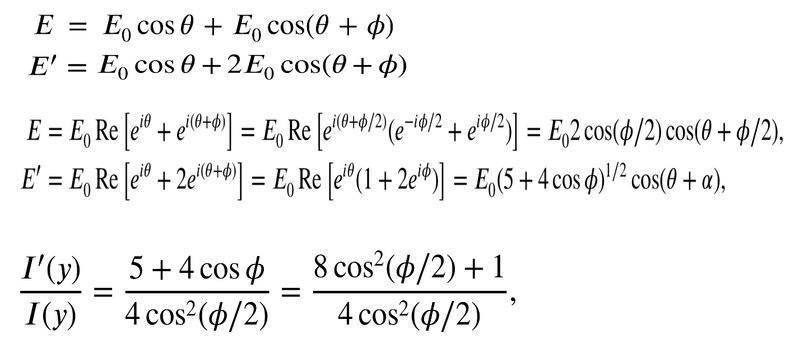
578AC464-5454-42AD-903B-0608511081BA.jpeg
 
Physics news on Phys.org
From a little experimentation, I got that ##\alpha=2\phi/3##. But when I plug that in it does not seem to work. Might be an issue with multiple solutions of ##arccos(c)##.

Cracked it, @maxim07 :
##\cos(\theta)+2\cos(\theta+\phi)=\cos(\theta)+2\cos(\theta)\cos(\phi)-2\sin(\theta)\sin(\phi)##
##=\cos(\theta)(1+2\cos(\phi))-2\sin(\theta)\sin(\phi)##.
Defining ##\cos(\alpha)=\frac{1+2\cos(\phi)}{\sqrt{5+4\cos(\phi)}}## we find that ##\sin(\alpha)=\frac{2\sin(\phi)}{\sqrt{5+4\cos(\phi)}}##
So ##\cos(\theta)+2\cos(\theta+\phi)=(\cos(\theta)\cos(\alpha)-\sin(\theta)\sin(\alpha))\sqrt{5+4\cos(\phi)}##
 
Last edited:
But if you didn’t know the end result where would the sqrt(5 + 4cos(φ)) come from ?
 
The key is to write ##\cos \theta + 2 \cos (\theta + \phi)## as one cosine expression. That is, find ##A## and ##\alpha## such that $$\cos \theta + 2 \cos (\theta + \phi) = A \cos(\theta + \alpha)$$ for all values of ##\theta##.

Hint: One approach is to expand ##\cos(\theta + \phi)## on the left side of the above equation and expand ##\cos(\theta + \alpha)## on the right. Rearrange the overall equation by collecting together all terms containing ##\cos \theta## and all terms containing ##\sin \theta##. Thus obtain an equation of the form $$a \cos\theta + b \sin\theta = 0$$ where ##a## and ##b## are expressions in terms of ##A##, ##\alpha##, and ##\phi##. For this equation to hold for all possible choices of ##\theta##, what can you say about ##a## and ##b##?

An alternate approach is to use phasors. But, I don't know if you are familiar with this method.
 
maxim07 said:
But if you didn’t know the end result where would the sqrt(5 + 4cos(φ)) come from ?
Faced with an equation like ##A\sin(x)+B\cos(x)=C## a useful trick is to let ##\cos(y)=\frac A{\sqrt{A^2+B^2}}##, so ##\sin(y)=\frac B{\sqrt{A^2+B^2}}## and ##\frac C{\sqrt{A^2+B^2}}=\frac A{\sqrt{A^2+B^2}}\sin(x)+\frac B{\sqrt{A^2+B^2}}\cos(x)=\cos(y)\sin(x)+\sin(y)\cos(x)##
##=\sin(x+y)##.
 
TSny said:
The key is to write ##\cos \theta + 2 \cos (\theta + \phi)## as one cosine expression. That is, find ##A## and ##\alpha## such that $$\cos \theta + 2 \cos (\theta + \phi) = A \cos(\theta + \alpha)$$ for all values of ##\theta##.

Hint: One approach is to expand ##\cos(\theta + \phi)## on the left side of the above equation and expand ##\cos(\theta + \alpha)## on the right. Rearrange the overall equation by collecting together all terms containing ##\cos \theta## and all terms containing ##\sin \theta##. Thus obtain an equation of the form $$a \cos\theta + b \sin\theta = 0$$ where ##a## and ##b## are expressions in terms of ##A##, ##\alpha##, and ##\phi##. For this equation to hold for all possible choices of ##\theta##, what can you say about ##a## and ##b##?

An alternate approach is to use phasors. But, I don't know if you are familiar with this method.
tanθ = -a/b ?
 
maxim07 said:
tanθ = -a/b ?
If you have an equation of the form ##a \cos \theta + b \sin \theta = 0##, where ##a## and ##b## are independent of ##\theta##, and if the equation is to hold for all ##\theta##, then you can conclude that ##a = 0## and ##b = 0##. For example, you can let ##\theta = 0## to get ##a = 0##.
 
Ah okay, so then I get 1 + 2cos Φ - Acos α= 0 and -2sin Φ + Asin α = 0
 
maxim07 said:
Ah okay, so then I get 1 + 2cos Φ - Acos α= 0 and -2sin Φ + Asin α = 0
Looks good. You have two unknowns: ##A## and ##\alpha##. And you have two equations.

Can you eliminate ##\alpha## so that you get one equation for ##A##? Hint: ##\sin^2\alpha + \cos^2\alpha = 1##.
 
  • #10
Greta thanks solved it
 
  • Like
Likes   Reactions: TSny

Similar threads

Replies
13
Views
2K
  • · Replies 3 ·
Replies
3
Views
2K
Replies
4
Views
2K
  • · Replies 8 ·
Replies
8
Views
3K
  • · Replies 9 ·
Replies
9
Views
7K
  • · Replies 3 ·
Replies
3
Views
4K
  • · Replies 7 ·
Replies
7
Views
3K
Replies
1
Views
4K
  • · Replies 5 ·
Replies
5
Views
4K
  • · Replies 8 ·
Replies
8
Views
3K