Two variants of the Right hand rule

Click For Summary
SUMMARY

This discussion focuses on two variants of the Right Hand Rule used to determine the direction of magnetic fields produced by electric currents. Method 1 involves pointing the thumb in the direction of the current for straight wires, while Method 2 requires curling the fingers in the direction of the current and extending the thumb to indicate the magnetic field direction for loops. Both methods are equivalent for current loops, but Method 1 is preferable when dealing with straight wires. The conversation emphasizes the importance of intuition and understanding over rote memorization, particularly in exam situations.

PREREQUISITES
  • Understanding of magnetic fields and electric currents
  • Familiarity with the Right Hand Rule
  • Basic knowledge of cylindrical coordinates
  • Concepts of the Biot-Savart law
NEXT STEPS
  • Study the application of the Biot-Savart law in various scenarios
  • Explore advanced techniques in electromagnetism
  • Practice problems involving the Right Hand Rule with different configurations
  • Learn about the implications of magnetic fields in real-world applications
USEFUL FOR

Students in physics courses, educators teaching electromagnetism, and anyone looking to deepen their understanding of magnetic fields and electric currents.

PhysicsTest
Messages
256
Reaction score
27
TL;DR
I found the two variants of right hand rule to find the direction of magnetic field. Need clarity on when to apply each rule.
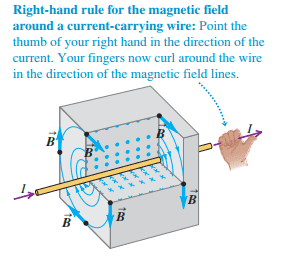
I found two variants of Right hand rule one of the straight wire and to find the direction of the magnetic field i need to use the below method

Method1:
1601214141608.png

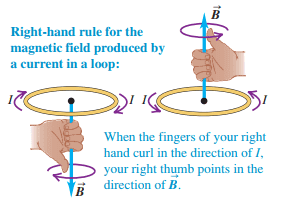
And to find the direction of magnetic field produced by current in a loop

Method2:
1601214233224.png

In method1 the thumb was pointing in the direction of current, but in Method2 the fingers are curl in the direction of current and the thumb points in the direction of Magnetic field. Why this difference and when to apply the Method1 and Method2?
 
Engineering news on Phys.org
It just turns out that for the current loop they're equivalent. Try applying the first method to the loop and you'll realize it's the same. Obviously you can't really apply the second version if there is no loop to curl your fingers. So I'd go with the first version if you have no loop and with the second if you have a loop. But when in doubt, you can always go back to basics...hard math.
 
  • Like
Likes   Reactions: PhysicsTest
They both look the same to me; just one is using the fingers to follow the current and the other uses the thumb.

You can either or both, or use the one that makes you most comfortable and that you can follow consistently.

"back to basics" and "hard math" is fantastic when you have time. I use to forget and get twisted up and I'd go back to basics, but the exams often had a time constraint deriving things during the exam would eat up valuable time and easily pave the way to a failing grade instead of the perfect score I felt like I could have earned. Even when the exam asks you to solve the problem using math the students who have the insight/intuition are likely going to do better. Knowing the material isn't good enough for exams you're being tested on your intuition and if the class is curved, then you're competing for your grade and if other students have intuition or tricks to follow you're going to be running a race on one foot.
 
Well, "hard math" is a bit of an exaggeration. Draw a coordinate system, and you let for example the current flow in the positive ##\vec{e_z}## direction and the radial distance vector from the wire is in the ##\vec{e_r}## direction then just use ## \vec{e_z} \times \vec{e_r} = \vec{e_{\theta}} ## in cylindrical coordinates. You don't need to use the full Biot-Savart law for it.
 

Similar threads

  • · Replies 21 ·
Replies
21
Views
9K
  • · Replies 18 ·
Replies
18
Views
4K
  • · Replies 118 ·
4
Replies
118
Views
10K
  • · Replies 8 ·
Replies
8
Views
4K
  • · Replies 27 ·
Replies
27
Views
1K
Replies
9
Views
638
Replies
5
Views
2K
Replies
34
Views
2K
  • · Replies 2 ·
Replies
2
Views
1K
  • · Replies 3 ·
Replies
3
Views
2K