Sorry, just saving typing.
o/c = open circuit. ie. negligible current, only voltage. Voltmeter has very high resistance, 20 kΩ - 10 MΩ
s/c = short circuit. ie negligible voltage, only current. Ammeter has very low resistance.
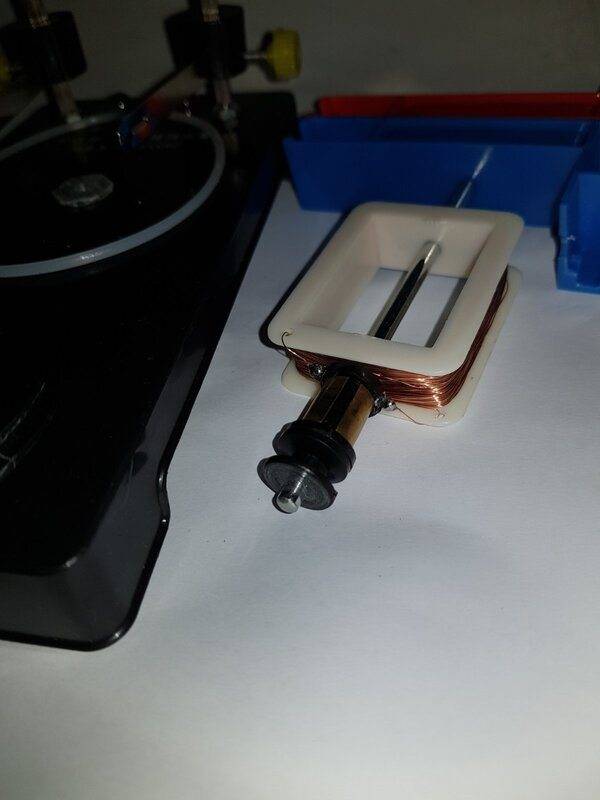
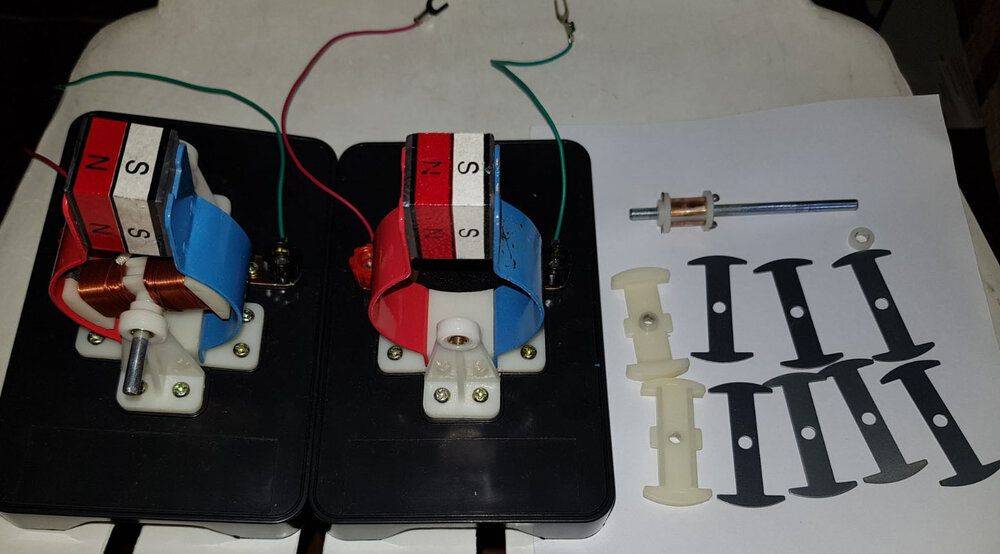
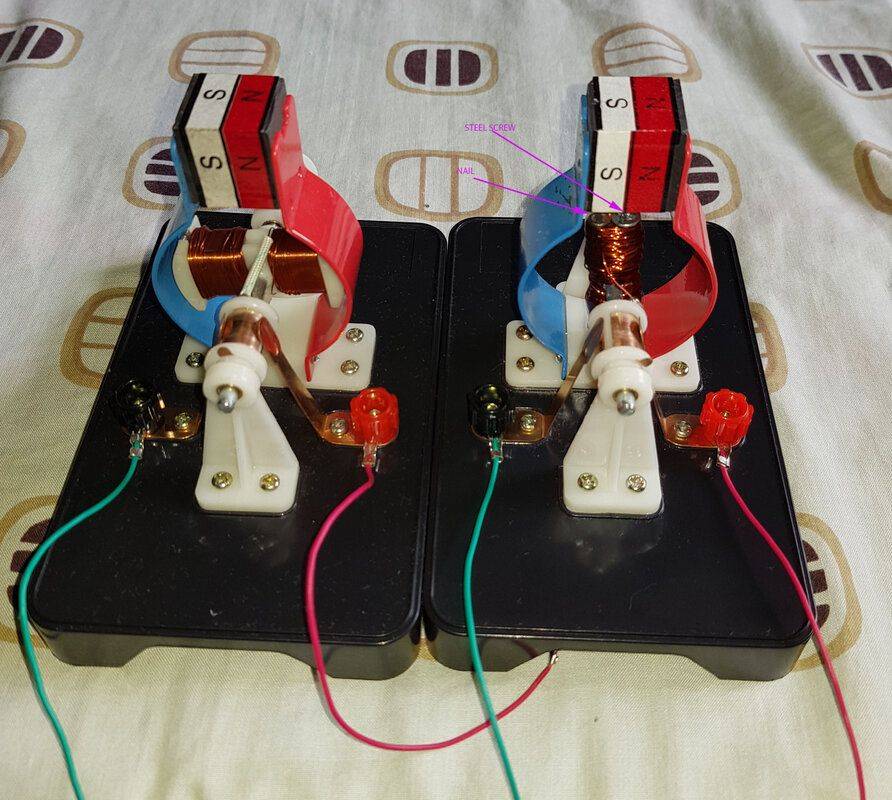
"I measured the resistance of the winding of the amazon generator by directly tapping the leads at the 2 commutators. It is exactly 24 ohms."
So this should be correct and your other measurements must have faults.
"Why does putting multimeter in AC gives higher voltage?"
Measuring DC is easy: there is only one value.
AC is more confusing: you could measure the peak value, the RMS value (which is equivalent to DC value in resistive circuit), or average value (average modulus, otherwise it would be zero for pure AC!) It gets even more difficult when the voltage is a mixture of AC and DC. What you see depends on your meter. Many meters give an average, but modern electronic meters can do RMS (and maybe peak as well.)
But, for all that, I can't see how you get the values you do.
"What I exactly want to know is this principle. Whether if the rotor at motor mode rotates at a certain RPM at a given voltage and current. Whether if the rotor is put in generator mode. It will output the same voltage and current at the same RPM. What do you think?"
View attachment 274676This is a model circuit for a DC motor. There is a source of emf, whose value depends on the speed of rotation and the motor constant - a function of the stator magnetic field and rotor windings.
At a given speed the emf is determined, kω. The current is then determined by the internal resistance R and the external load resistance. The voltage you measure at the output terminals or across the load will be less than Bemf by the voltage across the internalresistance R. If there is no load and no current, then you measure the Bemf.
When you drive it as a motor, the current is determined by the resistance, the applied voltage and the speed that it rotates - which will depend on the mechanical load and friction.
Say, at 1000 rpm the emf is 5 V (and R is 24 Ω as you measured) then attaching a 26 Ω load will give a current of ## \frac {5 V}{24 +26 Ω } = 0.1 A ## with ## 0.1 A \times 26 Ω = 2.6 V ## across the load.
To drive it as a motor you will need to apply more than 5 V to get that same 1000 rpm, because you need some current to give the torque to overcome friction.
If you apply 5 V, then ## \frac {5V}{24 Ω } = 208 mA ## will flow (neglecting battery resistance.)
If the torque that generates is enogh to overcome friction, then the rotor will accelerate.
That will cause some Bemf which will reduce the current. For eg. if the rotor got up to 900 rpm, the Bemf will be 4.5 V, so the current will drop to ##\frac {5-4.5 V}{24 Ω } = 21 mA ##
If that is just enough to overcome friction at that speed, then that's the speed it will run at. If it isn't, then it won't ever reach that speed.
If for eg. it needs about 25 mA to have the torque needed to overcome friction, that requires a voltage across R of ## 0.025 A \times 24 Ω = 0.6 V ##
So with 5 V battery the Bemf can rise to 4.4 V , leaving 0.6 V across R. But Bemf = 4.4 V means it is rotating at ## 1000 \times \frac {4.4}{5} = 880 rpm ##
If you now add a mechanical load, that requires extra torque, which requires extra current.
Say eg. the extra load requires a current of 100 mA. Now the total required current is 125 mA to give the torque needed for the load and friction.
That requires a voltage across R of ## 0.125 A \times 24 Ω = 3 V ##
So now we can afford only 2 V of Bemf and the motor must slow to ## 1000 \times \frac{2}{5) = 400 rpm ##
If we wanted the motor to run at 1000 rpm with that load, then we need our 125 mA current to provide the correct torque and enough voltage to overcome the 5 V Bemf. So with 125 mA needing 3 V across R, we need a supply of 8 V.
That's probably laboured the point a bit, but I hope it shows the nature of the model and the source of the values.