Un-clear proof of my professor - logic and theory set

Join the discussion
Registration is free. Start your own thread to ask a follow-up.
4 replies · 2K views
dana1
Messages
4
Reaction score
0
hey all, I am currently studing logic and set theory.
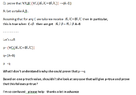
My professor solved this question in a way that seems quit strange to me-
Hope you could be of help.
I attached the question in image file so signs won't be lost
 
Attachments
  • question.png
    question.png
    12.4 KB · Views: 141
Physics news on Phys.org
dana said:
hey all, I am currently studing logic and set theory.
My professor solved this question in a way that seems quit strange to me-
Hope you could be of help.
I attached the question in image file so signs won't be lost

Hi dana! Welcome to MHB! :)

It seems you have made a typo.
Can it be that you meant: "shouldn't she look at the case that will give p=true and prove that if follows that q=true"?

If so, that is exactly what she did.
She assumed that $p$=true.
In other words, that:
$$\forall C(A\cup B = B \cup C)\qquad (1)$$

From here she wanted to prove that $q$=true, meaning:
$$A=B\qquad\qquad\qquad\qquad (2)$$

So the question is if we can up with a chain of deductions that leads from (1) to (2).

Now perhaps I am misunderstanding you.
Can you explain?
 
I like Serena said:
Hi dana! Welcome to MHB! :)

It seems you have made a typo.
Can it be that you meant: "shouldn't she look at the case that will give p=true and prove that if follows that q=true"?

If so, that is exactly what she did.
She assumed that $p$=true.
In other words, that:
$$\forall C(A\cup B = B \cup C)\qquad (1)$$

From here she wanted to prove that $q$=true, meaning:
$$A=B\qquad\qquad\qquad\qquad (2)$$

So the question is if we can up with a chain of deductions that leads from (1) to (2).

Now perhaps I am misunderstanding you.
Can you explain?

hey Serena,
thanks for answering. Yes I had a typo- I ment if q=t then p=t.
my confusion is that she didnt say anything about all cases where p=t and c isn't the empty set. because see should prove this is correct for all cases not just one. am I correct?
 
dana said:
hey Serena,
thanks for answering. Yes I had a typo- I ment if q=t then p=t.
my confusion is that she didnt say anything about all cases where p=t and c isn't the empty set. because see should prove this is correct for all cases not just one. am I correct?

That sounds as if you would like to proof that $\forall C$ we have that:
$$(A\cup C = B \cup C) \to (A=B)$$
which can also be written as:
$$\forall C((A\cup C = B \cup C) \to (A=B))$$As opposed to:
$$(\forall C(A\cup C = B \cup C)) \to (A=B)$$

How does that look as a difference?
 
There are some $A,B,C$'s for which is is NOT true that:

$A \cup C = B \cup C \implies A = B$.

For example, if $A,B \subseteq C$, but $A \neq B$, then $A \cup C = B \cup C = C$.

To see why your professor's proof works, consider this statement:

"If John knows everyone, then John knows Sally".

We do not need to argue that since John knows Sam, John knows Sally; and since John knows Tom, that John knows Sally; etc., some of which may not even be true (for example, none of the forgoing statements are true in and of themselves, as it is possible to imagine the case where John knows Tom, but John does not know anyone BUT Tom).

We merely need to observe that since, in particular, Sally is part of "everyone", we have: John knows Sally implies John knows Sally, which is always true.

A statement like: "For all (something), such-and-such involving (something) is true" is a shorthand way of saying:

For something A it is true AND
for something B it is true AND
for something C it is true AND...etc.

If the truth of the statement for "something X" implies the conclusion we are after, that is the only case we need.

Contrast this with a statement like:

If $A \cup C = B \cup C$, then $A = B$. Here, we DO have to consider the truth value of every statement involving the $C$ part, because if we find even ONE $C$ for which $A \cup C = B \cup C$ is true, but $A = B$ is false, we have:

true implies false, which is false.

It's a subtle distinction, but the range (which part of the statement it applies to) of the quantifier "for all" makes a BIG difference.