Under-the-Ice Prototype Rover for Europa

Click For Summary
SUMMARY

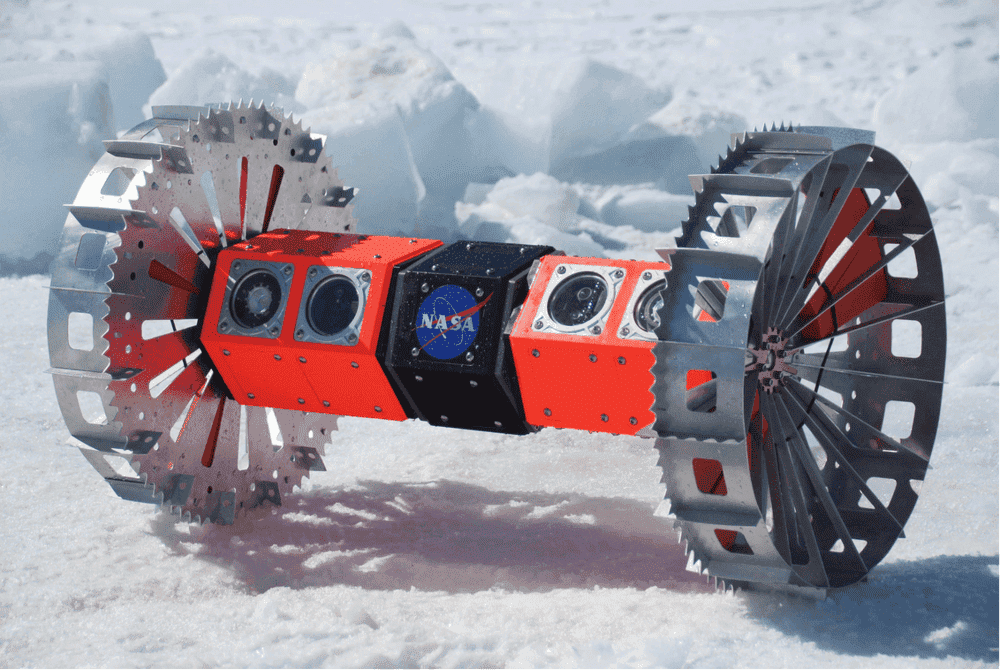
The Under-the-Ice Prototype Rover, named Bruie (Buoyant Rover for Under-Ice Exploration), has been developed by NASA to explore the icy shell of Europa, which is theorized to be 15 to 25 kilometers thick. The rover has successfully undergone tests in extreme environments, including Alaska and Antarctica, where it was submerged for over 42 hours. It operates using a tether for power and communication, as direct radio signals cannot penetrate the thick ice. The rover's design allows it to analyze the ice-ocean interface without disturbing delicate ecosystems, making it a crucial tool for studying potential extraterrestrial life.

PREREQUISITES
  • Understanding of planetary science, specifically Europa's ice shell characteristics.
  • Familiarity with remote-operated vehicles (ROVs) and their operational constraints.
  • Knowledge of power supply systems for robotic exploration, including nuclear power applications.
  • Basic principles of non-invasive exploration techniques in astrobiology.
NEXT STEPS
  • Research the engineering principles behind the design of the Bruie rover.
  • Study the effects of ice thickness on communication and power transmission in extraterrestrial environments.
  • Explore non-invasive techniques for studying extraterrestrial ecosystems.
  • Investigate the potential for nuclear power in deep-space robotic missions.
USEFUL FOR

Aerospace engineers, planetary scientists, astrobiologists, and anyone interested in the exploration of icy celestial bodies and the search for extraterrestrial life.
BillTre
Science Advisor
Gold Member
Messages
2,739
Reaction score
11,966
TL;DR
NASA has tested a rover to explore the underside of the ice surface of Europa
NASA'a rover prototype floats up to the bottom of the surface ice and rolls around looking at things.
It has been tested in Alaska and the Antarctic.
Screen Shot 2020-01-07 at 4.24.43 PM.png


This NY Times article has videos of it moving around and of what it sees under the Antarctica ice.
 
  • Like
  • Informative
Likes   Reactions: Ibix, Klystron and anorlunda
Physics news on Phys.org
How cool is that... :smile:
 
They would have to get it down there first.
How thick is the ice in/ on Europa?
Get it halfway down and the hole freezes over - poor thing.:nb)
 
I was wondering about that.
As I recall kilometers thick.

Here's what NASA says:
Theory and observation indicate that Europa's icy shell is around 15 to 25 kilometers (10 to 15 miles) thick, overlying an ocean approximately 60-150 kilometers (40 to 100 miles) deep. Support for this hypothesis comes from observations of pits, domes, and spots on Europa's surface. The size and spacing of the features suggests that they are due to churning within the ice shell, and theory suggests that such churning (called convection) can occur only if the shell is between greater than about 15 kilometers thick. Measurements of the height of domes on Europa (up to a kilometer or just over half a mile high) also suggest that the ice shell must be fairly thick for the domes to be so tall. Some scientists have argued that the ice shell might be thinner, only a few kilometers thick.
 
berkeman said:
How cool is that... :smile:
0 C.

But yes, I agree. A floating robot ambling around on the underside of ice is rather brilliant. What's its endurance, does anyone know?
 
  • Haha
  • Like
Likes   Reactions: BillTre and berkeman
Maybe nuclear power onboard? Certainly no solar panels down there. Is is plausible that they use nuclear power to melt its way down through the ice cap?
 
  • Like
Likes   Reactions: BillTre
This prototype I believe is tethered, for the signals and perhaps power.
On Europa it would have to be on its own.
 
  • Like
Likes   Reactions: BillTre
256bits said:
This prototype I believe is tethered, for the signals and perhaps power.
On Europa it would have to be on its own.
I think it would need to be tethered to a lander on the surface. I don't think you can radio through 10 km of ice.
 
  • Like
Likes   Reactions: BillTre and 256bits
From the linked article:
A fourth, critical test kept it submerged beneath the ice for 42 hours and 30 minutes. Andy Klesh, the project’s lead engineer, drove the rover using a laptop. While the rover can be piloted via satellite connection, during this mission, Dan Berisford, a mechanical engineer, carefully fed it a thin yellow tether.

and:
To study such life, any undersea rover would need to be noninvasive.“While the thrusters of a normal underwater remote-operated vehicle can jet-blast delicate algaes off the bottom of ice sheets during close encounters, Bruie gently tiptoes beneath them,” said Daniel Arthur, a technologist who works with Caltech and the University of Western Australia.

The rover analyzes the ice-ocean interface passively and at consistent distances, drawing little power — especially relative to submarine-type drones. “Power will be in short supply on Europa,” Dr. Arthur said, “and we don’t want a propeller obliterating humanity’s first encounter with extraterrestrial life.”

Bruie = Buoyant Rover for Under-Ice Exploration
 
  • Like
Likes   Reactions: Ibix
  • #10
Thanks - I recall reading the second sentence of our first quote but missed the first... somehow. o0)
 

Similar threads

  • · Replies 9 ·
Replies
9
Views
3K
  • · Replies 1 ·
Replies
1
Views
4K
  • · Replies 3 ·
Replies
3
Views
4K
  • · Replies 26 ·
Replies
26
Views
3K
  • · Replies 5 ·
Replies
5
Views
2K
  • · Replies 11 ·
Replies
11
Views
5K
  • · Replies 7 ·
Replies
7
Views
8K
  • · Replies 21 ·
Replies
21
Views
5K
  • · Replies 7 ·
Replies
7
Views
3K
  • · Replies 5 ·
Replies
5
Views
4K