Understanding Angular Momentum and Energy Equations

6 replies · 1K views · last reply
LCSphysicist
Messages
644
Reaction score
163
Homework Statement
1. Obtain Eqs.(9.7a and b) by differentiating Eqs.(9.8a and b) with respect to time.
Relevant Equations
Aceleration in a polar coordinates and energy and momentum angular in a central force motion
Since the equations are, actually, the question, i will post the image with relevant equations here:
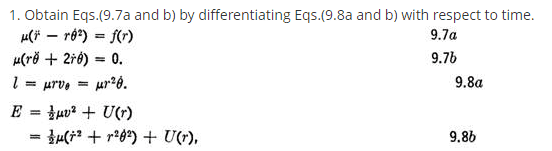
Typed homework problem: obtain Eqs. 9.7a and b by differentiating Eqs. 9.8a and b with respect to time, followed by equations 9.7a, 9.7b, 9.8a and 9.8b for polar motion, including angular momentum l = mu r v_theta = mu r^2 theta-dot and energy E = (1/2) mu v^2 + U(r).

it seems strange, I'm almost sure that I didn't make a mistake in the differentiation, but differentiating 9.8b I found 9.7a with both positive terms
 
LCSphysicist said:
Homework Statement:: 1. Obtain Eqs.(9.7a and b) by differentiating Eqs.(9.8a and b) with respect to time.
Relevant Equations:: Aceleration in a polar coordinates and energy and momentum angular in a central force motion

Since the equations are, actually, the question, i will post the image with relevant equations here:

View attachment 262151
it seems strange, I'm almost sure that I didn't make a mistake in the differentiation, but differentiating 9.8b I found 9.7a with both positive terms
Did you remember to differentiate ##r^2\dot\theta^2## using the product rule?
 
haruspex said:
Did you remember to differentiate ##r^2\dot\theta^2## using the product rule?
Yes, will post soon.
 
Handwritten derivation labeled 9.1: E = ½μ(ṙ² + r²θ̇²) + U(r), then dE/dt = ½μ(2ṙr̈ + 2rṙθ̇²) + (dU/dr)ṙ = 0, leading to μ(ṙr̈ + rṙθ̇²) = −(dU/dr)ṙ, dU/dr = −f(r), and μ(r̈ + rθ̇²) = f(r) (Eqn. 9.7a).

[This solution is actually equal to my solution, which is, unfortunately, not equal to equation nine.seven a]

Assuming theta two dots equal zero.
 
LCSphysicist said:
Yes,
No, you didn't.
LCSphysicist said:
Assuming theta two dots equal zero.
Why would you assume that?
 
  • Like
Likes   Reactions: LCSphysicist
haruspex said:
No, you didn't.

Why would you assume that?
I did, just cutted the therm with theta two dots and so don't put in the resolution:

call theta by a
(r²a²')' = 2rr'a²' + 2r²a'a'', if a'' is zero, = 2rr'a²' like the image

But stopping to think now, i really see that [theta]'' is not zero, how to deal with that term?
 
Wow, using L = mw²r i got the answer! thank you