SprucerMoose
- 62
- 0
Hey guys,
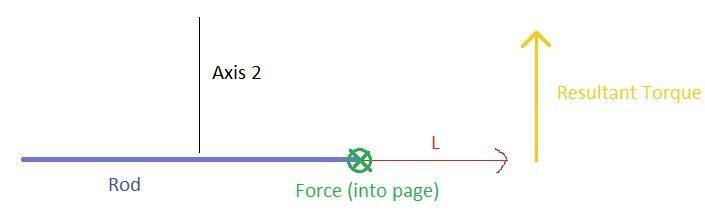
If I have a uniform rod rotating about its longitudinal axis of symmetry in space it will have an angular momentum vector that is colinear to this axis. If I now apply a force directly perpendicular to this (as shown in attachment) it will induce a torque that is perpendicular to the angular momentum vector. The centre of mass of the object must accelerate in the direction of the applied force and the torque will cause a change in angular momentum.
My question is will this torque just cause this rod to kick up or down, i.e. the angular momentum vector follows the direction of the torque vector and/or will the rod also attempt to rotate about axis 2 in the diagram? If it does rotate about axis 2, where does the torque come from to change the perpendicular angular momentum vector.
If I have a uniform rod rotating about its longitudinal axis of symmetry in space it will have an angular momentum vector that is colinear to this axis. If I now apply a force directly perpendicular to this (as shown in attachment) it will induce a torque that is perpendicular to the angular momentum vector. The centre of mass of the object must accelerate in the direction of the applied force and the torque will cause a change in angular momentum.
My question is will this torque just cause this rod to kick up or down, i.e. the angular momentum vector follows the direction of the torque vector and/or will the rod also attempt to rotate about axis 2 in the diagram? If it does rotate about axis 2, where does the torque come from to change the perpendicular angular momentum vector.