Understanding Axial Loading On a Member

  • Thread starter Thread starter tomtomtom1
  • Start date Start date
  • Tags Tags
    Axial Member
Click For Summary
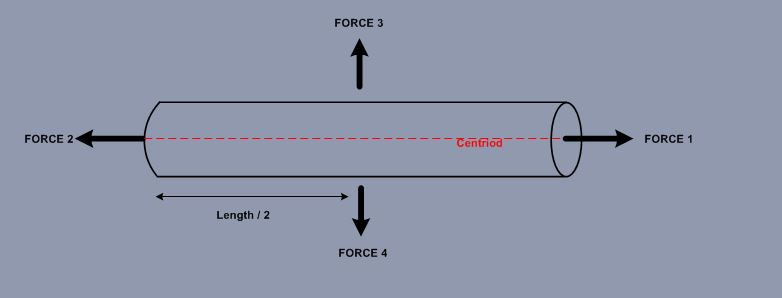
Axial forces are defined as forces that cause compression or tension along the centroid of a member, categorized as concentric when passing through the centroid and eccentric otherwise. The discussion clarifies that while Forces 1 and 2 are axial loads, Forces 3 and 4 are considered transverse forces and do not contribute to axial loading. Understanding the application of these forces is crucial, as their distribution can vary, impacting how they affect the member. The distinction between axial and transverse forces is essential for accurate analysis in structural engineering. Overall, the explanation helped clarify the concept of axial loading.
tomtomtom1
Messages
160
Reaction score
8
Homework Statement
Understanding Axial Loading On A Member
Relevant Equations
Understanding Axial Loading On A Member
Hello all

I was hoping someone could explain Axial Forces with respect to the diagram below.

I know that Axial forces relate to compression or tension and if the forces go through the centriod then it is said to be concentric or if it is not going through the centriod then its said to be eccentric.

I know that Force 1 and 2 are forces that are causing the axial loading but doesn't Force 3 and 4 also cause the member to be in tension so why isn't Force 3 and 4 considered to be the axial loading?
AXFORCeS.JPG
I just want to get it correct in my head and I'm struggling.

Can someone explain?

Thanks
 
Physics news on Phys.org
tomtomtom1 said:
Homework Statement:: Understanding Axial Loading On A Member
Homework Equations:: Understanding Axial Loading On A Member

Hello all

I was hoping someone could explain Axial Forces with respect to the diagram below.

I know that Axial forces relate to compression or tension and if the forces go through the centriod then it is said to be concentric or if it is not going through the centriod then its said to be eccentric.

I know that Force 1 and 2 are forces that are causing the axial loading but doesn't Force 3 and 4 also cause the member to be in tension so why isn't Force 3 and 4 considered to be the axial loading?View attachment 254622I just want to get it correct in my head and I'm struggling.

Can someone explain?

Thanks
In the context of rods, beams etc. the axis is considered to be in the long direction. The other pair of forces you show may be termed transverse.
But it is not clear how those other two forces are applied. Are they localised to the places shown, uniformly distributed along strips at top and bottom, uniformly distributed over half cylinders, a result of rotation about the axis ("centrifugal"), ...?
 
haruspex said:
In the context of rods, beams etc. the axis is considered to be in the long direction. The other pair of forces you show may be termed transverse.
But it is not clear how those other two forces are applied. Are they localised to the places shown, uniformly distributed along strips at top and bottom, uniformly distributed over half cylinders, a result of rotation about the axis ("centrifugal"), ...?

Hi haruspex

I think i get, axial loads act through the centriod of a member or parallel to a member - the bit that cleared things up was the Through / Parallel part.

It makes sense to me thank you.
 
The book claims the answer is that all the magnitudes are the same because "the gravitational force on the penguin is the same". I'm having trouble understanding this. I thought the buoyant force was equal to the weight of the fluid displaced. Weight depends on mass which depends on density. Therefore, due to the differing densities the buoyant force will be different in each case? Is this incorrect?

Similar threads

Replies
4
Views
2K
  • · Replies 5 ·
Replies
5
Views
3K
  • · Replies 20 ·
Replies
20
Views
2K
  • · Replies 1 ·
Replies
1
Views
23K
Replies
2
Views
1K
  • · Replies 8 ·
Replies
8
Views
3K
  • · Replies 18 ·
Replies
18
Views
3K
  • · Replies 6 ·
Replies
6
Views
5K
  • · Replies 18 ·
Replies
18
Views
2K
  • · Replies 2 ·
Replies
2
Views
2K