Understanding Compression in Eccentrically Loaded Columns and Beams

Click For Summary

Discussion Overview

The discussion revolves around the concepts of compression and stress in eccentrically loaded columns and beams, particularly focusing on the differences in stress states between these two structural elements. Participants explore the implications of loading conditions on stress distribution, including the presence of compression in different directions and the assumptions involved in analyzing these structures.

Discussion Character

  • Exploratory
  • Technical explanation
  • Debate/contested

Main Points Raised

  • One participant questions why an eccentrically loaded column experiences uniform compression while a beam under similar conditions does not, suggesting a potential misconception about the stress states.
  • Another participant points out that the analysis of beams is often an approximation, particularly for beams that are much taller than wide, and that close to the contact points of forces, compression may occur.
  • There is a discussion about the state of stress in the horizontal beam, with a focus on the vertical direction and the implications of shear stress versus compression.
  • Some participants highlight that stress and strain are not uniform throughout an object, referencing specific elements in the beam to illustrate this point.
  • One participant expresses a desire to understand how to calculate vertical compression or tension at arbitrary points in a beam, particularly above supports where compressive stresses may be significant.
  • A suggestion is made to use 3D CAD tools and finite element analysis for more sophisticated modeling of the stress states in beams.

Areas of Agreement / Disagreement

Participants express differing views on the nature of stress in beams versus columns, with some agreeing on the presence of compression in certain areas of beams while others emphasize the complexity and variability of stress distribution. The discussion remains unresolved regarding the exact nature and calculation of vertical compression in beams.

Contextual Notes

Participants note that the analysis relies on approximations and assumptions, particularly regarding the uniformity of stress distribution and the conditions under which compression occurs. There is also mention of the limitations of textbook explanations in capturing the nuances of real-world applications.

curiousnoncat
Messages
4
Reaction score
0
I'm a student taking a non-calculus strength of materials course, and I believe I have what is probably a very simple misconception.

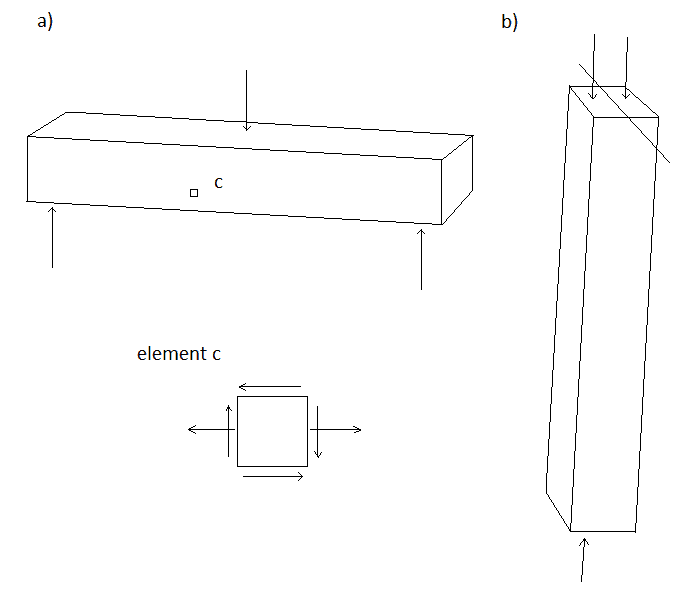
I'm wondering why in the "eccentrically loaded column" b), which has two point loads placed at distances of equal magnitude from a centroidal axis, the moments will cancel each other out, and the cross section will be under uniform compression of a single value, but an element on beam a), which is in a state of plane stress, is not considered to be in compression in the y direction (at least in my textbook).

These seem completely analogous to me, besides the material's dimensions. I've got this sneaking suspicion that compression must exist in the y direction but is "negligible" (would it be negligible in an I-beam?), and also not uniformly distributed.
25dae4978b28c2e7aac57692ba9aeb43.png
 
Engineering news on Phys.org
What is the y direction?

curiousnoncat said:
I'm wondering why in the "eccentrically loaded column" b), which has two point loads placed at distances of equal magnitude from a centroidal axis, the moments will cancel each other out, and the cross section will be under uniform compression of a single value
That is an approximation for beams that are much taller than wide (using the orientation of (b) for those words).
 
mfb said:
What is the y direction?

That is an approximation for beams that are much taller than wide (using the orientation of (b) for those words).
By the y direction, I meant the vertical direction on element c, which has no stress indicated.

And what I'm really interested in hearing is a response to that part of the question, about the state of stress in the horizontal beam.
 
Last edited:
This is again an approximation. Close to the contact points of the forces there will be compression, but you do not have an opposing force on the other side of the beam that would give the usual way of compression. You get shear stress instead.
 
curiousnoncat said:
And what I'm really interested in hearing is a response to that part of the question, about the state of stress in the horizontal beam.
I think I see where your misconception is. You're thinking of the beam as a static whole.
curiousnoncat said:
I've got this sneaking suspicion that compression must exist in the y direction but is "negligible" (would it be negligible in an I-beam?), and also not uniformly distributed.
Notice how there is particular attention paid to element c. This is an attempt to show you that stress/strain is not necessarily uniform throughout an object. Precisely as you surmised.

See http://en.wikipedia.org/wiki/Neutral_axis for a little more information.
 
jackwhirl said:
I think I see where your misconception is. You're thinking of the beam as a static whole.

Notice how there is particular attention paid to element c. This is an attempt to show you that stress/strain is not necessarily uniform throughout an object. Precisely as you surmised.

See http://en.wikipedia.org/wiki/Neutral_axis for a little more information.
Thanks Jack, but I am aware of the derivation for bending stress and the distribution of shear stress in vertical and longitudinal planes, so what I want to know is how you would calculate vertical compression or tension in a beam at an arbitrary point. For example, surely as mfb said, right above actual beam supports there would be compressive stresses approximately equal to the reaction force divided by the area of application.
 
curiousnoncat said:
Thanks Jack, but I am aware of the derivation for bending stress and the distribution of shear stress in vertical and longitudinal planes, so what I want to know is how you would calculate vertical compression or tension in a beam at an arbitrary point.
Well, I would model the system in a 3D CAD tool and run it through finite element analysis...
If you're looking for something more sophisticated, I must leave that to our more erudite fellows.
 

Similar threads

  • · Replies 1 ·
Replies
1
Views
3K
Replies
2
Views
3K
  • · Replies 1 ·
Replies
1
Views
7K
  • · Replies 1 ·
Replies
1
Views
4K
  • · Replies 23 ·
Replies
23
Views
8K
  • · Replies 5 ·
Replies
5
Views
3K
Replies
5
Views
11K
  • · Replies 8 ·
Replies
8
Views
3K
  • · Replies 4 ·
Replies
4
Views
3K
Replies
4
Views
2K