musicfairy
- 101
- 0
I need some help on those multiple choice questions that I'm using to learn the concepts. Some of them I know how to do and needs someone to check my work. Other ones I need hints so I know how to start.
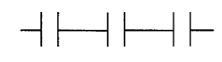
1. Three ½ μF capacitors are connected in series as shown in the diagram above. The capacitance of the combination is
(A) 3/2 μF
(B) 1 μF
(C) 2/3 μF
(D) 1/2 μF
(E) 1/6 μF
I used this equation: 1/Ceq = 1/C1 + 1/C2 + 1/C3 and got E as the answer.
2. In a certain region, the electric field along the x-axis is given by
E = ax + b, where a = 40 V/m2
and b = 4 V/m.
The potential difference between the origin and x = 0.5 m is
(A) -36 V
(B) -7 V
(C) -3 V
(D) 10 V
(E) 16 V
I tried to plug in 0 and 0.5 for x and subtract them but that didn't work out.
3. A 20 μF parallel-plate capacitor is fully charged to 30 V. The energy stored in the capacitor is most nearly
(A) 9x10³ J
(B) 9xl0-3 J
(C) 6x10⁻⁴ J
(D) 2x10⁻⁴ J
(E) 2x10⁻⁷ J
Used the equation U = (1/2)CV2 and got B as the answer.
4. A potential difference V is maintained between two large, parallel conducting plates. An electron starts from rest on the surface of one plate and accelerates toward the other. Its speed as it reaches the second plate is proportional to
(A) 1/V
(B) 1 / √V
(C) √V
(D) V
(E) V2
qV = (1/2)mv2
When I rearrange it to isolate v it's proportional to √V so it's C.
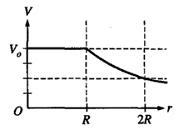
5. A solid metallic sphere of radius R has charge Q uniformly distributed on its outer surface. A graph of electric potential V as a function of position r is shown above. Which of the following graphs best represents the magnitude of the electric field E as a function of position r for this sphere?
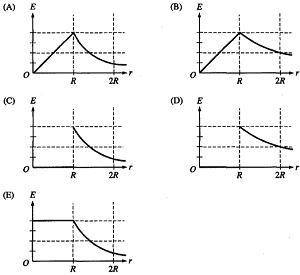
Electric field in a conductor is 0 and is proportional to 1/r2, so C is the answer.
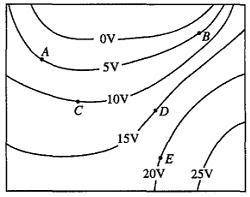
This diagram is used for the next 3.
6. Which vector below best describes the direction of the electric field at point A?
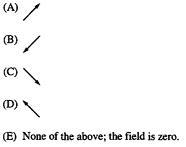
Electric field directs toward lower potential, so it's D?
7. At which point does the electric field have the greatest magnitude?
(A) A
(B) B
(C) C
(D) D
(E) E
Not sure. How do I start?
8. How much net work must be done by an external force to move a -1 μC point charge from rest at point C to rest at point E?
(A) -20 μJ
(B) -10 μJ
(C) 10 μJ
(D) 20 μJ
(E) 30 μJ
W = qV
= -1(20 - 10)
= -10 μJ
It's B.
Can someone(s) also please explain to me when is work done by field positive or negative? Thanks.
1. Three ½ μF capacitors are connected in series as shown in the diagram above. The capacitance of the combination is
(A) 3/2 μF
(B) 1 μF
(C) 2/3 μF
(D) 1/2 μF
(E) 1/6 μF
I used this equation: 1/Ceq = 1/C1 + 1/C2 + 1/C3 and got E as the answer.
2. In a certain region, the electric field along the x-axis is given by
E = ax + b, where a = 40 V/m2
and b = 4 V/m.
The potential difference between the origin and x = 0.5 m is
(A) -36 V
(B) -7 V
(C) -3 V
(D) 10 V
(E) 16 V
I tried to plug in 0 and 0.5 for x and subtract them but that didn't work out.
3. A 20 μF parallel-plate capacitor is fully charged to 30 V. The energy stored in the capacitor is most nearly
(A) 9x10³ J
(B) 9xl0-3 J
(C) 6x10⁻⁴ J
(D) 2x10⁻⁴ J
(E) 2x10⁻⁷ J
Used the equation U = (1/2)CV2 and got B as the answer.
4. A potential difference V is maintained between two large, parallel conducting plates. An electron starts from rest on the surface of one plate and accelerates toward the other. Its speed as it reaches the second plate is proportional to
(A) 1/V
(B) 1 / √V
(C) √V
(D) V
(E) V2
qV = (1/2)mv2
When I rearrange it to isolate v it's proportional to √V so it's C.
5. A solid metallic sphere of radius R has charge Q uniformly distributed on its outer surface. A graph of electric potential V as a function of position r is shown above. Which of the following graphs best represents the magnitude of the electric field E as a function of position r for this sphere?
Electric field in a conductor is 0 and is proportional to 1/r2, so C is the answer.
This diagram is used for the next 3.
6. Which vector below best describes the direction of the electric field at point A?
Electric field directs toward lower potential, so it's D?
7. At which point does the electric field have the greatest magnitude?
(A) A
(B) B
(C) C
(D) D
(E) E
Not sure. How do I start?
8. How much net work must be done by an external force to move a -1 μC point charge from rest at point C to rest at point E?
(A) -20 μJ
(B) -10 μJ
(C) 10 μJ
(D) 20 μJ
(E) 30 μJ
W = qV
= -1(20 - 10)
= -10 μJ
It's B.
Can someone(s) also please explain to me when is work done by field positive or negative? Thanks.