Understanding Fluid Flow in Physics Lab: Poiseuille Equation

Click For Summary

Homework Help Overview

The discussion revolves around a physics lab experiment related to fluid flow and the Poiseuille equation, focusing on measuring the height of fluid in a tank over time and evaluating the relaxation time from a graph of this data.

Discussion Character

  • Exploratory, Assumption checking, Problem interpretation

Approaches and Questions Raised

  • Participants discuss the best part of the graph to evaluate relaxation time, considering potential errors in measurements and the effects of turbulence and flow characteristics.

Discussion Status

Participants are exploring different sections of the graph for their suitability in measuring relaxation time, with some suggesting the initial linear portion may be best, while others consider the impact of inertial effects and turbulence. There is ongoing dialogue about the accuracy of measurements and the definition of initial conditions.

Contextual Notes

There are mentions of measurement errors and the influence of experimental factors on the data, as well as the potential for turbulence affecting flow characteristics at different times during the experiment.

svoboda32
Messages
4
Reaction score
0
Member warned that homework questions must be posted in a homework section
Hi everyone,

I have to answer some question about a physics lab..here are the questions
A tank is empty by a pipe and we measure the height (y-y0) of fluid in the tank as a function of time. We obtain this graph ( I join the graph)
We can find the relaxation time
ile_TEX.gif
with the relation :
ile_TEX.cgi?(y-y_{0})%20=%20e^{\frac{-t}{\tau%20}}%20.gif

with (yin -y0) is the initial height of the fluid in the tank and (y-y0) is the height of the fluid at a time t.
I can easily isolate
ile_TEX.gif
but the teacher say that it's a part of the graph which is the best to evaluate
ile_TEX.gif
.
He ask what is this part and why ??
It's a physics lab about the fluid flow and poiseuil equation for viscosity...
If someone can give me some track ..
Sorry for my English I'm French..
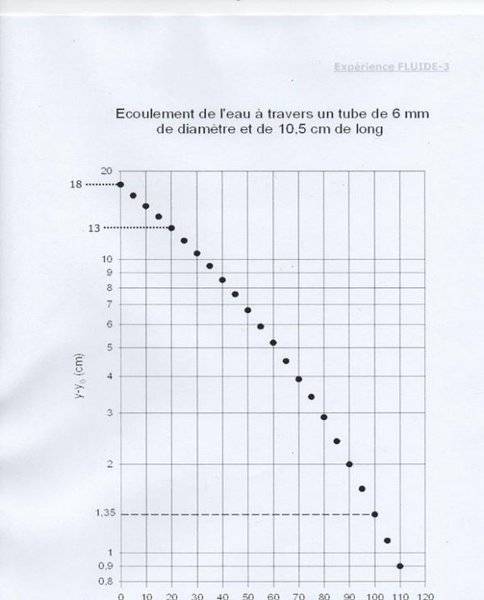
TpFluidok.jpg
 
Physics news on Phys.org
Assume your time measurements are accurate, but there may be some small error up to Δy in each height measurement.
If you pick two points (times) on the graph, how large might your error be in τ?
 
The data in your graph does not satisfy your equation. If it did, the data would fall on a straight line.
 
@haruspex if I have an error Δy on y I can eventually calculate the error on τ by the method of partial differentiation..

@Chestermiller I know because we obtain this curve experimentally and there is certainly another factors that interfer. That's why the teacher as what's the best part of the curve to evaluate τ
 
svoboda32 said:
we obtain this curve experimentally and there is certainly another factors that interfer. That's why the teacher as what's the best part of the curve to evaluate τ
That will depend on the cause of the error; which part of the curve does it least affect?
 
That's what I'm looking for ! Maybe the first part from t = 0s to t= 30s because we have a straight line like Chestermiller said ...
 
svoboda32 said:
That's what I'm looking for ! Maybe the first part from t = 0s to t= 30s because we have a straight line like Chestermiller said ...
There is also a straight line section between 80 and 110. Do you think inertial effects will be more important at short times or at long times?
 
Chestermiller said:
There is also a straight line section between 80 and 110. Do you think inertial effects will be more important at short times or at long times?
Any chance there could be turbulence in some stage? I'm guessing not.
 
haruspex said:
Any chance there could be turbulence in some stage? I'm guessing not.
Turbulence could definitely be a factor. At short times, when velocities are highest, the laminar-turbulent transition could be exceeded in the tube. Also, the hydrodynamic entrance length in the tube could be a significant factor at short times.
 
  • #10
I think at the beginning of the experience the velocity of water through the pipe is greater and we don't have a laminar flow...so the best measure will occur at long times when (y-y0) is small .. what do you think about that ??
 
  • #11
svoboda32 said:
I think at the beginning of the experience the velocity of water through the pipe is greater and we don't have a laminar flow...so the best measure will occur at long times when (y-y0) is small .. what do you think about that ??
Up to a point. The difficulty at small y-y0 is the accuracy in measuring it. The pipe has some width. How exactly is y0 defined? I wonder if the graph would look straighter if you were to take y0 as being a bit less.
 

Similar threads

  • · Replies 13 ·
Replies
13
Views
2K
  • · Replies 5 ·
Replies
5
Views
2K
  • · Replies 2 ·
Replies
2
Views
2K
  • · Replies 15 ·
Replies
15
Views
3K
Replies
0
Views
2K
Replies
4
Views
2K
  • · Replies 11 ·
Replies
11
Views
2K
  • · Replies 3 ·
Replies
3
Views
2K
Replies
2
Views
1K
