Understanding Frame Rates and Exposure Time in Video Capture

Click For Summary

Discussion Overview

The discussion revolves around understanding frame rates and exposure times in video capture, particularly focusing on the differences between film and solid-state cameras. Participants explore the implications of frame rates on exposure times and the technical aspects of capturing motion in video.

Discussion Character

  • Exploratory
  • Technical explanation
  • Debate/contested
  • Mathematical reasoning

Main Points Raised

  • Some participants question whether the time represented in a picture taken at 30 fps is effectively 1 second or 0, indicating confusion about the relationship between frame rate and exposure time.
  • There is a discussion about the mechanics of film motion picture cameras, where the shutter must open and close to expose frames, and how this differs from solid-state cameras.
  • Some participants clarify that exposure time can vary based on lighting conditions, especially in solid-state cameras, which do not use film.
  • One participant highlights the difference between frame rate and shutter speed, suggesting that the maximum shutter speed is determined by the frame rate.
  • Another participant shares their experience with astrophotography, explaining how they adjust frame rates and shutter speeds based on the brightness of the subject being captured.
  • Concerns are raised about the effects of blurring in video capture, particularly with fast-moving objects, and how exposure times are not always equal to the full frame duration.
  • Visual examples are provided to illustrate how exposure times can be less than the full frame duration, with specific percentages mentioned.

Areas of Agreement / Disagreement

Participants express varying levels of understanding regarding the relationship between frame rates and exposure times. Some agree on the mechanics of exposure in different camera types, while others remain uncertain about specific details, indicating that multiple competing views remain in the discussion.

Contextual Notes

There are limitations in the discussion regarding assumptions about camera settings, the dependence on lighting conditions, and the variability of exposure times across different camera models. Some mathematical steps related to frame rates and shutter speeds are not fully resolved.

Who May Find This Useful

This discussion may be useful for individuals interested in video capture techniques, photography enthusiasts, and those exploring the technical aspects of frame rates and exposure in both film and digital cameras.

Inwicta
Messages
7
Reaction score
0
So if i take a picture (for example) 30 fps camera. So my question is that: is the time in the picture 1 s \ 30 fps or is it just 0? (May be very stupid question)
 
Physics news on Phys.org
Inwicta said:
So if i take a picture (for example) 30 fps camera. So my question is that: is the time in the picture 1 s \ 30 fps or is it just 0? (May be very stupid question)
With film motion picture cameras, the film has to be advanced between frames. The shutter is closed while the film advances. It them opens for a time to expose the frame, and then closes to advance the film again. (EDIT -- Source = wikipedia)

The simplest cameras would open the shutter for about half of the frame time, and close it for the other half to advance the film. More advanced cameras may have more control over the shutter opening time.

Are you asking more about film cameras, or solid-state cameras? :smile:
 
Well i got this idea just 30 minutes ago when i got my gopro back. so film camera
 
berkeman said:
With film motion picture cameras, the film has to be advanced between frames. The shutter is closed while the film advances. It them opens for a time to expose the frame, and then closes to advance the film again. (EDIT -- Source = wikipedia)

The simplest cameras would open the shutter for about half of the frame time, and close it for the other half to advance the film. More advanced cameras may have more control over the shutter opening time.

Are you asking more about film cameras, or solid-state cameras? :smile:
Sorry forgot the quote^^
 
berkeman said:
Are you asking more about film cameras, or solid-state cameras? :smile:
Inwicta said:
Well i got this idea just 30 minutes ago when i got my gopro back. so film camera
That's a solid state digital camera. It doesn't use a film. The exposure time can vary, for example depend on the amount of available light.
 
Inwicta said:
So if i take a picture (for example) 30 fps camera. So my question is that: is the time in the picture 1 s \ 30 fps or is it just 0? (May be very stupid question)

Lets go back to the start
you said take a picture ... then say 30fps
that's a contradiction ... did you take a single pic with some arbitrary setting or a bit of video @ 30fps ?

the exposure time of a single image will be whatever you set it to be
the exposure time for the video is fixed, each frame is 1/30 th of a secDave
 
A.T. said:
That's a solid state digital camera. It doesn't use a film

indeed

A.T. said:
The exposure time can vary, for example depend on the amount of available light.

if used for taking still frames, not for video modeDave
 
  • #10
The frame rate does, however, set the maximum possible shutter speed.

For my astrophotos, I often set a frame rate based on the shutter speed. For Jupiter, I can set 30fps or even 60fps, with very short exposures. For Saturn (dimmer, further away), I'll set it lower (perhaps 7.5 or 15 fps) and set somewhat longer shutter speeds.
 
  • #11
davenn said:
hmmmm .. ok, appears that I have been lead astray again :rolleyes::rolleyes:
Note that not every camera gives you direct control of shutter speed in video mode. But you can easily see, that the full frame duration is not always used for exposure: Film a very fast object (which smears out) and overlay two subsequent frames: The combined smear of two frames usually has a gap, indicating the time of non exposure.
 
  • Like
Likes   Reactions: davenn
  • #12
davenn said:
Lets go back to the start
you said take a picture ... then say 30fps
that's a contradiction ... did you take a single pic with some arbitrary setting or a bit of video @ 30fps ?

the exposure time of a single image will be whatever you set it to be
the exposure time for the video is fixed, each frame is 1/30 th of a secDave
I took a video with 30 fps and thank you
 
  • #13
Inwicta said:
I took a video with 30 fps and thank you

The blurring of your personal movement perception acts on top of the effects of blurring with long camera exposure times.
The maximum exposure time will be 1/30s but you will get better motion portrayal if a shutter is used, to reduce the exposure time of each frame. Ideal time samples are short impulses and not a blurred frame image, which is why low light sequences may not look so good as well lit sequences. Frame rate conversion is also much better if a shutter is used to get short frame samples. A shutter shutter time is also essential if you want to use a wide lens aperture (for shallow focussing effects) in bright conditions.
Modern sensors perform much better than film and short shutter times are, I believe, more available to digital filming than for chemical filming because ISO numbers can be extremely high in modern sensors.
 
  • #14
Inwicta said:
So if i take a picture (for example) 30 fps camera. So my question is that: is the time in the picture 1 s \ 30 fps or is it just 0? (May be very stupid question)
Here is what a fast spinning propeller can look like in two consecutive frames of a video overlaid. Note that the smeared green & red markings are on one blade only, so the two green arcs represent the same object, in two consecutive frames:

?temp_hash=5c703719998c514746463077beda4f22.png


As you see the exposure time (time captured in each picture) is not the full frame duration (1/30s), but only about 75% of it. This fraction can vary, depending on what the camera chooses based on available light or your manual settings.
 

Attachments

  • video_exposure_time.png
    video_exposure_time.png
    36.8 KB · Views: 812
Last edited:
  • Like
Likes   Reactions: sophiecentaur
  • #15
A.T. said:
Here is what a fast spinning propeller can look like in two consecutive frames of a video:
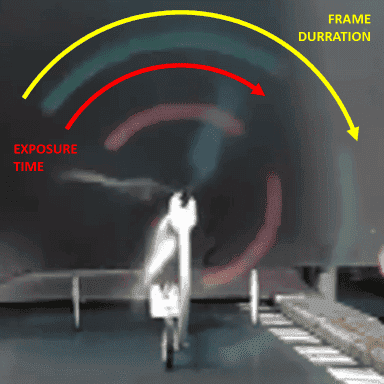
?temp_hash=5c703719998c514746463077beda4f22.png


As you see the exposure time (time captured in each picture) is not the full frame duration (1/30s), but only about 75% of it. This fraction can vary, depending on what the camera chooses based on available light or your manual settings.
I see thanks for the pictures for clearification! (Im visual person) and i think my gopro doesn't use any kind of flashes etc.
 

Similar threads

  • · Replies 7 ·
Replies
7
Views
3K
  • · Replies 30 ·
2
Replies
30
Views
6K
  • · Replies 12 ·
Replies
12
Views
2K
  • · Replies 2 ·
Replies
2
Views
3K
  • · Replies 12 ·
Replies
12
Views
3K
  • · Replies 16 ·
Replies
16
Views
2K
Replies
8
Views
2K
  • · Replies 47 ·
2
Replies
47
Views
4K
  • · Replies 1 ·
Replies
1
Views
2K
  • · Replies 4 ·
Replies
4
Views
3K